This guide is independent and contains no paid placement. If affiliate links are added later, they will be clearly marked and will not change our editorial checks.
Start early on the River Usk, cross the city centre quickly and on a lead, then give the dog the afternoon in Tredegar House parkland or on the permitted Wales Coast Path route at Newport Wetlands. Newport rewards a route-first plan: green space first, streets second, and a cafe stop only when the dog has already had a proper walk.
The one-day route in full
At half past seven on a grey Newport morning, the River Usk is doing most of the talking. The tide is low, the mud smells of salt and river weed, a gull is arguing with its own reflection, and a dog is already three sniffs into a lamp post that clearly matters a great deal. The owner has not yet had coffee. The dog has already had the best part of the day. That is the whole secret of Newport with a dog: let the river set the pace before the city wakes up, and the rest of the day falls into place.
Newport is Wales's third city, sitting where the Usk meets the Severn Estuary in the south-east of the country, between Cardiff to the west and the English border to the east. It is a working city rather than a polished resort, and that is part of its appeal for dog owners. There is no single famous dog beach to fight over, no narrow honeypot lane where every visitor arrives at the same hour. Instead there is a compact centre, a tidal river with paths on both banks, Victorian parks on the hill above the shops, a great National Trust parkland a short drive west, and a wild wetland reserve to the south-east where the Wales Coast Path threads past reedbeds and an old lighthouse. The distances are short, the walking is mostly flat, and the day can be shaped around the dog rather than around a timetable.
The route below is the backbone of this guide, and every later section expands one leg of it. It is designed for one full day, roughly 8am to 5pm, with a car for the afternoon legs and sensible shortcuts for anyone arriving by train or travelling with a dog that tires early. The order matters: river first, while the paths are quiet and the dog is fresh; city centre second, when the shops are open but the dog has already burned off the morning energy; parks third, when a long sniffing walk and a cafe stop can carry the afternoon; wetlands or Caerleon last only if the dog still has energy and the light allows it.
Here is the day in outline. Begin at the riverside near the City Bridge, walk the Usk path downstream and back, cross the modern footbridge for the view, and let the dog settle into the rhythm of the river. Then walk up into the centre for a short on-lead stretch past the market area and the main shopping streets, with a coffee stop at a dog-friendly table. After lunch, drive or take a bus west to Tredegar House, where the 90-acre parkland gives the dog lake, woodland and open-field circuits. If the dog is still keen, finish with the permitted dog route at Newport Wetlands or a short leg of the Wales Coast Path towards Goldcliff. If the dog is tired, finish instead with Belle Vue Park, a smaller hilltop green space close to the centre, and call it a day. Either ending is a good day; the mistake is trying to do both.
Three planning rules keep the route honest. First, keep the dog on a lead on every riverside, city and wetlands leg, and only let the dog off lead where the signs at Tredegar House or a specific park area clearly allow it. Second, build in a proper rest after each long walk: dogs that are marched from one attraction to the next without a pause get tired, hot and reactive, and Newport's flat paths make it easy to walk further than intended. Third, check the official guidance before you travel for anything that changes often — bridge works, path closures, cafe policies, parking tariffs and seasonal rules all move, and a five-minute check the night before saves an hour of improvisation on the day.
The rest of this guide follows the route leg by leg. It covers where to walk and where to keep the lead short, where to park and where to catch a bus, where a dog can sensibly join you for food, where to stay overnight, and how the seasons and the tide change the plan. It also flags the places where Newport asks a dog owner to be careful: tidal mud, livestock on the Levels, cyclists on shared paths, and the busy roads that separate the river from the parks. None of these is a reason to stay away. All of them are reasons to plan the day in the order given here.
Morning: the River Usk
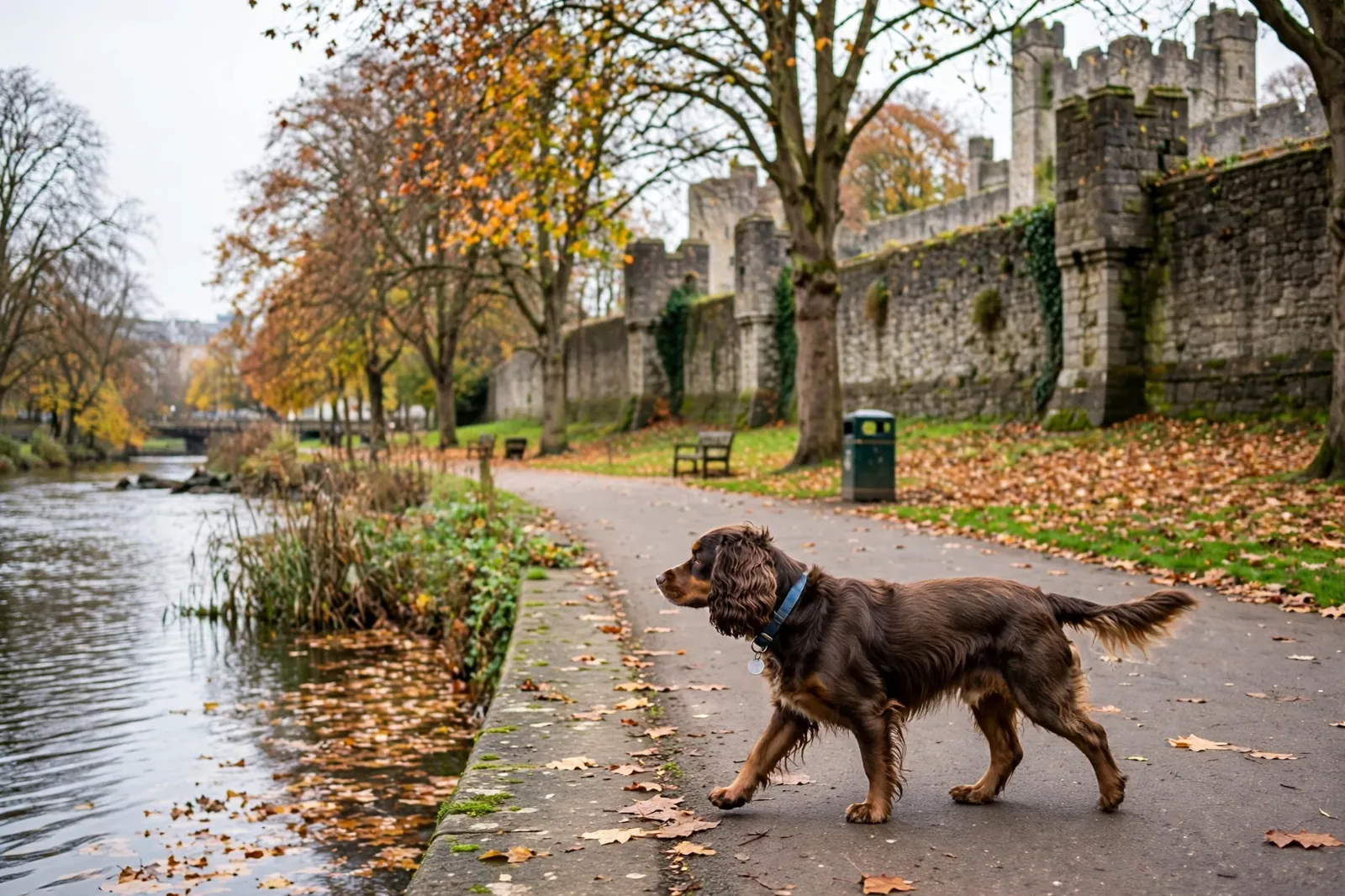
The Usk is the reason Newport exists, and it is the best place to start a dog day. The river is tidal here, which means the morning walk looks different every time: at low tide the mudflats stretch wide and wading birds pick over the edges, while at high tide the water comes up close to the path and the whole river feels bigger and faster. Either way, the walking surface is mostly surfaced and flat, the views are open, and the dog gets a long, interesting scent trail without a single hill to climb.
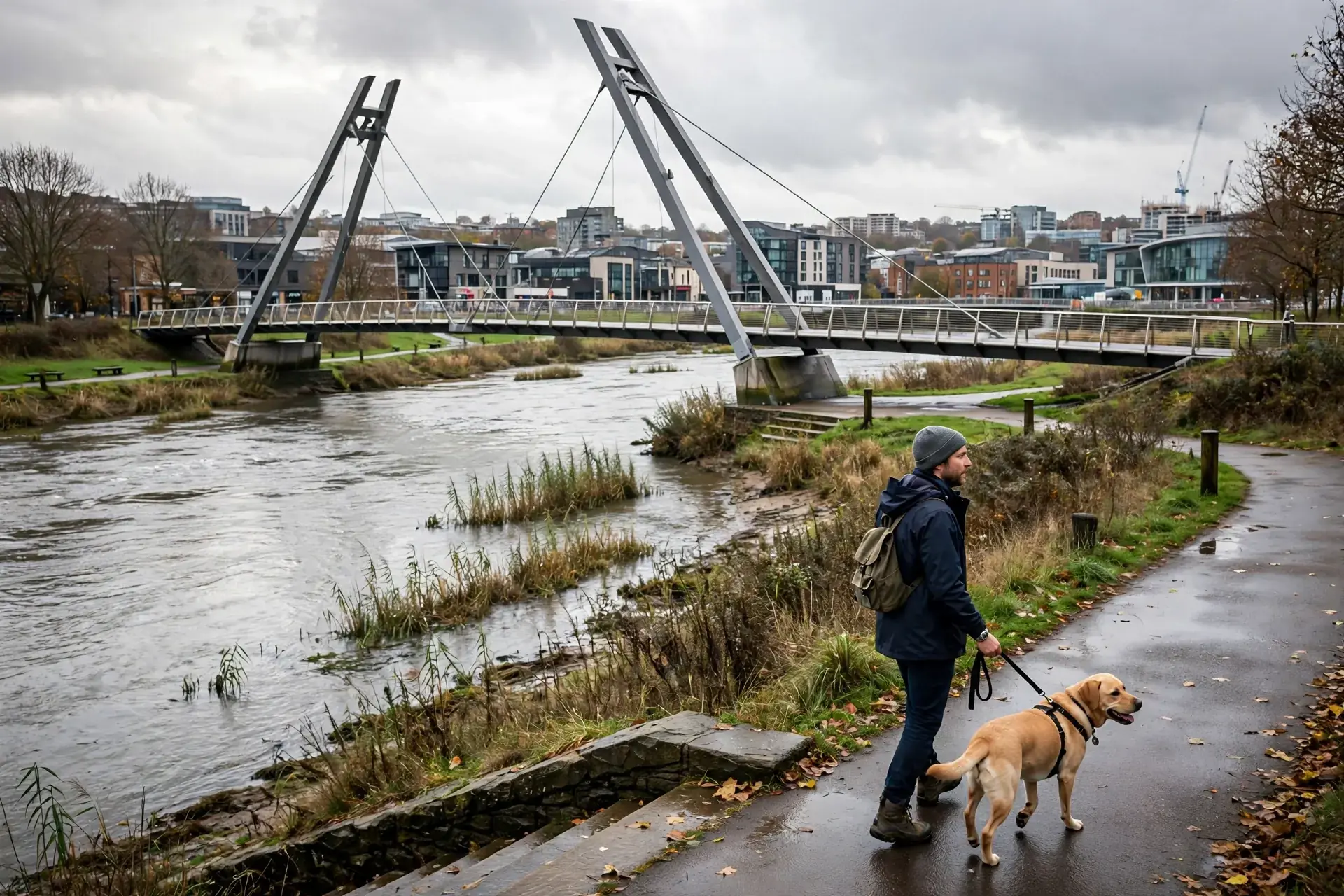
Begin near the City Bridge area, where the modern footbridge — a slender, curved structure that has become one of the city's landmarks — crosses the Usk beside the older road bridges. Walk downstream along the riverside path, keeping the dog on a short lead near the water's edge. The riverbank is not a beach: the mud is deep, soft and tidal, and a dog that charges into it can get stuck or come back filthy and exhausted. Treat the mud as scenery, not as a playground, and keep the dog on the path. The same rule applies to any slipway or set of steps down to the water; they are there for boats and maintenance, not for dogs.
Cyclists share much of the riverside network, including the routes that run towards Tredegar Park and along the Monmouthshire Canal, so walk on the left where the path is shared, keep the lead short, and teach the dog — or at least practise — a reliable recall to heel when a bicycle bell rings behind you. A long line is useful on the wider, quieter stretches, but it becomes a trip hazard on a narrow shared path, so shorten it whenever the path narrows or other users appear. Early morning is the kindest time for this: the commuter cyclists are fewer, the dog walkers are regulars who know the etiquette, and the dog can sniff without being hurried along.
Cross the footbridge at least once, even if the dog is not keen on bridges. The crossing is short, the surface is solid, and the view up and down the river repays the effort: the Transporter Bridge downstream, a great steel structure dating from 1906 and one of only a handful of transporter bridges still standing in the world, the city rising on the west bank, and the Levels stretching away to the east. Dogs that are nervous on bridges do better with a steady pace, a treat in the hand, and no stopping in the middle to take photographs. Walk across, let the dog sniff the far bank, and cross back when the dog is ready rather than when the camera is.
The Transporter Bridge itself deserves a look from the riverside path, but check the official guidance before you travel for its visitor arrangements, because the bridge and its visitor centre have had periods of closure and redevelopment, and opening times and access rules have changed. Do not plan the day around going up in the gondola or climbing the bridge with a dog; plan it around seeing the structure from the path, which costs nothing and suits a dog far better. If the visitor centre is open and dogs are welcome in its outdoor areas, that is a bonus, not a requirement.
A good morning riverside loop takes about an hour to ninety minutes at a dog's pace, including sniffing stops and a pause on a bench. That is enough. The dog has had water, movement and novelty, and the owner has had a proper look at the city before the shops open. Before leaving the river, offer water, check paws for grit or small stones, and give the dog a few minutes to settle in the car or at a bench. The next leg is the city centre, and a dog that arrives there already tired is a dog that will cope with pavements, crowds and shop doorways far better than one that arrives bursting with energy.
One more morning note: the Usk paths connect onwards to longer routes, including a 17-kilometre circular walk that links the river, Tredegar Park, the Ebbw River and Allt-yr-Yn Nature Reserve. That is a serious walk for a fit dog and a committed owner, not a casual morning stroll, and it is best saved for a dedicated walking day. For the one-day route in this guide, take the short riverside section, enjoy it properly, and leave the long circuit for another visit.
Midday: crossing the city centre
Newport city centre is compact, which is good news for a dog day: the useful streets, the market, the main shopping area around Friars Walk and Commercial Street, and the routes back to the river are all within a short walk of each other. It is also a working centre with buses, delivery vans, narrow pavements in places and the usual city noise, which is why this leg is deliberately short. The centre is a crossing, not a destination in itself, and the dog will enjoy it far more as a twenty-minute stroll with a purpose than as two hours of window shopping.
Walk the centre on a short lead, on the inside of the pavement away from the road, and keep the dog moving at a steady pace. City dogs do best when they have a job — walking beside the owner, stopping at kerbs, waiting at crossings — rather than when they are left to decide for themselves at every doorway. If the dog is reactive to other dogs, other people or traffic, choose the wider streets and the quieter side of the centre, cross the road early rather than squeezing past, and do not be embarrassed to step into a doorway to let a bus or a group pass. Newport's centre is small enough that a slightly longer, calmer route costs only a few minutes.
The market area is worth a pass-through for the atmosphere: covered markets are often the most dog-friendly part of a Welsh city centre, with traders who know the regular dogs by name and a slower pace than the main shopping streets. Even so, check the official guidance before you travel for the current dog rules in any indoor market hall or shopping centre, because policies differ between the building, the individual stalls and the management, and a rule that allowed dogs last year may have changed. As a general rule, assume dogs are welcome in open-air market areas and on outdoor seating, and ask before taking a dog into an enclosed hall.
Shopping with a dog in Newport works best when one person stays outside with the dog while the other goes in, or when the errand is genuinely short. Most high-street shops do not advertise a dog policy, and the polite approach is to ask at the door and accept a no gracefully. Shops that welcome dogs usually say so clearly, often with a water bowl or a sign, and those are the ones to remember for next time. Do not leave a dog tied up outside a shop in the centre: it is stressful for the dog, it blocks the pavement, and it is an invitation to trouble in any busy street.
Heat and cold matter more in a city centre than on a riverside path. On a warm day, pavements heat up quickly, and a dog that has already walked for an hour will feel it sooner than the owner does. Test the pavement with the back of a hand, stick to shaded streets, and carry water. On a cold, wet day, the centre's covered areas are a welcome shelter, but wet stone and metal grates are slippery for dogs, so keep the pace slow and watch for limping. In either season, the centre leg should end with the dog still comfortable, not with the dog exhausted — the afternoon parkland is the reward, and the dog needs energy left for it.
By late morning, the sensible move is to leave the centre. The dog has seen the city, the owner has had a look at the shops, and the next leg is the one the dog will remember. Head back towards the car, offer water, and let the dog rest for ten minutes before driving west to Tredegar House. A dog that sleeps in the car for a few minutes is not a dog that has missed out; it is a dog that is recharging for the best walk of the day.
Afternoon: Tredegar House and the city parks
Tredegar House is the afternoon that makes the whole Newport day worthwhile. The house itself is a 17th-century mansion, often described as one of the grandest of its kind in Wales, set in about 90 acres of parkland on the western edge of the city. Dogs are welcome in the parkland, and the circuits around the lake, through the woodland and across the open fields give a dog the kind of varied walking that a riverside path alone cannot provide. The best-known loop is a short, flat, easy circuit of about 1.6 miles that takes roughly half an hour to an hour at a walking pace, with longer options for dogs that want more.
The rules at Tredegar House are zone-based, and they are worth understanding before arrival. Dogs may be off lead in some areas of the parkland, but they must be kept on a lead in others, and the on-site dog leaflet — available around the site, with a handy map showing the different areas — is the document to follow. Well-behaved dogs are allowed in the shop and in the cafe, where dog ice cream is sometimes on offer, but they are not allowed inside the house itself. That division is sensible: the parkland is the dog's territory, the house is the humans' museum, and the cafe is the shared middle ground. Check the official guidance before you travel for the current parking charge and opening times, because both have changed over time, and the car park is pay-and-display.
Walk the lake circuit first, because it gives the dog water views, woodland shade and open grass in a single short loop, and it is the easiest way to judge how the dog is coping with the afternoon. The paths can get muddy after rain, so wear proper footwear and expect the dog to come back with muddy paws; a towel and a drying coat in the car are not optional extras here. Swans and other water birds use the lake, so keep the dog under control near the water and do not let the dog chase birds, even if the dog has been off lead on the open fields. A dog that recalls reliably is a pleasure on this circuit; a dog that does not should stay on a long line until the open-field section.
Beyond the lake, the woodland paths and the open fields offer the longer, sniffier walking that tires a dog out properly. The parkland is also a place where cyclists, runners, families and other dog walkers all share the same paths, so the same shared-path manners apply as on the river: keep the lead short when the path narrows, recall the dog when another dog approaches, and do not let the dog run up to picnics. Tredegar Park, the recreation ground to the south-west of the house parkland, is a separate, flatter and very accessible option for a shorter walk, with a circular trail around its perimeter that suits older dogs, puppies and dogs that need a gentle outing.
If the dog is tired after Tredegar House, or if time is short, Belle Vue Park is the smaller alternative closer to the centre. This Victorian park in the Stow Hill area, with terraced lawns, a pavilion and restored conservatories, is a local favourite for dog walkers and has a cafe where dogs have been made welcome. It is a hilltop park, so the walking is shorter and the views are better, and it suits a late-afternoon wind-down far better than a second long walk. Beechwood Park, to the east of the centre, is another local green space with open lawns and tree-lined paths, and it works well as a quick evening toilet walk if you are staying overnight. Neither park replaces Tredegar House, but either one is a good way to end the day without over-walking the dog.
For dogs that need a longer, wilder walk, the Sirhowy Valley line and the valley country park to the north-west offer a 7.6-mile trail through wooded valley beside the Sirhowy River, and the Ebbw River and Tredegar Park circular is a 2.5-mile easy loop that takes about 45 minutes. These are options for a second day or for a dog that has barely noticed the morning's walking, not additions to an already full day. The discipline of the one-day route is to choose one long afternoon walk and do it well, rather than stacking two or three and arriving home with a sore, over-tired dog.
The wetlands and Goldcliff leg
Newport Wetlands, the RSPB reserve on the Gwent Levels to the south-east of the city, is the wildest leg of the Newport dog day — and the one where the rules matter most. The reserve is a National Nature Reserve, home to reedbeds, open water, grazing marsh and, in winter, a starling roost that can number in the tens of thousands. It is a place for birds first and dogs second, and the dog rules reflect that. Dogs are only allowed along the Wales Coast Path and on one permissive perimeter route, marked with pawprint signs, and must be kept on a lead at all times. Dogs are not allowed on the main reserve trails, and the visitor centre is not dog-friendly indoors, although there is limited outdoor seating at the front where a dog can sit with its owner.
That restriction sounds limiting, but the permitted route is still a proper walk. From the RSPB car park, follow the Wales Coast Path around the outside of the reserve towards the East Usk Lighthouse, a 120-year-old structure that marks the edge of the estuary. The sculpture trail, the orchid trail and the woodland and estuary trail are each about a mile to a mile and a half, and the longest combined wetlands experience is about three miles, but the dog route is the perimeter path, not the interior trails. Pick up a map from the visitor centre, follow the pawprint signs, and do not be tempted to cut across the reserve on a path that looks inviting but is not marked for dogs. The birds, the wardens and the other visitors will all be grateful.
Livestock is a real consideration on this leg. Fields on the Levels may contain grazing animals, and the rule is simple: dogs must be on a lead, under effective control, and kept away from livestock at all times. Pick up after the dog without exception, because dog mess can harm livestock, and keep the dog out of the water channels and ditches that criss-cross the Levels. The ground is flat, which makes the walking easy, but it is also exposed, so wind and rain arrive without warning and there is little shelter on the coast path. Pack a waterproof for the owner and a drying coat for the dog, and be ready to shorten the walk if the weather turns.
Goldcliff, the small village to the south-east, is the natural extension of the wetlands walk. The Living Levels loop from the wetlands to Goldcliff runs along the coast path, past Salt Marsh Lane and Redhouse Farm, around Goldcliff Pill and on to St Mary's Church, with the Farmers Arms and the Waterloo Inn as landmarks along the way. It is a lovely, flat, historic landscape of sea walls, pill channels and church towers, and it is best walked as a slow, on-lead stroll rather than a route march. Check the official guidance before you travel for the current state of the loop, because field paths, stiles and livestock vary by season, and some sections are better after a dry spell than after heavy rain.
Parking at the wetlands is managed by the RSPB and has been charged, with free parking for RSPB members, so check the current tariff before you travel and bring a payment method that works in a rural car park. The visitor centre has tethering rings and a drinking bowl at the entrance, which is a thoughtful touch for dog owners, and the outdoor seating is the place to sit with a drink while the dog rests. Do not leave the dog in the car while you walk the interior trails alone: the reserve is not a place to leave a dog unattended, and the dog will be far happier on the permitted perimeter route than waiting in a car park.
This leg is optional, and it should be treated as such. If the dog has already had a long morning on the river and a full afternoon at Tredegar House, the wetlands can wait for another day. If the dog is still fresh, the light is good and the weather is kind, it is a memorable way to end a Newport day — estuary light, a lighthouse, and a dog walking calmly on a lead beside the reedbeds. Either way, the rule is the same: stay on the marked dog route, keep the lead on, and leave the reserve as you found it.
The Caerleon extension
Caerleon, a few miles north-east of Newport city centre on the River Usk, is the best half-day extension to the one-day route, and it works particularly well as a second morning. The village was the Roman fortress of Isca, built around AD 90, and its amphitheatre, fortress baths and barracks remain visible as grass-covered earthworks and stone ruins in the middle of a quiet village. Dogs are welcome on the circular walks around Caerleon and Lodge Wood, but must be kept on a lead, and the amphitheatre itself is an open, grassy site where a dog on a lead can walk beside the owner without the crowds of a larger attraction.
The Caerleon and Lodge Wood circular is a gentle, historic walk that suits a dog that has already had a city day and wants something slower. The route starts near the amphitheatre, climbs through Lodge Hill and its woodland, and returns through the village, with views back over the Usk valley. It is not a long walk, and it is not a difficult one, but it is a walk where the dog needs to be on a lead throughout: the paths pass houses, gardens, livestock fields and other walkers, and the amphitheatre is a protected site where a dog running free would be both unwelcome and unsafe. Treat it as a heritage stroll, not as an off-lead run.
Caerleon village itself is small and walkable, with a handful of pubs and cafes, a village green, and the river close by. As with the city centre, check the official guidance before you travel for the current dog rules in any indoor space, and assume that outdoor seating is the safest bet. The village is also a good place to practise the same city-centre manners on a smaller scale: short lead, pavement side, no tying up outside shops, and a pause for water before the drive home.
For readers building a longer Welsh trip, Caerleon pairs naturally with the castle country to the east and the coast to the south. Our guide to dog-friendly castles in Wales covers which castle sites welcome dogs, where leads are required and how the zones differ, and it is worth reading before adding a castle to a Caerleon day. A castle and a Roman amphitheatre in the same weekend is a lot of history for one dog, but the walking between them is the part the dog will enjoy most, and the history is the part the owner will remember.
If Caerleon is the second day, the sensible plan is to reverse the order: Caerleon in the morning, when the village is quiet, and a short riverside walk in Newport in the afternoon, when the dog is tired and the light is soft. Do not try to fit Caerleon, Tredegar House and the wetlands into a single day. Newport rewards a slow pace, and the dog will tell you when the day is full — usually by lying down in the car and refusing to get out for one more attraction.
Eating and drinking with a dog
Eating out with a dog in Newport is straightforward if the dog has already been walked and the owner chooses the right kind of place. The Tredegar House cafe, where well-behaved dogs are allowed inside, is the most reliable dog-friendly meal stop in the area, and the Belle Vue Park cafe has also been welcoming to dogs. Beyond those two, the general pattern is the same as in most Welsh cities: outdoor seating is usually dog-friendly, indoor dining is a matter for each individual pub, cafe or restaurant, and the answer can change with the season, the time of day and the manager on duty.
The practical approach is to look for a table outside, ask before sitting down with the dog, and keep the dog settled on a mat or blanket beside the chair rather than on a lap or under a neighbouring table. Bring the dog's own water bowl or ask for a bowl of water, and bring a chew or a stuffed Kong to keep a young dog occupied while the food arrives. A dog that has had a long walk, a drink and a chance to settle will usually lie down quietly; a dog that has been marched straight from the car to a restaurant will not. The walk is the preparation for the meal, not an afterthought.
Pubs on the Levels and in Caerleon, including the Farmers Arms and the Waterloo Inn near Goldcliff, are traditional stopping points on the coast-path walks, and they illustrate the same rule: the garden or the outdoor seating is the dog's space, and the indoor bar is a question to ask. Do not assume that a pub that welcomed dogs last summer still does, and do not assume that a pub that welcomes dogs in the garden welcomes them in the restaurant. A quick check on the day — a phone call, a look at the door sign, or a question at the bar — is worth more than any list, because lists go out of date and door signs do not.
For a packed lunch, Newport is well served by supermarkets and delis in the centre, and a picnic is often the best dog-friendly meal of all. Tredegar House parkland has large open spaces and a waterfront area where a picnic works well, and the riverside benches are a good place for a sandwich while the dog rests. Pack the dog's food as carefully as the owner's: the same feeding time, the same food, and no sharing of rich picnic food that will upset a stomach on the drive home. A dog that eats its normal food at its normal time is a dog that will sleep well that night.
One final eating note: do not feed the dog immediately before a long walk or immediately after a hard run. Give the dog a small snack before the morning riverside walk, a proper meal after the dog has rested, and a light meal in the evening. Dogs that eat a large meal and then walk hard are at risk of stomach problems, and the flat, easy paths of Newport make it tempting to walk further than the dog's stomach allows. The route in this guide already builds in rests between walks; use them for feeding as well as for water.
Staying overnight in Newport
Newport works well as an overnight base for a longer South Wales trip, and it is a sensible place to stay if the plan includes Cardiff, the Wye Valley and the Gwent Levels in the same few days. The city has hotels, guesthouses and self-catering options in and around the centre, and the dog-friendly ones are usually clear about their rules: a pet fee, a limit on the number of dogs, a designated dog-friendly room type, and a rule about leaving the dog alone in the room. Read those rules before booking, and get the dog arrangements confirmed in writing with the total cost, because a hotel that accepts dogs in principle may only accept them in a handful of rooms.
Choose a stay by its morning walk, not by its lobby. A hotel near the river gives the dog a proper first walk without a drive; a hotel near Tredegar House gives the dog a parkland walk before breakfast; a hotel in the centre gives the dog a pavement walk and a busy street. For most dogs, the riverside or parkland option is the better choice, even if the centre hotel looks smarter in the photographs. Ask where the nearest practical toilet walk is after dark, whether there is a lit route from the door, and whether the dog can be exercised on the hotel grounds or needs a short drive to a park. A hotel that cannot answer those questions has not thought about dogs properly.
Self-catering is often the easiest overnight option for a dog in Newport, because the dog has a kitchen, a garden or a yard, and a front door that opens onto a walk rather than a corridor. Holiday parks and cottages in the wider Newport area, including the Gwent Levels and the Usk valley, suit dogs that need space and a routine, and they pair well with the day route in this guide: river in the morning, parkland in the afternoon, and a quiet evening in a place that feels like home. Our guide to dog-friendly holiday parks in Wales covers the coast access, livestock rules, secure boundaries and booking checks that matter for a Welsh park stay, and it is worth reading before choosing between a hotel and a park.
Whatever the stay, pack for the dog as carefully as for the owner: the dog's bed or blanket, the usual food and bowls, a lead and a spare, towels and a drying coat, poo bags, and any medication. Keep the dog's routine as close to home as possible — same feeding time, same last walk, same bed — and do not leave the dog alone in an unfamiliar room for a long evening meal. If the plan is to eat out in the evening, choose a place where the dog can join you outside, or eat in, or take it in turns. A dog that spends its first night in Newport stressed and alone is a dog that will not enjoy the second day, however good the walking is.
For a longer trip, Newport also makes a good first or last night on a South Wales tour. Cardiff, with its Bute Park, River Taff trails, Cardiff Bay barrage walk and Roath Park, is a short drive or train ride to the west, and our Cardiff with a dog guide covers the river, the bay and the city parks in the same route-first style as this guide. Tenby, further west in Pembrokeshire, is a different kind of day — beaches, harbour and town walls — and our Tenby with a dog guide covers the beach-by-beach rules that matter there. Newport, Cardiff and Tenby together make a sensible South Wales dog tour, with a city, a capital and a seaside town in three very different registers.
Parking, buses and practical details
Driving is the easiest way to do the Newport route in full, because the river, the centre, Tredegar House and the wetlands are all a short drive apart, and the bus network, while usable, adds waiting time that a tired dog does not enjoy. Park close to the first walk of each leg, not in the most central car park, and check charges, maximum stays and closing times on the day. The Tredegar House car park is pay-and-display, the Belle Vue Park car park is pay-and-display, and the wetlands car park is managed by the RSPB with a charge for non-members, so the day's parking is a small but real cost that should be budgeted in advance.
City-centre car parks suit the midday leg, but they are not the best place to leave a dog in the car while the owner walks the river or the parkland. Never leave a dog in a car on a warm day, even for a few minutes, and never leave a dog in a car while the owner walks a long trail. If the dog must wait in the car for a short stop, park in shade, leave windows open for ventilation, and keep the stop genuinely short. In practice, the Newport route is designed so the dog is out of the car for most of the day, and the car is a base for rests, water and towels rather than a waiting room.
Arriving by train is workable: Newport station is in the city centre, a short walk from the river and the main shopping streets, and the morning riverside leg and the midday centre leg can both be done on foot from the station. The afternoon legs to Tredegar House and the wetlands are harder without a car, and a taxi or a bus is the practical answer. Check the official guidance before you travel for the current bus routes and taxi dog policies, because both change, and allow extra time for a bus journey with a dog. A dog that travels well on a train may not travel well on a crowded bus, and the owner should be ready to walk the shorter legs instead.
The practical kit for a Newport dog day is short but worth packing properly: water and a bowl, poo bags, a short lead and a long line, a towel and a drying coat, the dog's usual food and a chew, a first-aid kit with tick remover, and a phone with the route and the nearest vet saved. The nearest vet is a number to save before the day starts, not a number to search for in an emergency, and the same applies to the car park closing time and the last train home. Newport is a safe, easy city for a dog day, but the same preparation that makes a countryside walk safe makes a city walk safe too.
Finally, remember the local rules that apply everywhere in Wales: clean up after the dog, keep the dog under control, keep the dog on a lead near livestock and on the wetlands perimeter route, and respect the signs in each park and reserve. The Countryside Code applies on the Levels and in the country parks, and the same courtesy — short lead, no chasing, no fouling — applies on the city streets. A dog owner who follows those rules will find Newport welcoming; a dog owner who ignores them will find the same signs and wardens that every other visitor finds.
Seasons, tides and wet weather
Newport is a year-round dog city, but the best version of the route changes with the season. Spring is the kindest time: the parkland is green, the wetlands are full of birds, the paths are drying out, and the city is quiet before the summer visitors arrive. The Tredegar House lake circuit is at its best in spring, with woodland flowers and open fields that have not yet baked hard, and the riverside paths are firm underfoot. Pack a waterproof anyway, because a Welsh spring can turn in an hour, and keep the dog on a lead on the wetter field paths.
Summer brings longer days and warmer pavements, and the route needs to shift earlier. Start the riverside walk at 7am or 8am, take the city-centre leg before midday, and do the parkland walk in the late afternoon when the shade is longer. Carry extra water, test the pavements, and watch for heat in a dog that has already walked for an hour. The wetlands in summer are exposed and hot, with little shade on the coast path, so shorten that leg or skip it on the hottest days and spend the time in the Tredegar House woodland instead. Summer is also the season when the city is busiest, so the early start matters more, not less.
Autumn is the season the locals love: the parkland turns, the wetlands fill with waders and, later, the starling roost, and the light on the Usk is low and golden. It is also the season when the paths get muddy, the leaves hide slippery patches, and the dog comes home filthy. The drying coat and the towels earn their place in the car in autumn, and the long line is worth packing for the open fields when the ground is soft. Fireworks around early November can unsettle noise-sensitive dogs, so check whether any displays are planned near the parks or the river, and keep a nervous dog close on the evenings around Bonfire Night.
Winter is quieter and, for a well-prepared dog, just as rewarding. The riverside paths are empty, the parkland is stark and beautiful, and the wetlands starling roost — which can number in the tens of thousands — is a spectacle worth planning a late-afternoon visit around, from the permitted dog route and with the dog on a lead. Winter also brings the shortest days, the coldest wind off the estuary, and the highest risk of flooded paths along the Usk, so check the official guidance before you travel for any flood or path-closure notices, keep the walks shorter, and make sure the dog has a warm, dry place to rest between legs. A dog that is cold and wet is a dog that will not enjoy the next walk, however scenic it is.
The tide is the other seasonal factor, and it is worth understanding even on a single day. The Usk is tidal at Newport, and the river at low tide is a wide expanse of mud with wading birds, while at high tide it is a full, fast river close to the path. Neither state is dangerous from the path, but both change the walk: low tide is better for birdwatching and for a long, open view, high tide is better for the sense of the river as a working port. Check the tide times before the morning walk if the dog is interested in birds or if the owner wants a particular view, and keep the dog away from the mud at either state. The mud is the one part of the Newport river walk that should always be admired from a distance.
Wet weather is not a reason to cancel a Newport dog day, but it is a reason to change the order. On a wet day, shorten the riverside and wetlands legs, favour the surfaced paths at Tredegar House and the tree cover in the parkland, and use a cafe stop as a drying break. Pack two towels, not one, and a drying coat that the dog can wear in the car. Keep the dog on a lead on muddy or slippery paths, and watch for the dog's paws on wet stone and metal grates in the centre. Newport in the rain is still Newport — the river, the parks and the wetlands are all there, just wetter — and a dog that is properly dressed and properly rested will enjoy it as much as a sunny day, if not more.
Practical questions
Before you go
Is Newport a good city for a day out with a dog?
Yes, for a compact day built around walks rather than indoor attractions. The River Usk paths, Tredegar House parkland, Belle Vue Park and the Wales Coast Path give a dog plenty of outdoor time, while the city centre works best as a short, on-lead stretch between green spaces. Plan the route first and treat shops and cafes as stops, not the main event.
Can dogs walk along the River Usk in Newport?
Yes, riverside paths beside the Usk are a central part of a Newport dog day, including the City Bridge area and the routes towards Tredegar Park. Keep the dog on a lead near roads, bridges, cyclists and the tidal river edge, and check the official guidance before you travel if you plan a longer circular route, because bridge closures and path works can change the loop.
Are dogs allowed at Tredegar House parkland?
Dogs are welcome in the parkland at Tredegar House, including the lake, woodland and open-field circuits, and may be off lead in some areas. Well-behaved dogs are allowed in the shop and cafe, but not inside the house itself. Follow the on-site dog leaflet and pawprint or lead signs, because the rules differ between zones.
Can I take my dog to Newport Wetlands?
Only on the permitted perimeter route and the Wales Coast Path, with the dog on a lead at all times. Dogs are not allowed on the main reserve trails, and assistance dogs are the exception. Pick up the map at the visitor centre, stay on the marked dog route, and keep the dog away from livestock and nesting birds.
Where can I park in Newport with a dog?
Use a car park close to your first walk rather than the most central one: riverside and Tredegar House parking suit the morning route, while city-centre car parks suit a short midday stop. Check charges, maximum stays and closing times on the day, because tariffs and pay-and-display rules change, and leave nothing valuable visible in the car.
What should I do if it rains in Newport with a dog?
Shorten the riverside and wetlands legs, favour surfaced paths and parkland with tree cover, and use a dog-friendly cafe or the Tredegar House cafe as a drying stop. Pack a drying coat and towels, keep the dog on a lead on muddy or slippery paths, and check the official guidance before you travel for any flood or path-closure notices along the Usk.