This guide is independent and contains no paid placement. If affiliate links are added later, they will be clearly marked and will not change our editorial checks.
The Severn Way runs 210 miles from Plynlimon in mid Wales to Bristol, and a fit dog can walk it in stages if you plan around three things: winter flooding across the Severn floodplain, fast tides below Gloucester, and livestock on the embankment paths. Walk it in late spring or early autumn, book the riverside towns ahead, and keep the dog on a lead through farmland, towns and the tidal reaches.
What the Severn Way is
The Severn Way follows the River Severn, the longest river in Britain, for about 210 miles from its source on the slopes of Plynlimon in the Cambrian Mountains to its finish at Bristol, where the river meets the Severn Estuary. It is a waymarked long-distance trail, not a single riverside promenade: the route changes character almost every day, from a narrow moorland stream above Llanidloes to a broad, slow river winding through Shrewsbury, Worcester and Gloucester, and finally to a tidal channel with mudflats, sea walls and the famous Severn Bore. For a dog, that variety is both the appeal and the challenge. One morning the path is a firm towpath beside a canalised reach; the next it is a grassy flood embankment with cattle on one side and a steep drop to the water on the other.
Most walkers take 12 to 15 days, covering 14 to 18 miles a day, though there is no rule that says the trail must be walked end to end in one push. Many dog owners walk it in long weekends, using the railway stations at Welshpool, Shrewsbury, Telford, Worcester, Gloucester and Bristol to hop on and off the route. The Severn Way is waymarked with the river symbol, but waymarks can be sparse on the floodplain, where the path crosses open meadows and the river itself is the main landmark. A printed map or an offline mapping app matters here more than on a walled moorland trail, because a missed stile on a featureless water meadow can add a mile of backtracking with a tired dog.
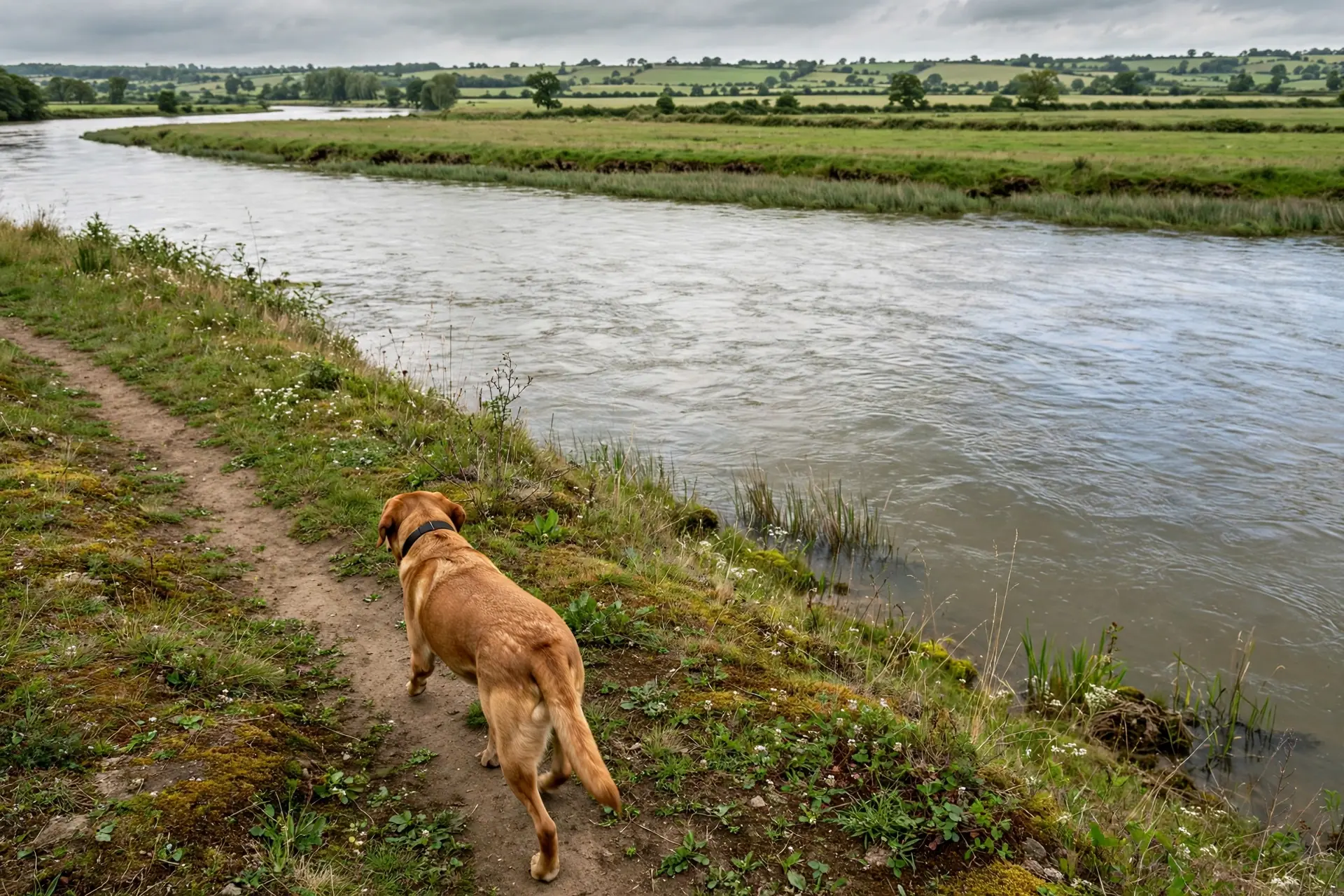
The river sets the pace of the whole walk. Above Shrewsbury the Severn is a lively, shallow river running through farmland and small market towns. Between Shrewsbury and Gloucester it deepens and slows, passing under road bridges and through the wooded Ironbridge Gorge. Below Gloucester the river turns tidal, and the walking changes completely: the path leaves the water's edge for sea walls and embankments, the mud takes over, and the tide timetable starts to matter as much as the daylight. Dogs that love water need watching throughout, because the Severn is a working river with strong currents, deep pools below weirs, and banks that can be steep, slippery and undercut. A dog that swims happily in a lake can get into trouble fast in a river that is running high after rain in the Welsh hills.
From the source to Welshpool
The trail begins high on Plynlimon, where the infant Severn is little more than a stream threading through moorland and conifer plantation. This opening stretch is the hardest walking on the whole route for a dog: exposed, boggy in places, and a long way from help if a paw is cut on rough ground or a dog goes lame on the descent. The path from the source drops towards Llanidloes through the Hafren Forest, where forestry tracks give way to riverside meadows. Water is plentiful up here, but so is rough ground, and young or unfit dogs should not be asked to do the Plynlimon section as a first long-distance day. Start at Llanidloes instead if the dog is new to multi-day walking, and treat the source as a short out-and-back for the fit and the keen.
Llanidloes is the first proper town on the route and the first easy place to restock, find a dog-friendly room and let a dog sleep indoors after a wet moorland day. From Llanidloes the Severn Way follows the river down through Llandinam and Caersws to Newtown, on field paths and quiet lanes that cross the river several times. This is sheep country, and the fields between Llanidloes and Newtown hold ewes and lambs through spring, so a lead is not optional here. The river itself is still narrow enough to tempt a dog in, and the banks are often soft and muddy after rain, so keep a close eye on a dog that likes to drink from every stream it passes. Newtown has the first railway station on the route, which makes it a practical start or finish point for a weekend section.
From Newtown the river widens and the walking eases. The path runs through riverside meadows towards Abermule and Welshpool, with the Cambrian Mountains falling away behind and the Shropshire plain opening ahead. Welshpool is a useful overnight stop, with pubs and guesthouses that take dogs, and the Montgomery Canal running alongside the river for part of the way. The canal towpath near Welshpool is a welcome change of surface for sore paws after the field paths from Newtown, and it gives a flat, enclosed stretch where a dog can walk steadily without livestock on either side. Check the official guidance before you travel if you plan to follow the canal towpath, because towpath closures and maintenance works can divert walkers onto the road for a stretch.
Welshpool to Shrewsbury
Between Welshpool and Shrewsbury the Severn grows into a proper river, wide enough for rowing boats and deep enough to run fast after rain. The path follows the floodplain through Crew Green and Melverley, where the river meanders so much that the trail can feel as if it is going backwards. This is classic Severn water-meadow country: flat, open, grazed by cattle in summer, and liable to flood in winter. The walking is easy on the legs and hard on the boots, because the grass paths hold water long after rain and turn to deep, clinging mud in the gateways. A dog will come back from this section filthy even on a dry day, so carry a towel and plan a wash-down at the end of the day rather than hoping the dog dries clean.
The fields between Welshpool and Shrewsbury are working farmland, and the route crosses them on stiles, kissing gates and narrow footbridges that were not designed with a large dog in mind. Some stiles have a dog gate or a gap beside them; others do not, and a big dog may need lifting over or a detour to the nearest field gate. Count on at least one awkward stile per day on this stretch, and keep the dog on a short lead approaching every one, because cattle often gather near gates and water troughs. The river itself runs close to the path in places, with steep, crumbling banks and no fence, so a dog that chases waterfowl needs to be under close control. Swans and geese use this reach heavily in winter, and a dog that charges into the river after them can be swept downstream faster than its owner can follow along the bank.
Shrewsbury approaches slowly, with the river looping around the town in a great bend that the trail follows faithfully. The last miles into town pass through riverside meadows and the Quarry Park, where the path is wide, surfaced and busy with other walkers, runners and dogs. This is the first stretch where the Severn Way feels like a town walk rather than a farm track, and it is a good place to let a tired dog stretch its legs on a long line after the long, muddy fields. Do not let the easy surface fool you into rushing: the dog has already walked a long day by the time the town appears, and the last mile along the river is the one where sore paws and tired legs show most.
The Shrewsbury loop
Shrewsbury sits inside a loop of the Severn, and the trail follows the river right around the town, giving one of the most satisfying town walks on any British long-distance route. The Quarry Park is the centrepiece: a large riverside park with open lawns, mature trees and a wide path along the water, where dogs on leads mix with families, rowers and the town's own dog walkers. Our Shrewsbury with a dog guide covers the river loop, the Quarry Park and the town's dog-friendly pubs in detail, and it is worth reading before you arrive, because Shrewsbury is the best place on the whole Severn Way to take a rest day. The town's timber-framed streets are compact enough to explore on foot with a dog, and the riverside pubs along the loop give a tired walker somewhere to sit without leaving the dog outside.
The loop is not without its dog hazards. The river at Shrewsbury is deep and fast, especially after rain in Wales, and the banks along parts of the loop drop straight into the water with no shallow edge for a dog to climb out. Keep the dog on a lead along the whole loop, even where the path looks wide and safe, because a dog that slips in near the English Bridge or the Welsh Bridge will be carried downstream before it can find a bank to scramble up. The weir at Shrewsbury is another danger: the water below a weir is turbulent and deceptively strong, and dogs should never be allowed to swim anywhere near it. In winter the loop floods, and the riverside path through the Quarry can be under water for days after the Severn rises; when that happens, walk the town streets instead and rejoin the river below the town.
Leaving Shrewsbury, the Severn Way heads south-east towards Atcham and the Ironbridge Gorge, and the river changes again. The wide, slow loop gives way to a narrower, faster river running through wooded banks, and the path climbs away from the water in places where the valley steepens. This is a good stretch to take slowly, because the dog has just had a town day and the next section is hillier than anything since Plynlimon. Stock up in Shrewsbury before you leave: the villages between Shrewsbury and Ironbridge have fewer shops, and a dog that needs a particular food or a spare lead will not find it easily on the trail.
Through Ironbridge Gorge
The Ironbridge Gorge is the most dramatic walking on the Severn Way, and the most demanding for a dog. The river cuts a steep, wooded gorge through the hills, and the path follows it closely, climbing and dropping on narrow, sometimes slippery tracks above the water. The Iron Bridge itself, the world's first iron bridge, spans the river at the heart of the gorge, and the trail crosses from one bank to the other here. Dogs must be on a lead through the whole gorge: the paths are narrow, the drops are real, and the road through Ironbridge is busy with traffic that does not expect a dog to step out from a footpath. The gorge is also a World Heritage Site, which means the paths are well maintained but the villages are busy, especially at weekends and in school holidays, when the pavements fill with visitors.
The gorge towns of Ironbridge, Coalbrookdale and Coalport are strung along the river, and each has pubs and cafes where a dog can sit outside or, in some cases, inside. The walking between them is short but steep, with steps and uneven ground that test a dog's joints after days of flat floodplain. Take the gorge in a single short day rather than trying to push through it as part of a longer stage, and give the dog time to rest on the riverside benches at Coalport, where the path flattens out beside the water. The river here is deep and fast, running between stone walls and old wharves, and there is nowhere safe for a dog to swim: keep the dog well back from the edge, especially on the narrow sections where the path runs directly above the water with only a low wall between.
Below the gorge the valley opens out again towards Bridgnorth, and the walking eases. The path leaves the steep wooded banks and returns to riverside meadows, with the river widening and slowing as it approaches the town. This is a good place to let the dog walk off the lead on a quiet, enclosed stretch if you can find one, but check the ground first: the meadows below Ironbridge are grazed, and the riverbank is still steep in places. The gorge is the section most walkers remember best, and it is also the section where a tired dog is most likely to slip or stumble, so treat it with respect and do not rush it.
Bridgnorth to Bewdley
Bridgnorth is a steep town split between a high town on the cliff above the river and a low town down by the water, and the Severn Way passes through both. The climb from the riverside up to the high town is a stiff pull on tired legs, and dogs with sore paws or stiff joints will feel it. Take the funicular railway out of the equation — dogs are not the question there, the steps are — and walk the dog up slowly, or stay down by the river and save the high town for a rest-day visit without the pack. Bridgnorth has dog-friendly pubs on both levels, and the riverside at the low town is a good place to rest, with a wide path along the water and benches where a dog can lie down out of the wind.
South of Bridgnorth the river runs through a wooded valley towards Bewdley, and the path follows it closely, with the Severn Valley Railway running on the opposite bank for much of the way. Steam trains pass regularly, and the noise and smoke can unsettle a nervous dog, especially where the path runs close to the line. Keep the dog on a lead and move well away from the trackside fence when a train passes, because a dog that bolts at the whistle can end up on the road or in the river. The valley here is one of the prettiest stretches on the whole trail, with the river running clear over gravel and the woods coming right down to the water, but the path is narrow and the ground is uneven, with tree roots and loose stones that trip a tired dog.
Bewdley is a small, handsome riverside town and one of the best overnight stops on the Severn Way. The river runs through the middle of the town, with a bridge, riverside pubs and a long, flat walk along the water towards Stourport. Bewdley floods, and it floods badly: the river here has put the town's riverside streets under water more than once, and the Severn Way along the river can be impassable after heavy rain. If the river is high, walk through the town streets instead and rejoin the riverside path below Bewdley. Stourport-on-Severn, a few miles further on, sits where the Staffordshire and Worcestershire Canal meets the Severn, and the canal towpath gives a firm, flat alternative to the river path when the floodplain is waterlogged. The canal basins at Stourport are busy with boats in summer, so keep the dog on a lead around the locks and moorings, where the water is deep and the edges are hard stone.
Worcester and its riverside
Worcester is the biggest city on the Severn Way between Shrewsbury and Gloucester, and the trail follows the river right through it, past the cathedral, the cricket ground and the long riverside walk that locals use every day. The path here is surfaced, wide and busy, which makes it a relief after the muddy fields of the upper river, but also means the dog needs to be on a lead and under control among cyclists, runners and other dogs. The riverside at Worcester floods regularly, and the path along the river can be closed for days in winter while the water covers the walk and laps at the steps of the riverside pubs. When the river is up, the trail diverts through the city streets, and the cathedral green gives a dry, open space where a dog can stretch its legs away from the water.
The river at Worcester is wide, deep and slow, and it tempts dogs to swim. Do not let them. The current is stronger than it looks, the banks are steep and revetted with stone in the city centre, and a dog that jumps in near the bridge may not find a place to get out for a long way downstream. The weir at Worcester is another hazard: the water below it is turbulent and the banks are fenced for a reason. Keep the dog on the path, enjoy the view of the cathedral from the river, and save the swimming for a safe, shallow stretch further up the river. Worcester is also the place to restock properly: the city has pet shops, vets and outdoor shops within a short walk of the river, which is useful if a lead has frayed, a dog coat has torn, or the dog needs a new bag of food mid-walk.
South of Worcester the river runs through a broad, flat valley towards Upton-upon-Severn and Tewkesbury, and the walking returns to floodplain meadows. This is one of the flattest stretches on the whole trail, which sounds easy but can be hard on a dog in summer, because there is almost no shade on the embankment and the sun beats down on the open grass. Walk early in the day in hot weather, carry water for the dog, and use the shade of the riverside trees at Upton and at the villages along the way. Upton-upon-Severn is a small town with a long history of flooding, and the riverside path here is a good place to see how the Severn behaves: the flood defences, the high-water marks on the buildings, and the way the whole town is built to live with a river that regularly leaves its banks.
Tewkesbury to Gloucester
Tewkesbury sits where the River Avon joins the Severn, and the town is famous for flooding: the whole area is a floodplain, and the Severn Way here runs across low, open meadows that can be under water for weeks in a wet winter. The abbey at Tewkesbury is the landmark to aim for, rising above the flat land, and the riverside walk from the town towards Gloucester follows the Severn through meadows grazed by cattle and crossed by drainage ditches. The ditches are a hazard for dogs: they look like small streams but can be deep, steep-sided and full of muddy water, and a dog that jumps in may struggle to climb out. Keep the dog on a lead where the path runs beside a ditch, and watch for the small wooden bridges that cross them, which can be slippery when wet.
The path from Tewkesbury to Gloucester is long, flat and exposed, with few places to shelter from wind or rain. The river here is wide and tidal in all but name, and the banks are high embankments built to hold the Severn back from the meadows. Walking on top of an embankment with a dog is a particular skill: the dog must stay on the path and not drop down the steep grass slope to the water, and the owner must watch for cyclists coming the other way on the narrow top. The villages along this stretch — Deerhurst, Apperley, Ashleworth — are small and quiet, with few facilities, so carry food and water for the dog and do not rely on finding a shop. Our Gloucester with a dog guide picks up the story at the city end of this stretch, with the docks, the cathedral and the canal walks that make Gloucester a good rest stop.
Gloucester is where the Severn Way changes character for the last time. The city sits at the head of the tidal Severn, and the river here is controlled by weirs and locks that hold back the tide. The Gloucester and Sharpness Canal runs alongside the river from here to the estuary, and the canal towpath gives a firm, flat, traffic-free alternative to the river path for the tidal stages. The docks at Gloucester are a good place to rest: wide, open, with pubs and cafes, and a long, surfaced walk along the water where a dog can walk steadily after the long, muddy meadows from Tewkesbury. The cathedral is worth a visit, though dogs cannot go inside, so plan a split visit if you want to see it, with one person staying outside with the dog.
The tidal Severn to Bristol
Below Gloucester the Severn is a tidal river, and the walking changes completely. The path leaves the riverbank and follows sea walls and flood embankments through the flat land of the Severn Vale, past Slimbridge, Sharpness and the villages that sit behind the defences. The river itself is mostly out of sight behind the embankment, a wide, brown channel running between vast mudflats that are exposed at low tide. The mud is the danger here: Severn mud is deep, soft and sticky, and a dog that runs onto it can get stuck fast. Never let a dog onto the mudflats, and keep it on a lead on the embankment, because the slope down to the mud is steep and a dog that slips will slide straight into it. The tide also rises very fast on the Severn, faster than most people expect, and a dog on the mud at low tide can be cut off by the incoming water within minutes.
The Severn Bore is the tidal river's most famous feature: a wave that runs up the river on the largest tides, sometimes reaching several feet high, and drawing crowds to watch it at places like Stonebench and Minsterworth. The bore is spectacular and dangerous in equal measure. Keep the dog on a lead and well back from the water when the bore is due, because the wave arrives with a roar that can panic a dog, and the surge that follows it can overtop the bank and sweep across the path. Do not let a dog chase the bore along the bank: the ground is uneven, the water is fast, and a dog that falls in will be carried upstream and then back down with the tide. Check the bore timetable before you plan a stage on the tidal river, and check the official guidance before you travel if you are unsure whether a particular embankment path is open.
The final stages run from Sharpness along the canal towpath and then into Bristol, where the Severn Way ends at the city centre, near the harbour and the old docks. The canal towpath from Sharpness to Bristol is long, flat and easy, but it is also exposed and monotonous after the variety of the upper river, and dogs can find it boring after days of new smells and new ground. Break it up with stops at the canal villages, and let the dog off the lead only where the towpath is wide and there are no boats passing. Bristol itself is a busy city, and the finish of the trail is a city walk rather than a riverside ramble: keep the dog on a lead through the harbour area, where the water is deep, the quaysides are busy, and the traffic is constant. The end of the Severn Way is worth celebrating, but the last mile through Bristol needs the same care as the first mile on Plynlimon.
Floods, mud and closed paths
Flooding is the single biggest planning problem on the Severn Way, and it is a dog problem as much as a walker problem. The Severn drains a huge catchment in Wales, and heavy rain in the Cambrian Mountains can raise the river at Shrewsbury, Worcester and Gloucester days after the rain has stopped in the towns themselves. The floodplain sections — between Welshpool and Shrewsbury, around Bewdley, between Worcester and Tewkesbury, and below Gloucester — can be under water for days or weeks in winter, and the riverside path simply disappears. A dog that walks through floodwater risks cuts from hidden debris, stomach upsets from contaminated water, and exhaustion from wading through deep, cold water that looks shallow from the bank. Never walk a dog through floodwater if there is a road alternative, and never let a dog drink from floodwater.
Mud is the everyday version of the same problem. The Severn floodplain is clay, and the paths turn to deep, clinging mud after rain, especially in gateways, around stiles and along the riverbank where cattle have churned the ground. A dog's paws take a battering on muddy, rutted paths, and the mud hides stones, thorns and broken fencing that can cut a pad. Check the dog's paws every evening on the Severn Way, wash the mud off with clean water rather than letting it dry and crack the skin, and carry a small first-aid kit with paw balm and bandages. In summer the same paths dry out and bake hard, with deep cracks in the clay that can twist a dog's ankle, so the ground is never truly easy on this trail. The best defence is to walk in late spring or early autumn, when the paths are at their firmest and the river is at its lowest.
Path closures are a regular feature of the Severn Way, and not only because of flooding. Embankment repairs, lock maintenance on the canal, and landslips in the Ironbridge Gorge can all close a section with little notice. Check the official guidance before you travel for each stage, and have a road-based alternative ready for the floodplain sections, because a closed riverside path with a dog and a full pack is not a problem you want to solve on the day. The Environment Agency flood warnings are the best source for the river's state, and the local councils publish path closure notices for the sections they maintain. A stage that looks fine on a map can be impassable on the ground, and the river does not care about your itinerary.
Livestock and embankment walking
The Severn Way crosses working farmland for most of its length, and livestock is a constant presence. Cattle graze the water meadows in summer, sheep graze the higher fields in spring, and horses appear in paddocks near the villages. Cattle are the main concern for dog walkers: a herd with calves can be protective and unpredictable, and a dog running loose among cattle can trigger a charge that endangers both the dog and its owner. Keep the dog on a short lead in every field with cattle, walk around the edge of the herd rather than through the middle of it, and if cattle approach, let the dog off the lead only as a last resort so it can run clear — a dog on a lead cannot escape a charging cow, and an owner holding the lead can be dragged into danger. The safest rule on the Severn is simple: if you can see cattle, the dog is on a lead.
Embankment walking brings its own discipline. The flood embankments between Tewkesbury and Gloucester and along the tidal Severn are narrow, with a steep grass slope down to the river on one side and a drop to the fields on the other. A dog that pulls on the lead can pull its owner off balance on a narrow embankment top, and a dog that drops down the slope to the water may not be able to climb back up. Walk the dog on the side away from the river where possible, keep the lead short, and stop to let cyclists and other walkers pass rather than trying to squeeze past them on a narrow top. The embankments are also where the wind hits hardest: there is no shelter on an open floodplain, and a small dog can be chilled quickly in a cold wind after a wet day, so carry a dog coat for the exposed stages even in spring.
Stiles and gates deserve a mention because they shape every day on the Severn Way. The route uses a mix of stiles, kissing gates and field gates, and their condition varies from well-maintained to broken and overgrown. A kissing gate is easy with a dog; a high stile with no dog gate is not, and a large or elderly dog may need lifting over, which is hard with a pack on your back. Plan for slow progress on the farmland stages, and do not assume that a stile marked on the map will be passable with a dog: check the official guidance before you travel if a particular section is known for awkward stiles, and be ready to detour to a field gate rather than forcing a dog over a stile it cannot manage. The dog's confidence matters here as much as its fitness — a dog that has been lifted over three stiles in a morning will be reluctant to approach the fourth.
Planning your days on the trail
A realistic Severn Way plan for a dog starts with the towns, not the miles. The natural overnight stops are Llanidloes, Newtown, Welshpool, Shrewsbury, Bridgnorth, Bewdley, Worcester, Tewkesbury, Gloucester and Bristol, and the distances between them set the shape of each day. Some stages are short — Ironbridge to Bridgnorth, for example — and some are long and flat, such as Tewkesbury to Gloucester, where the miles pass slowly across open meadow. Build the plan around 14 to 16 miles a day for a fit, adult dog, and drop to 10 to 12 miles on the hilly opening days above Llanidloes and through the Ironbridge Gorge. Puppies, elderly dogs and dogs new to multi-day walking should not be asked to walk the Severn Way end to end: the repeated long days, the mud and the livestock make it a poor first long-distance trail, and the Cotswold Way with a dog or the Coast to Coast with a dog may suit a first attempt better, with shorter stages and more frequent towns.
Transport is the Severn Way's quiet advantage. The railway follows the river for much of its length, with stations at Newtown, Welshpool, Shrewsbury, Telford, Worcester, Gloucester and Bristol, and buses serve most of the riverside towns. That makes it easy to walk the trail in sections, to cut a day short if the dog is tired, or to skip a flooded stage by train and rejoin the river further down. Dogs travel on trains in Britain without a ticket, usually on a lead and under the seat or in the vestibule, but check the train operator's rules before you travel, because the rules vary and a large dog on a crowded train at rush hour is a poor combination. Baggage transfer services operate on the Severn Way in the walking season, and they are worth using: a dog that walks 15 miles a day does not need its owner carrying a heavy pack as well, and a tired owner makes worse decisions about livestock, tides and river crossings.
Water and food need planning on the long floodplain stages, where there may be no shop or pub for ten miles. The Severn itself is not a safe water source for a dog: it carries farm run-off, sewage overflows after heavy rain, and the blue-green algae that can appear in slow, warm reaches in summer. Carry water for the dog on every stage, and top up at pubs, cafes and village taps rather than letting the dog drink from the river. Food is simpler: carry the dog's normal food, in the normal amount, and do not change it mid-walk, because a change of diet on top of long days and new water is a recipe for an upset stomach. A dog that has walked 15 miles needs more food than at home, but the extra should be the same food, given in the same way, at the same times of day.
Stays and riverside pubs
The Severn Way is well served for dog-friendly stays, because the riverside towns have been hosting walkers for years. Llanidloes, Newtown and Welshpool have small guesthouses and pubs with rooms that take dogs, often for a small charge, and the pubs in these towns are used to muddy walkers and muddy dogs arriving at the end of a long day. Shrewsbury has the widest choice, from hotels to self-catering cottages, but it also has the highest demand, especially in summer and during the town's festivals, so book ahead. Bridgnorth and Bewdley are smaller, with fewer rooms, and the best dog-friendly pubs in both towns can be fully booked weeks ahead in the walking season. Worcester, Tewkesbury and Gloucester all have hotels and guesthouses near the river, and Bristol has the widest choice of all, though the city centre hotels are the least dog-friendly part of the trail.
Riverside pubs are the social heart of the Severn Way, and most of them welcome dogs, at least outside and often inside as well. The rules vary from pub to pub and from season to season, so do not assume: ask when you book, or check the pub's own website before you arrive, and be ready to sit outside if the inside is full or the dog is wet and muddy. A wet dog in a pub is a familiar sight on the Severn Way, and most landlords would rather have a wet dog on a towel by the fire than a wet dog left outside in the rain. The practical points are the same in every riverside pub: keep the dog on a lead, keep it off the furniture unless the pub says otherwise, and bring a towel and a mat so the dog can lie down without spreading mud across the floor. A dog that has walked all day will usually sleep under the table, which is the best outcome for everyone.
Camping with a dog on the Severn Way is possible but needs more planning than a pub stay. Campsites along the river vary in how they handle dogs: some welcome them on a lead, some restrict them to certain pitches, and some close in winter when the floodplain is at its wettest. The ground is the problem: a riverside campsite on a floodplain can be waterlogged after rain, and a tent pitched on wet clay with a wet dog inside is a miserable night. Check the campsite's dog rules and its drainage before you book, and have a pub or guesthouse as a fallback for the nights when the river is high. Wild camping is not a practical option on the Severn Way: the route crosses private farmland for most of its length, and camping without permission is not acceptable. The towns are close enough together that a pub or a campsite is never far away, and a dry bed is worth more than a wild pitch after a long day in the rain.
Practical questions
Before you go
Can a dog walk the whole Severn Way?
Yes, in stages, if the dog is fit for repeated long days and the walker plans around floods, tides and livestock. The 210-mile route runs from Plynlimon to Bristol, and most walkers split it into 12 to 15 days of 14 to 18 miles. Winter flooding on the Severn floodplain can close riverside sections for days, so check the official guidance before you travel and keep a road-based fallback for each stage.
Is the Severn Way safe for dogs near the tidal river?
The tidal Severn below Gloucester needs more care than the upper river. The tide rises fast, the mud is deep and sticky, and the Severn Bore can surge up the channel on large tides. Keep the dog on a lead on tidal embankments, never let it chase the bore or play on exposed mud, and time the Sharpness to Bristol stages around the tide tables.
When is the best time of year to walk the Severn Way with a dog?
Late spring and early autumn usually suit dogs best. May, June and September offer longer days, firmer floodplain paths and fewer midges than high summer, while winter brings the highest flood risk on the Severn, with long stretches of the riverside path under water after heavy rain. Summer heat is a real limit on the exposed floodplain, where shade is scarce between towns.
Do dogs need to be on a lead on the Severn Way?
Yes, on much of it. The route crosses working farmland with cattle and sheep, passes through riverside towns, and follows narrow flood embankments where a loose dog can slip into the river or onto a road. Use a lead through livestock fields, on embankments, in Ironbridge Gorge and in every town, and only let the dog off where the ground is enclosed, livestock-free and well away from the water.
Where can I stay with a dog on the Severn Way?
The riverside towns are the natural overnight stops: Llanidloes, Newtown, Welshpool, Shrewsbury, Bridgnorth, Bewdley, Worcester, Tewkesbury, Gloucester and Bristol all have dog-friendly pubs, guesthouses and self-catering options, though availability is tightest in Shrewsbury and Ironbridge in summer. Book ahead, confirm the dog charge in writing, and check whether the room has a ground-floor entrance for a tired dog.