This guide is independent and contains no paid placement. Route conditions, access rules and transport timetables change, so check the latest official guidance before you travel.
Tryfan's summit routes are graded scrambles involving sustained hands-on-rock climbing, and they are not suitable for dogs — full stop. The good news is that the Ogwen Valley at its feet offers some of the finest dog walking in Wales: the Cwm Idwal circuit, the Llyn Ogwen shoreline and the lower boulder fields give your dog a spectacular mountain day without a single scramble step. This guide separates the two honestly.
The hard truth first: Tryfan's summit is a scramble, not a walk
Most mountain guides for dog owners are exercises in route choice. Tryfan is different, and this article will not pretend otherwise. The mountain rises to 917 metres above the Ogwen Valley, and every recognised route to its summit — the North Ridge most famously, the South Ridge more gently but still unmistakably — is a scramble. Scrambling means sustained sections where hands are needed on rock for balance and upward progress, where the line is exposed, and where a slip has consequences. That terrain and a dog on a lead are a dangerous combination for both ends of the lead.
The North Ridge in particular is graded, committing and impossible to reverse gracefully in places once you are on it. A dog cannot be belayed like a climbing partner, cannot be talked through a down-climb it cannot see, and cannot be carried safely down steep rock by a walker who also needs their hands. Dogs have become cragfast on Tryfan and mountain rescue teams in the Ogwen Valley deal with stuck animals as well as stuck people. None of that is a criticism of the mountain — it is a magnificent scramble for equipped humans — but it settles the dog question completely.
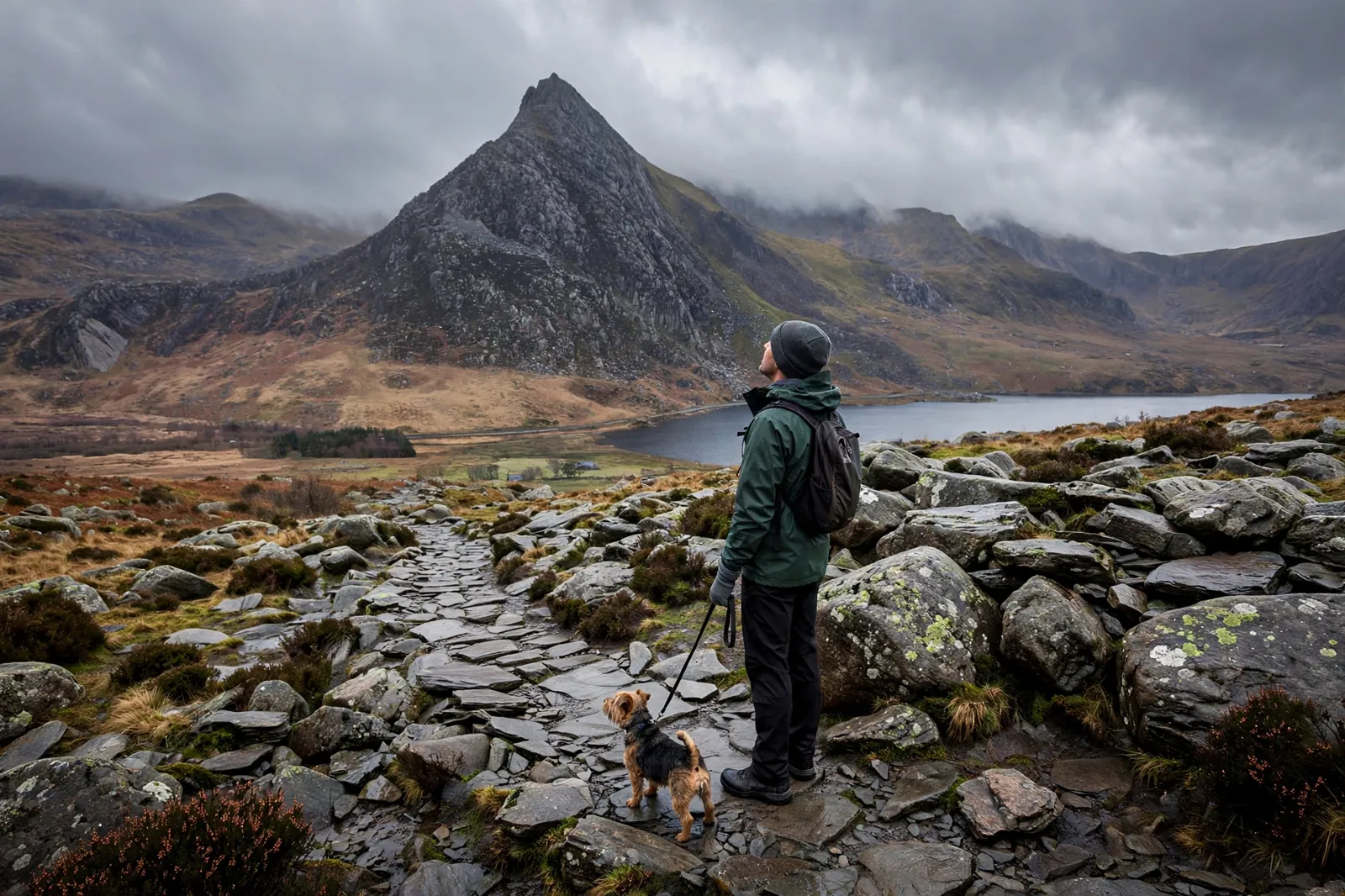
So this guide does something more useful than a watered-down summit description. It builds the dog's day around Tryfan instead: walking to the boulder fields and viewpoints where the peak fills the sky, circling the dark lake of Cwm Idwal beneath the Glyderau, following the Ogwen shoreline, and watching the climbers' mountain from ground where a dog can be a dog. Many owners report these among their best Welsh days, precisely because nobody spent them anxious. If the summit itself calls you, walk it on a separate, dog-free day and enjoy it properly.
Cwm Idwal: the circuit that earns its reputation
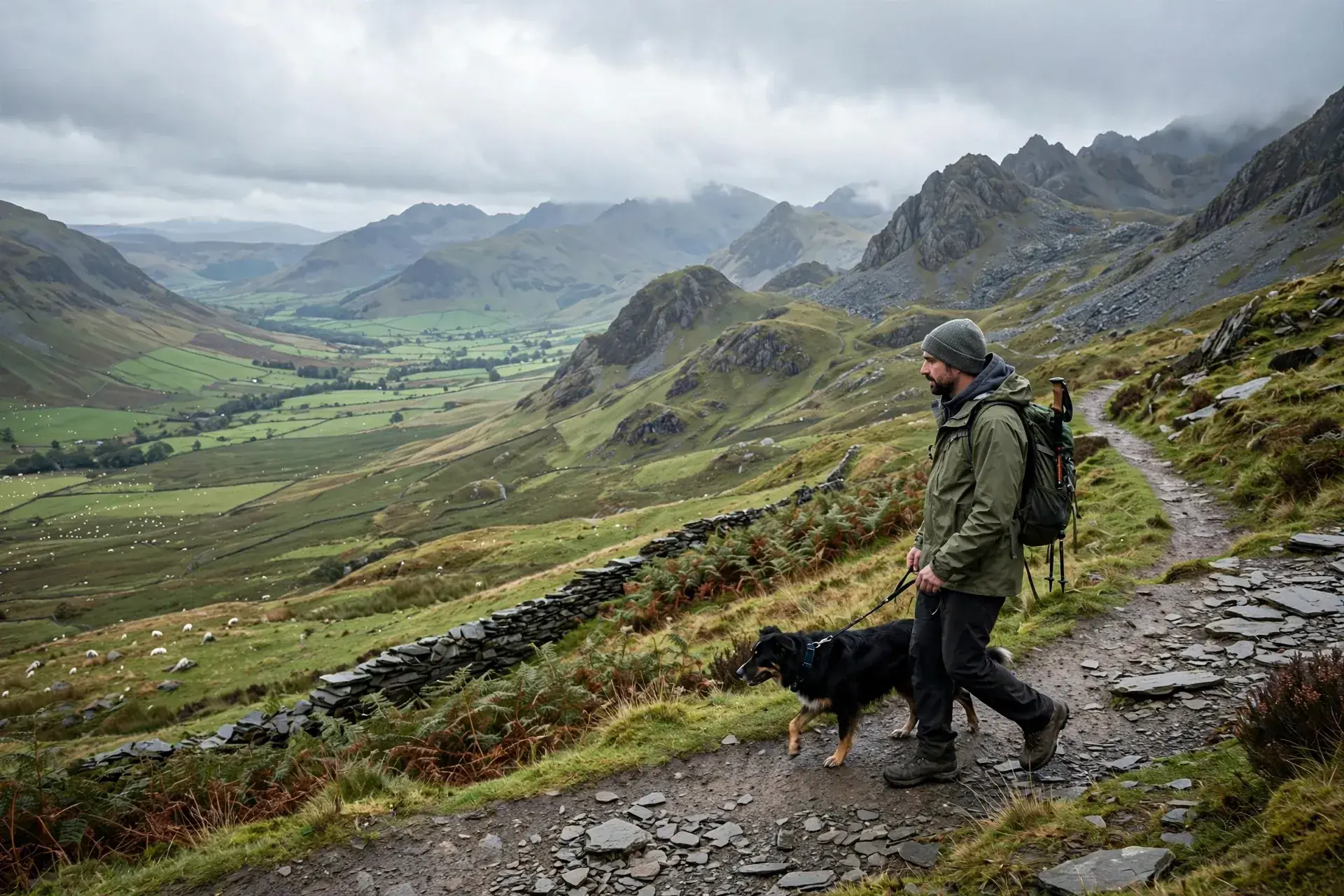
The walk round Llyn Idwal is the centrepiece of a dog day in the Ogwen Valley, and at roughly three miles with a well-made path for most of its length it suits a wide range of dogs. From the visitor centre and car park beside Llyn Ogwen, a clear path climbs gently to the lake, which sits in a high rocky cwm beneath the cliffs of the Glyderau. The circuit of the lake takes most parties between ninety minutes and two and a half hours with a dog, depending on how many swimming stops, photograph stops and sniffing investigations the itinerary absorbs.
Dogs should stay on the lead around the cwm. Cwm Idwal is a protected site — a National Nature Reserve valued for its rare arctic-alpine plants — and sheep graze the surrounding slopes, so the short-lead discipline described in our livestock worrying law guide applies from the car park onwards. The path is mostly firm, but the section beneath the cliffs crosses streams and can run wet and slabby after rain, where claws and pads cope well but rushing owners do not. Walk it clockwise or anti-clockwise; the views of Tryfan across Llyn Ogwen on the return leg are the reward either way.
Practical details make this walk. The main car park fills early on fine weekends and the lay-bys on the A5 fill with it, so arrive before the crowds or come on a weekday. There is no shade on the circuit, and the cwm acts as a heat trap on still summer days despite its altitude, so carry water for the dog rather than relying on the lake, which should be admired rather than drunk from where livestock have access. In winter the same path can hold ice in its shaded corners long after the valley road has cleared — a fact worth knowing before you promise a small dog a gentle day.
The Llyn Ogwen shoreline and the old road
For dogs that need an easier day — older dogs, puppies building stamina on vet-approved exercise, dogs recovering fitness — the shoreline of Llyn Ogwen itself is the valley's gift. A path runs along the northern shore beneath Tryfan's boulder fields, giving continuous mountain theatre at lake level. The walking is rough in places, with short rocky steps and boggy patches, but there is no exposure and retreat is instant: turn round whenever the dog has had enough and the car is never far in spirit, even when it is a mile in fact.
The A5 that threads the valley is a fast road with no pavement in places, so treat every road crossing and roadside section with real respect. Keep the dog on the inside, on a short lead, and never let an extendable lead put a terrier's nose at lorry height in the carriageway. Where the shoreline path and the road run close, many owners prefer to walk out along the lake and return the same way rather than completing any loop that involves road walking. The light on this lake changes by the hour — Tryfan reflected in still morning water is one of the classic views of Wales — so a slow shoreline amble is no consolation prize.
Combine the shoreline with the lower boulder fields for younger, athletic dogs that need more stimulation. The great blocks tumbled below Tryfan's north ridge are a natural playground at ground level, and supervised scrambling over the lowest boulders — off the main ridge entirely — gives agile dogs problem-solving exercise of a safe kind. Set the boundaries yourself: paws stay below head height, no chasing games between blocks where legs can trap, and the session ends while the dog is still thinking clearly rather than when it is overtired and careless.
Splitting the party: when the humans still want the ridge
Many groups solve Tryfan neatly by splitting. The confident scramblers take the North Ridge with proper preparation, while the dog party walks Cwm Idwal and the Ogwen shore, and everyone reunites at the valley café or the car park with the best stories from both altitudes. This works far better than the compromise nobody wants: a dog hauled halfway up a scramble, or a scrambler resentfully confined to the valley. Plan the split in advance — who carries the dog kit, which walk the dog party is doing, where and roughly when you will meet — rather than improvising it in the car park.
If you are the scrambler, brief yourself as rigorously as you would for any graded route. The North Ridge is a serious undertaking in mist, route-finding errors put parties onto harder ground, and the famous summit stones, Adam and Eve, are a leap between boulders that this guide mentions only to file under things no dog should ever be near. Carry the navigation you would want in the cloud level typical of the Glyderau, tell the dog party your planned route and latest return time, and treat the arrangement as two separate mountain days that happen to share a car park. The wider context for planning an Eryri trip with a dog is in our Snowdonia guide.
The dog party's day is not the lesser ticket, and framing matters if younger family members are involved. Give the valley walkers their own objectives: the full Idwal circuit, a swim stop where it is safe and permitted, the Tryfan viewpoint photographs, perhaps the walk up towards the base of the Milestone Buttress area paths without entering scrambling ground. Children who have 'done Tryfan base camp' while the adults did the ridge tend to remember a triumph, not an exclusion. Everyone eats together afterwards, which is where the day actually becomes one shared day again.
Ogwen weather: why this valley changes its mind fastest
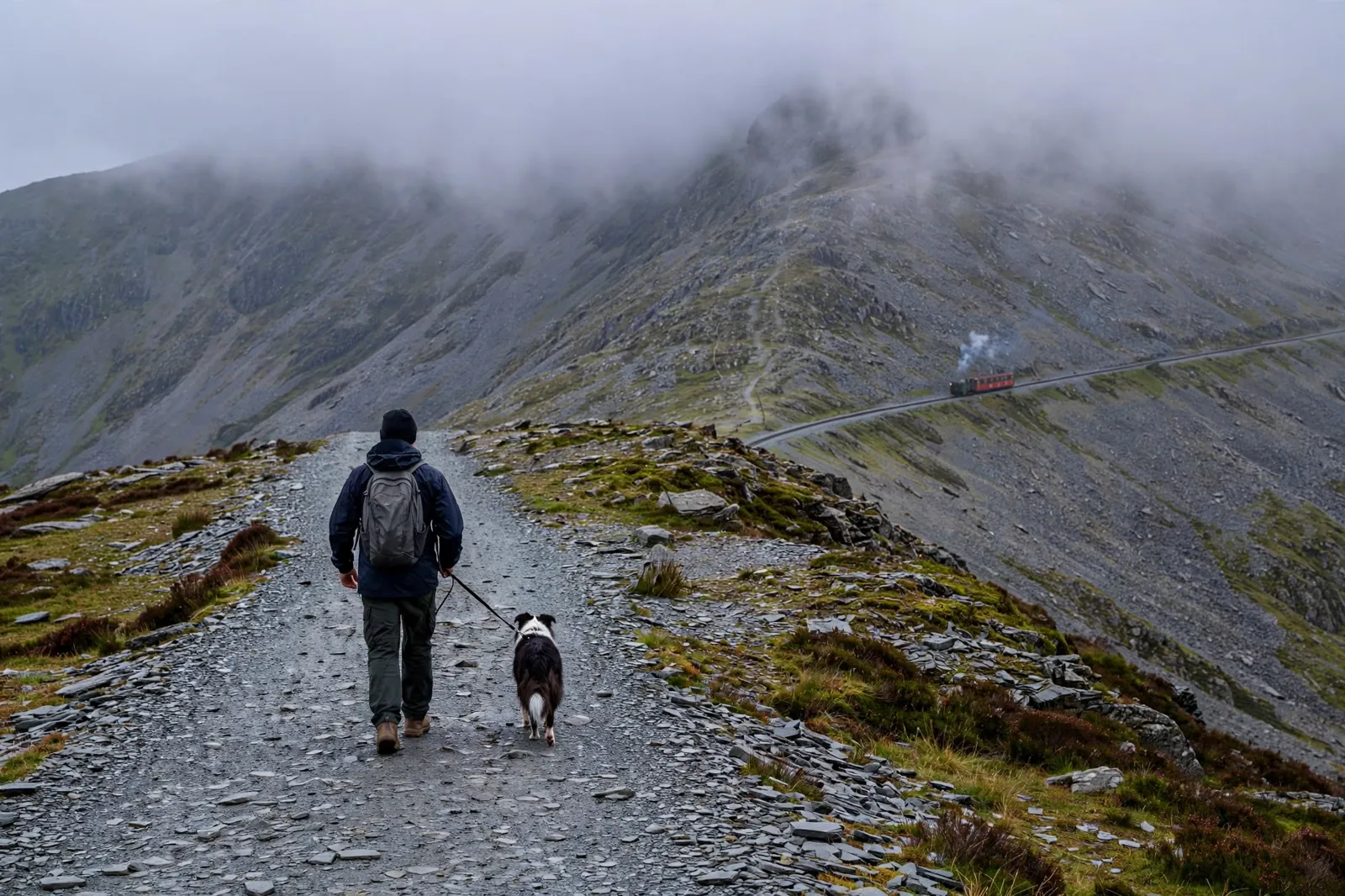
The Ogwen Valley sits between high ground on both sides, and its weather turns with a speed that surprises visitors used to gentler hills. Cloud sits on the Glyderau and Tryfan for long stretches even when Llanberis, a few miles away, is clear; rain funnels through the pass; and the wind accelerates along the lake. For the dog walks in this guide the practical reading is simple: dress and pack for one grade worse than the valley floor suggests, and treat a clear dawn as a bonus rather than a promise. Check the latest official guidance before you travel, including any mountain forecast for the Glyderau.
Cold matters at Cwm Idwal even in spring and autumn, because the cwm holds shade and the path beside the lake catches the wind. Small, short-coated and elderly dogs feel a stationary ten minutes at Idwal very differently from a moving ten minutes, so pack a dog coat for rest stops if your dog uses one, and keep breaks short and purposeful in poor weather. At the other extreme, a still July day can make the Idwal path hot work with no tree cover at all, and the same heat discipline as any exposed walk applies — the signs and first response are covered in our hot-weather travel guide.
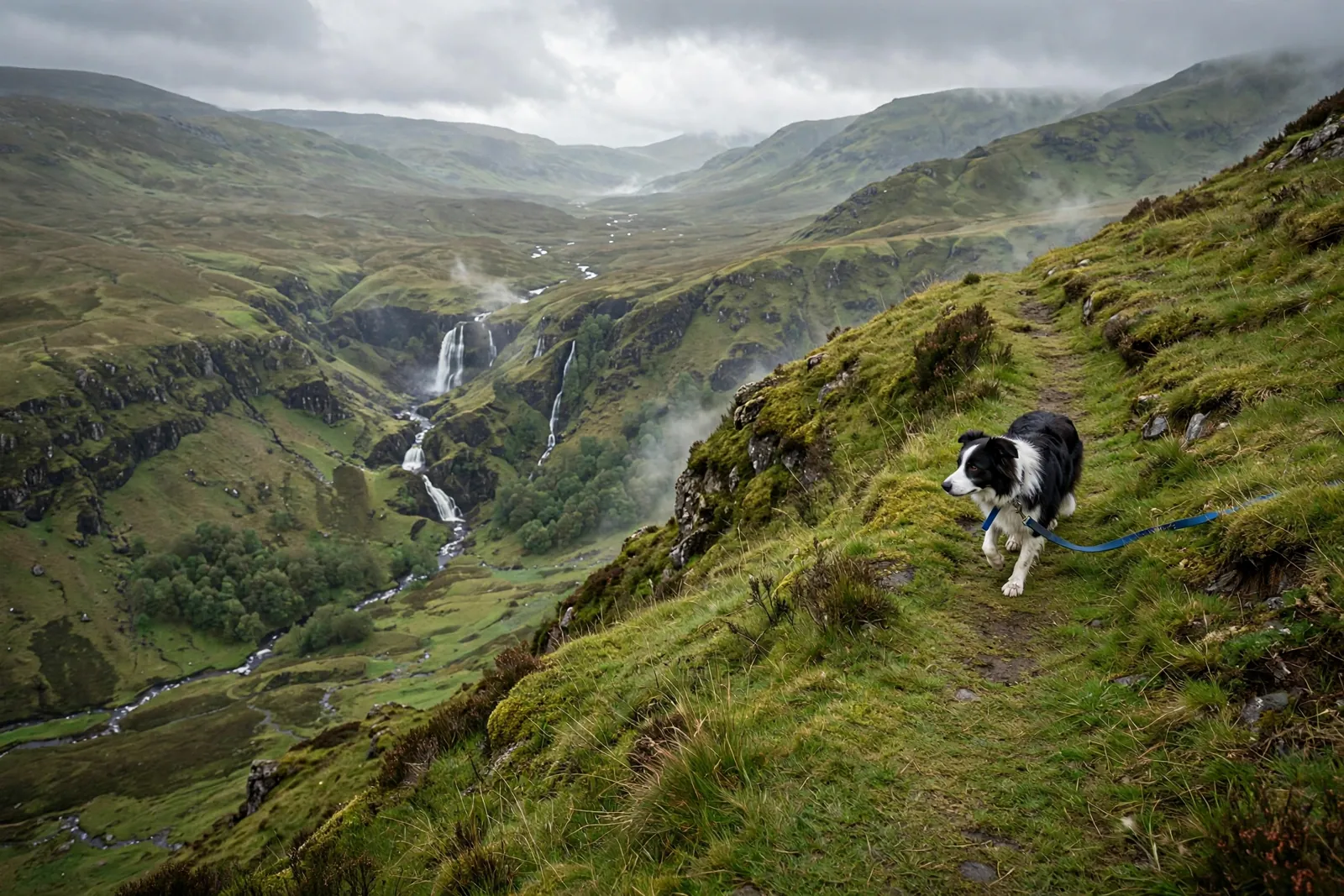
Streams are the valley's hidden trip hazard for dogs. After heavy rain, the crossings around Cwm Idwal and the falls tumbling towards Llyn Ogwen rise quickly, and a dog that paddles happily in a July trickle should not be encouraged into a brown, pushing current in November. Keep the lead on near fast water, cross at the established points, and be willing to shorten the circuit: a three-quarter Idwal walk in safety beats a full circuit with one frightening crossing in it. Dogs read your tension down the lead, so calm, early decisions serve everyone.
Pads, rock and the boulder-field workout
Granite and rhyolite are honest teachers of paw condition. Even the valley walks in Ogwen cross sharp-edged gravel, blocky paths and stream-worn slabs that test pads far more than grassland miles do. Before an Ogwen day, check each pad for cracks and trim the fur between the toes if your breed grows it, because grit packs into that fur and works like sandpaper over a long walk. Dogs that have done mostly pavement and park miles may need a fortnight of rougher-ground walking before a full Idwal circuit is fair to ask.
During the walk, build in pad checks the way you would check a child's shoes on a long day. At each natural stop, lift each paw briefly, look for limping causes — a stone wedged between pads is the classic — and watch for the dog starting to choose grass verges over the path, which is often the first vote of sore feet. A single emergency boot or a cohesive bandage in the pack turns a minor cut from a carry-out problem into a walk-out inconvenience. Fit and practise any boot at home; a dog introduced to boots on a rocky path will spend the walk trying to remove them, which on slabby ground is its own hazard.
Afterwards, rinse paws in clean water to shift the grit, dry between the toes, and re-check by lantern light at home or at your base. Minor grazes usually settle with rest; a dog still favouring a leg the next morning, or any cut that gapes, is a vet conversation rather than a wait-and-see. The Ogwen Valley rewards repeat visits across the seasons, and looking after pads is what turns one good day into a habit rather than a one-off followed by a fortnight of limping. For base-and-stay planning in the area, the questions in our guide to Welsh holiday parks are worth asking of any Ogwen-side accommodation.
A complete Tryfan dog day, hour by hour
Start early, especially from spring to autumn. Arrive at Ogwen by nine on a weekday — earlier on a fine Saturday — park once, and walk the Cwm Idwal circuit first while legs and light are fresh and the path is quiet. That gives the dog the day's main exercise in the coolest hours, gives photographers the classic views before the breeze ruffles the lake, and leaves the afternoon gloriously uncommitted. Dogs that meet the world on a quieter path settle better, greet fewer dogs nose-to-nose on narrow sections, and finish the circuit ready for lunch rather than wired by it.
Make the middle of the day about food, water and shade-seeking rest, whether that is a picnic on the Ogwen shore set back from the road, or a café stop in the valley where dogs are welcome — confirm current arrangements before relying on them, and check the latest official guidance before you travel for anything time-sensitive. Then walk the Llyn Ogwen shoreline in the afternoon at the dog's pace, letting the mountain do the entertaining. This two-walk structure, with a genuine rest between, suits most dogs far better than one huge outing, and it mirrors how the valley's own walkers have always used it.
Finish with the honest review this whole guide argues for. If everyone — dog included — ends the day tired and happy at valley level, you have not 'failed' Tryfan in any sense that matters. You have walked beneath one of Britain's great mountains, in a cwm carved by ice and a valley steeped in climbing history, and the dog has had exactly the day its body was built for. The summit ridge will keep. Come back for it with the dog party resourced, or come back without the dog and with both hands free — either way, Tryfan gets the respect its shape demands.
Practical questions
Before you go
Can a dog climb Tryfan?
Dogs should not be taken on Tryfan's summit routes. Every recognised way to the summit, including the North Ridge and South Ridge, involves graded scrambling with sustained hands-on-rock sections and exposure that a dog on a lead cannot negotiate safely. Dogs have become stuck on the mountain and needed rescue. The valley walks below — Cwm Idwal and the Llyn Ogwen shoreline — are the right way to enjoy Tryfan with a dog.
What is the best dog walk near Tryfan?
The Cwm Idwal circuit is the standout: roughly three miles on a mostly well-made path around Llyn Idwal beneath the Glyderau cliffs, starting from the Ogwen visitor centre. The Llyn Ogwen shoreline path is the easier alternative for older dogs or shorter outings, and the lower boulder fields below the North Ridge give athletic dogs supervised play at ground level.
Are dogs allowed off lead at Cwm Idwal?
Keep your dog on a short lead. Cwm Idwal is a National Nature Reserve with rare alpine plants, sheep graze the slopes, and access-land rules require dogs on a short lead near livestock and during the spring and early summer season. A short fixed lead also keeps your dog safe on the wet, slabby sections of path beneath the cliffs.
Where do I park for Tryfan and Cwm Idwal with a dog?
The main car park is at Ogwen Cottage by the visitor centre on the A5, with lay-by parking along Llyn Ogwen. Both fill early on fine weekends, so arrive before nine or visit on a weekday. Parking is pay-and-display in the main car park — check the latest official guidance before you travel for current charges and any seasonal arrangements.
What if part of our group wants to scramble Tryfan's North Ridge?
Split the party on purpose. The scramblers take the ridge with full navigation kit and a stated return time, while the dog party walks Cwm Idwal and the Ogwen shoreline, with an agreed meeting place afterwards. This is safer and happier than taking a dog partway up a scramble — and the valley walk is a genuinely excellent day, not a waiting room.