This guide is independent and contains no paid placement. Route conditions, access rules and transport timetables change, so check the latest official guidance before you travel.
Yr Wyddfa is a serious mountain day for a dog, not a long park walk. The Llanberis Path is the most forgiving route for most dogs, the Rhyd Ddu and Snowdon Ranger paths are quieter middle options, and the Watkin Path and the Pyg and Miners tracks demand far more from paws, joints and concentration. Keep the lead on around livestock and steep ground, carry water for the dog as well as yourself, and turn back early if cloud, wind or heat builds. Official source: Snowdon Mountain Railway FAQs (checked October 2026).
Start with the path, not the summit photo
Every conversation about taking a dog up Yr Wyddfa — Snowdon in English, and the name most older signs and maps still use — should begin with the path rather than the peak. The mountain stands at 1,085 metres, and each of its main routes asks something different of a dog. A fit adult dog that hikes weekly will cope with demands that would overwhelm a young dog, an older dog, a short-legged breed or a dog that only knows flat pavement walks. Choosing the wrong path does not just make the day harder; on ground this exposed, it can make retreat difficult exactly when you need it most.
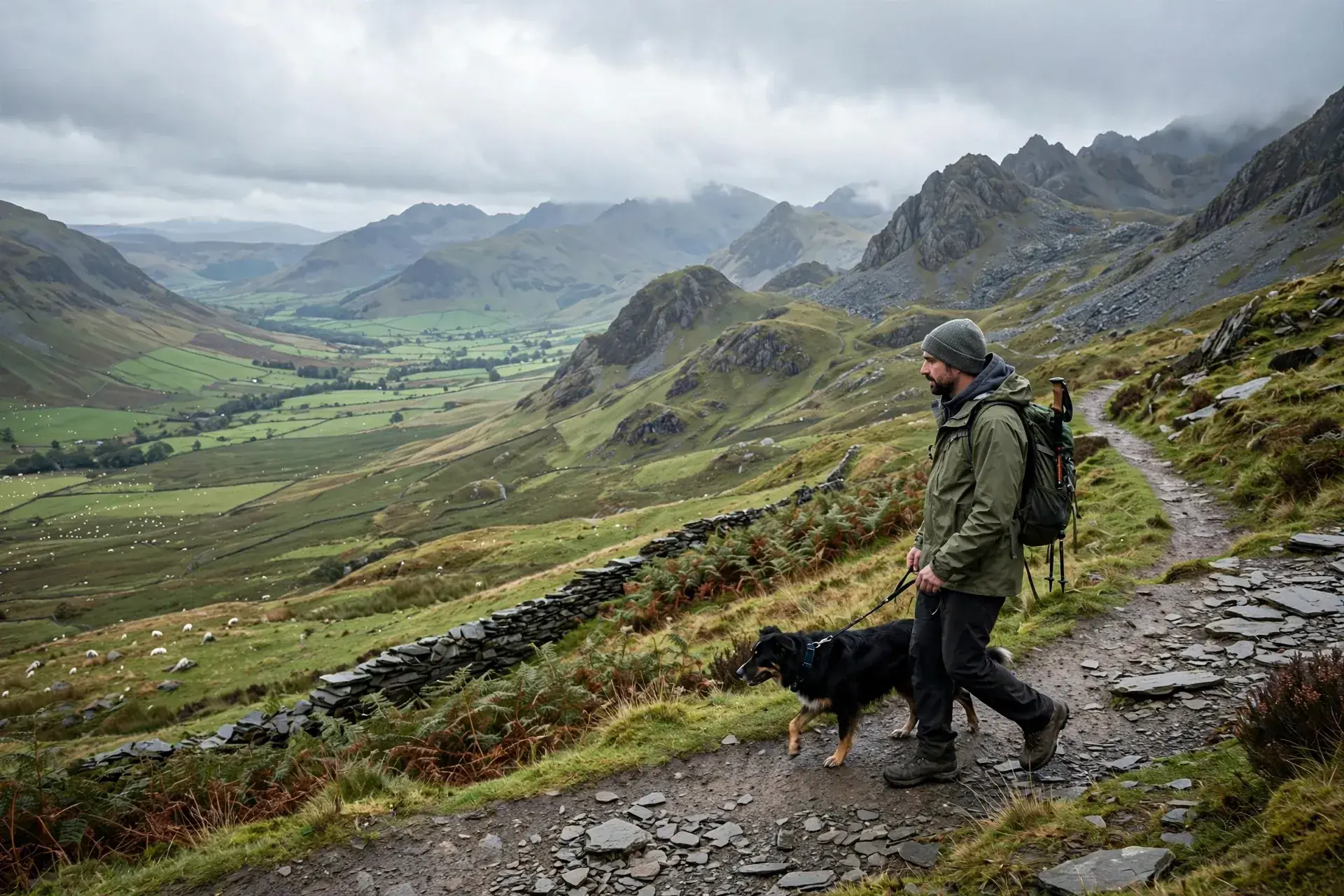
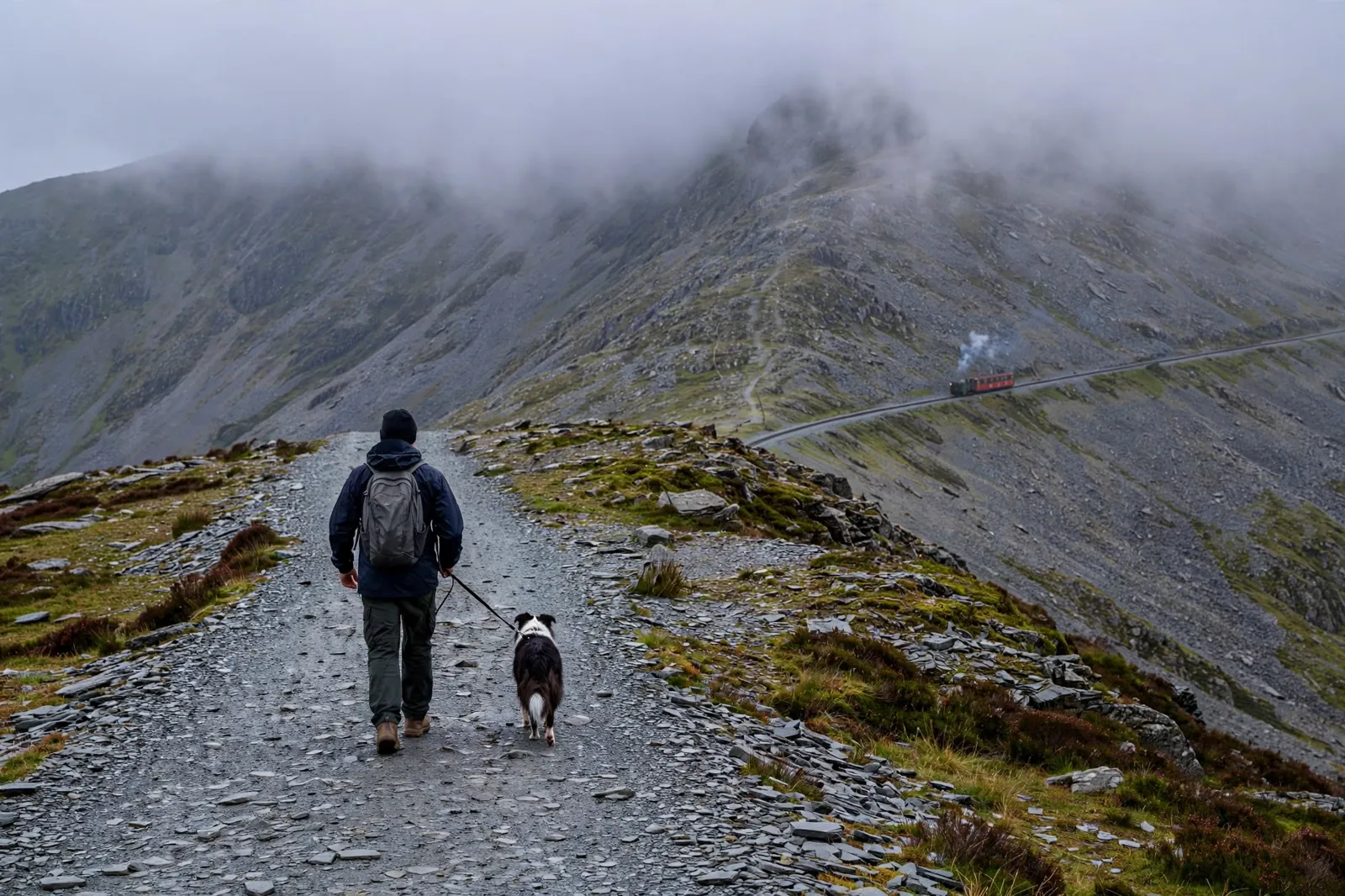
The Llanberis Path is the route most dog owners should consider first. It is the longest of the main paths at roughly nine miles there and back, but it is also the most gradual, follows the line of the mountain railway for much of its length, and offers the clearest line of retreat: at almost any point you can simply turn round and walk back down the same broad track. There are no scrambles, no narrow arêtes and no sections where a dog needs to be lifted. For a first big Welsh mountain with a dog, that combination of length over steepness is usually the right trade.
At the other end of the scale sit the Pyg Track and the Miners Track from Pen-y-Pass, and the Watkin Path from the south. The Pyg is rocky and stepped, the upper Miners Track crosses rough ground beside the lakes, and the Watkin Path finishes with a steep, loose scree slope that is hard on pads and genuinely awkward for a dog being handled on a lead. Crib Goch, the famous knife-edge ridge sometimes photographed in summit pictures, is a graded scramble and is never a route for a dog. If your plan involves any hand-on-rock scrambling, the dog stays home that day — that rule has no exceptions worth inventing.
The quieter middle options: Ranger, Rhyd Ddu and Beddgelert
The Snowdon Ranger Path, starting near the youth hostel on the western side, is a steadier climb than its name sometimes suggests. It crosses open hillside, joins the Llanberis Path near the top, and sees far fewer walkers than the Pen-y-Pass routes. For a dog that finds crowds, queues at stiles and constant passing traffic stressful, that quietness is a real welfare benefit, not just a nicer photograph. The trade-off is exposure: there is little shelter if the weather turns, and water sources for a dog are unreliable once you leave the lower ground.
The Rhyd Ddu Path is often described as one of the quieter ways up, and it rewards confident walkers with a narrower, more interesting ridge line as it climbs. That narrowing is exactly what a dog owner needs to think about. The upper section follows a ridge with drops to one side, so a dog that lunges at birds, pulls sideways on the lead or freezes on exposed ground is in the wrong place. Walked by a calm dog on a short lead with an owner comfortable on ridges, it is a fine route; for a nervous dog, it is a poor choice dressed up as an adventure.
Whichever path you choose, apply the same honesty test used everywhere on this site: describe your dog's worst realistic behaviour, not their best. A dog that pulls hard downhill changes the descent entirely, because most accidents on these paths happen on tired legs going down. A dog that barks and lunges at other dogs will meet dozens on the Llanberis Path on a summer Saturday. A dog that overheats quickly faces a long, shadeless climb on every route. The mountain does not grade itself to your dog, so the grading has to happen in your planning. Our wider Snowdonia guide puts this walk in context with lower-level Eryri days for building up to it.
Lead rules, livestock and the law on open access land
Yr Wyddfa sits within Eryri National Park, and much of the walking crosses open access land and working farmland. Dogs are welcome on the public rights of way, but that welcome comes with conditions that matter. On open access land in England and Wales, dogs must be kept on a short lead of no more than two metres between 1 March and 31 July, and at all times near livestock — and because Welsh hill sheep are present across these slopes for most of the year, the practical rule on Yr Wyddfa is simpler: the lead stays on. Check the latest official guidance before you travel, because local restrictions can change seasonally.
Sheep worrying is not a technicality. A dog chasing sheep can be lawfully shot by a farmer, and owners can face prosecution and unlimited liability for injuries — the detail is covered in our guide to livestock worrying law. Hill sheep here are not fenced away from the paths; they graze across them, rest beside them and appear round blind corners with lambs. A retractable lead at full extension gives a dog enough rope to start a chase before you can react, so use a fixed short lead on the open hill and keep both hands free for the ground.
Lead handling on a mountain path is a skill in itself. Keep the lead short but not tight on descents, position yourself on the outside edge when passing other walkers, and step aside to let groups pass rather than letting your dog weave between legs on a narrow track. If your dog wears a harness for hill walking, check that straps do not rub behind the front legs over a five-hour day — a rub that is invisible at mile two can be a raw patch by mile eight. Dogs that are reactive to close passing should tackle this mountain on a weekday morning, setting off early, rather than in the midday summit queue.
Is your dog fit enough? Building up honestly
A fit, healthy adult dog that already walks two hours daily over varied ground is a reasonable candidate for the Llanberis Path. A dog whose exercise is thirty minutes round the block is not, and no amount of enthusiasm on the day changes that arithmetic. The full Llanberis round trip involves roughly 975 metres of ascent and around five to seven hours of walking for most parties with a dog. Build up over several weeks: increase hill walks gradually, add a longer weekend walk each week, and watch how your dog moves the following morning, because stiffness the next day is the clearest signal you have about what the joints actually thought of the effort.
Age limits matter at both ends. Puppies and young dogs whose growth plates are still closing should not do sustained mountain descents; the repetitive impact of a long downhill is exactly the load vets warn about for developing joints. Senior dogs may have the experience but not the cardiovascular reserve, and a dog that was a mountain dog at seven may be a valley dog at eleven. Our senior dog travel guide covers adapting big days for older dogs in more depth. Brachycephalic breeds — flat-faced dogs that already work hard to breathe and cool down — face additional risk on a long exposed climb, and for many of them a lake-level Eryri walk is simply the better day.
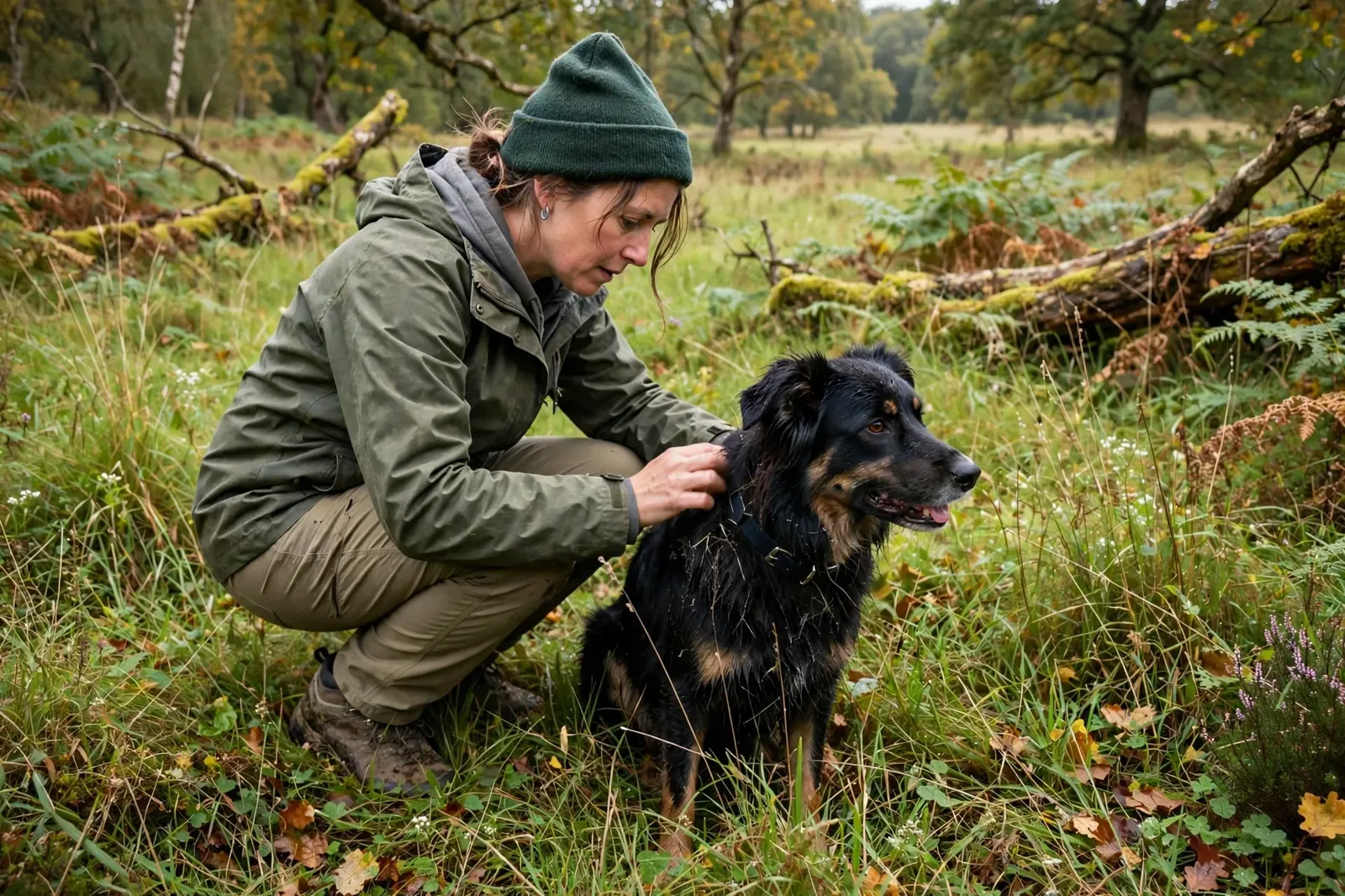
Do a deliberate rehearsal before committing. Pick a smaller Welsh hill, walk it with the exact kit, lead and boots-or-no-boots arrangement you plan to use, and time the descent as carefully as the climb. Check pads that evening under a good light, pressing gently around each pad and between the toes for grit, small cuts or tenderness. A dog that finishes the rehearsal bright, eats normally and moves freely next morning has earned the bigger day. A dog that does not has told you something valuable at a much cheaper price than learning it at 900 metres.
Water, food and the summit-day fuel plan
There is no reliable drinking water for a dog on the upper mountain. Streams cross the lower paths, but they shrink in dry spells, can carry contamination from livestock, and disappear entirely on the higher slopes of several routes. Carry water for the dog in its own right — as a working rule, plan at least a litre for a medium dog on a full summit day, more in warm weather, and offer small amounts frequently rather than one huge drink at the top. A collapsible bowl weighs almost nothing and means the dog actually drinks; many dogs will not take enough directly from a bottle or a cupped hand.
Food needs planning too, but not overfeeding. A dog burning mountain miles can have a modest extra portion, split either side of the walk rather than a big meal immediately before climbing, which risks discomfort and, in deep-chested breeds, the serious emergency of bloat. Carry high-energy treats for the summit and the descent, when blood sugar and morale both dip. Pack out everything, including dog waste: on a mountain this heavily walked, leaving bags beside the path is a genuine and much-criticised problem, and there are bins at the main trailheads.
Watch for the quiet signs that a dog is running out of reserves. Heavy panting that does not settle during a rest, a dog that starts lying down at every stop, lagging behind on ground they led on earlier, or repeatedly seeking shade on a shadeless slope all mean the same thing: shorten the day. The summit café building, Hafod Eryri, is a landmark rather than a dog facility — do not plan around dogs being admitted inside, and check the latest official guidance before you travel if that detail matters to your plan. The mountain will still be there next season; a dog pushed past its limit may not forgive the sport as quickly.
Weather checks that actually decide the day
Yr Wyddfa makes its own weather, and the summit is routinely 8 to 10 degrees colder than Llanberis village, with wind speeds far higher than the valley forecast suggests. Check a mountain-specific forecast the night before and again on the morning, and treat wind as the deciding factor for a dog: a dog cannot brace, cannot hold a map and cannot tell you the gusts are frightening it until it plants its feet and refuses. Gusts above roughly 40 miles per hour make exposed sections miserable for most dogs and dangerous for small ones, whatever the temperature says.
Heat is the opposite trap, and it catches more dog owners than cold does. The main paths are almost entirely without shade, dark slate and gravel reflect heat onto pads, and a clear summer morning in the valley can become a serious heat-management problem by midday on the climb. Start at dawn in summer, carry the extra water, and know the early signs of heatstroke — frantic panting, thick saliva, a bright red tongue, wobbliness — because it can progress frighteningly fast. Our hot-weather travel guide covers cooling and first response in detail. If the forecast is for a genuinely hot day, the kind decision is a woodland or river walk instead.
Navigation discipline matters more with a dog, not less. Cloud can close over the summit plateau while the path in remains in sunshine, and a dog adds a second creature to keep track of when visibility drops to a few metres. The summit area has serious cliff edges, particularly on the eastern side above the lakes, and in mist the difference between the path and the edge is not always obvious. Keep the dog on the short lead near the top in poor visibility, know your descent route before you need it, and remember that several paths dropping off the summit go to different valleys — following the wrong one with a tired dog is a long mistake.
Trains, parking and where to stay the night before
Logistics decide whether summit day starts calmly or in a scramble. The Llanberis trailhead pairs naturally with the village's parking, cafés and the Snowdon Mountain Railway, but note the railway is a people railway — do not assume a dog can ride it, and check the latest official guidance before you travel if a part-rail, part-walk plan appeals. Pen-y-Pass, for the Pyg and Miners tracks, has limited parking that is commonly pre-booked in season and fills very early; arriving to a full car park with an excited dog and no plan B is a poor start to a mountain day, so use the park-and-ride and Sherpa bus services where they fit your route.
Staying locally the night before converts a dawn start from a punishment into a pleasure, and Eryri has plenty of dog-welcoming bases. Llanberis itself suits the Llanberis Path, Beddgelert suits the southern routes and makes a good base for the Watkin and Rhyd Ddu paths, and Betws-y-Coed works for drivers happy to travel to the trailhead in the morning. When booking, the questions in our Welsh holiday parks guide about enclosed outdoor space matter doubly here: after a mountain day, a dog that can be let into a secure garden for its last outing is worth real money.
Plan the evening after as carefully as the morning of. A dog that has climbed Yr Wyddfa needs a genuinely easy following day — a short lead walk, food, water and sleep, not a second attraction. Check pads again that evening, rinse off grit and mud, and watch appetite and gait. If you are touring, put the summit attempt early in the trip while legs — yours and the dog's — are fresh, and keep a low-level alternative in reserve for the day itself: the lakeside and woodland walks around Llanberis and Beddgelert are excellent consolation prizes, not failures.
The turn-back decision and descending well
Set your turn-back rules in the valley, where pride is quiet. A fixed latest time to start descending, a weather threshold and a dog-welfare threshold — agreed before anyone sets off — turn an emotional argument at 800 metres into a simple check against a list. Common sense versions include: if the dog has drunk most of its water by halfway up, the summit is cancelled; if cloud drops below the path ahead, the summit is cancelled; if the dog is lagging on the ascent, the descent starts now. The Llanberis Path rewards this discipline because turning round on it is always straightforward.
The descent is the real test of pads, knees and temperament. Tired dogs pull differently, clip their feet on steps they cleared in the morning, and stop planting their paws carefully on loose gravel. Walk slower than feels necessary, rest more often than the dog asks, and keep the lead arrangement exactly as practised rather than improvising a waist belt or a longer line on steep ground. This is also when other people's dogs are tiredest and least tolerant, so give passing space generously on narrow sections.
Back at the trailhead, resist the victory lap. A gentle cool-down walk to the car, water in small amounts, a pad check before the drive and a proper meal once home or back at base is the whole ceremony a dog needs. Note how long recovery takes — a dog still stiff two days later is giving you data for the next mountain choice, and honest owners write it down. Yr Wyddfa with a dog, done at the dog's pace on the right path, is one of the great days out in Britain. Done as a summit-bagging exercise with the dog as an accessory, it is how good dogs have bad days. The difference is almost entirely decided before you leave the car park.
Practical questions
Before you go
Can dogs go all the way to the summit of Yr Wyddfa?
Yes, dogs can reach the summit of Yr Wyddfa on the walking paths, and many fit dogs do it every season. There is no general ban, but dogs must stay under close control and on a short lead around livestock and on open access land. The summit building has its own admission rules, so do not plan on taking your dog inside, and check the latest official guidance before you travel.
Which Snowdon path is best for a dog?
For most dogs, the Llanberis Path is the best choice: it is the longest route but the most gradual, with no scrambling and an easy line of retreat at any point. The Snowdon Ranger Path is a quieter alternative for confident dogs. The Pyg, Miners and Watkin paths are rockier and steeper, and Crib Goch is a scramble that is never suitable for a dog.
Does my dog need boots for Yr Wyddfa?
Most dogs with conditioned pads manage the Llanberis Path without boots, but the rocky upper sections of the Pyg and Watkin paths can cut soft pads. Build up walking on rough ground beforehand, carry a spare boot or paw bandage in case of a cut, and check pads at the summit and again that evening. If your dog has never worn boots, do not debut them on summit day.
Can my dog ride the Snowdon Mountain Railway?
Do not plan around it. The mountain railway is primarily a passenger service to the summit and dog carriage is restricted and subject to change, so a walk-up, ride-down plan can strand you with a tired dog and no seat. Check the latest official guidance before you travel, and always plan the day as a full walk in both directions.
How much water should I carry for my dog on Yr Wyddfa?
Plan at least one litre for a medium-sized dog on a full summit day, and more in warm weather or for large, thick-coated breeds. There is no reliable water on the upper mountain, so everything the dog drinks must be carried. Offer small drinks often using a collapsible bowl, and treat running low on the dog's water as a firm reason to turn back.
What should I do if my dog is injured on the path?
Stop, keep the dog warm and still, and assess: minor pad cuts can be cleaned, bandaged and walked out slowly on the easiest line of descent. For a dog that cannot walk, call for help — mountain rescue teams would always rather be called early — and be ready to give your exact path, nearest landmark and grid reference. Carry an emergency blanket and a basic dog first-aid kit on every summit attempt.
Can I take my dog down on the Snowdon Mountain Railway after walking up?
No. Pet dogs cannot board the railway at all — only registered assistance animals are allowed on the trains. On top of that, the railway states that passengers cannot hike to the summit and then use a return ticket solely for the journey back down, so a walk-up day must also be a walk-down day for your dog. Plan water, rest stops and descent time accordingly. See the railway’s official FAQ: Snowdon Mountain Railway FAQs (checked October 2026).
How long is the Llanberis Path, and where can I refill water?
Route guides put the Llanberis Path return at about 9 miles (14.5 km), with 975 metres of ascent, taking about 5.5-7 hours return (2.5-4 hours one way). The Halfway House (Pen y Ceunant Isaf) cafe, about halfway up, is the main refuelling point on the way up. Do not rely on finding water higher up the mountain, so carry enough water for your dog. Pet dogs are not allowed inside the summit building. See the Eryri National Park Llanberis Path guide and the Climb Snowdon Llanberis Path guide for route details, and for a different mountain day, see Tryfan with a dog and Cader Idris with a dog.