This guide is independent and contains no paid placement. If affiliate links are added later, they will be clearly marked and will not change our editorial checks.
Ulverston works best as a two-part day: a calm town walk first, then a short, steep climb to the Sir John Barrow Monument on Hoad Hill. Keep the dog on a lead, expect wind at the top, and choose your descent before you set off, so a change in weather never leaves you improvising on an exposed slope.
Start in the town, not on the hill
Ulverston is a market town in Furness, on the southern fringe of Cumbria, and that position shapes the whole visit. It is not a remote fell village, and it is not a large resort town either. It is compact enough to walk across without a car, busy enough on market days to need a plan for a nervous dog, and close enough to the hill that the monument seems to watch over the streets below. Beginning in the town, rather than driving straight to a hill path, gives your dog time to settle, gives you time to read the weather, and gives the day a natural rhythm: sniff, settle, climb, descend, rest.
Park once and walk if you can. A town-centre base means the car becomes a fallback, not the centre of the plan. Leave water, a spare lead and a towel in the car, but carry what the dog needs for the first hour: water, a bowl or bottle, poo bags, a short lead and, if your dog wears one, a harness that does not restrict the shoulders on a steep climb. A long line is useful on open ground elsewhere, but in a town centre and on a shared hill path a short lead is safer and kinder to other walkers. If your dog pulls, sort that out on flat streets before you add gradient, wind and other dogs to the mix.
Walk the town at the dog's pace first. Market squares, narrow lanes, shop doorways and delivery vehicles all carry scent and sound, and a dog that has already had twenty unhurried minutes on flat ground will climb more steadily than one taken straight from a car to a steep path. Look for the quieter streets as well as the main ones. A dog that is overwhelmed by a busy stretch does not need to be marched through it for the sake of completeness; a parallel street, a pause beside a wall, and a return to a familiar corner are all legitimate parts of a town walk. The aim is a dog that arrives at the foot of Hoad Hill relaxed, hydrated and interested, not already over threshold.
Use this first walk to make practical decisions. Check the wind by looking at trees, flags and cloud movement rather than trusting a single forecast figure. Notice whether your dog is pulling towards every doorway, hanging back, or trotting happily beside you. Notice your own energy too: a climb that feels easy after a coffee and a calm town loop can feel very different after a rushed arrival and a stressful search for parking. If the town walk reveals that your dog is tired, stiff, anxious or unwell, the honest choice is a town-only day. Ulverston still offers a worthwhile outing without the hill, and a dog that enjoys a shorter day is more likely to enjoy the next hill you try.
Before you leave the town centre, agree the rest of the plan out loud, even if you are travelling alone. Decide where you will start the climb, how long you will allow for the ascent, where you will stop if the dog needs a break, and which descent you will use. Decide what will make you turn back: a stated wind speed, a dog that stops twice, rain that turns the path slippery, or simply a feeling that the summit is not worth the effort today. Writing these decisions down in advance removes the pressure to push on simply because you are halfway up. Hills reward good judgement more than determination, and a monument will still be there on a calmer day.
The climb to the monument, step by step
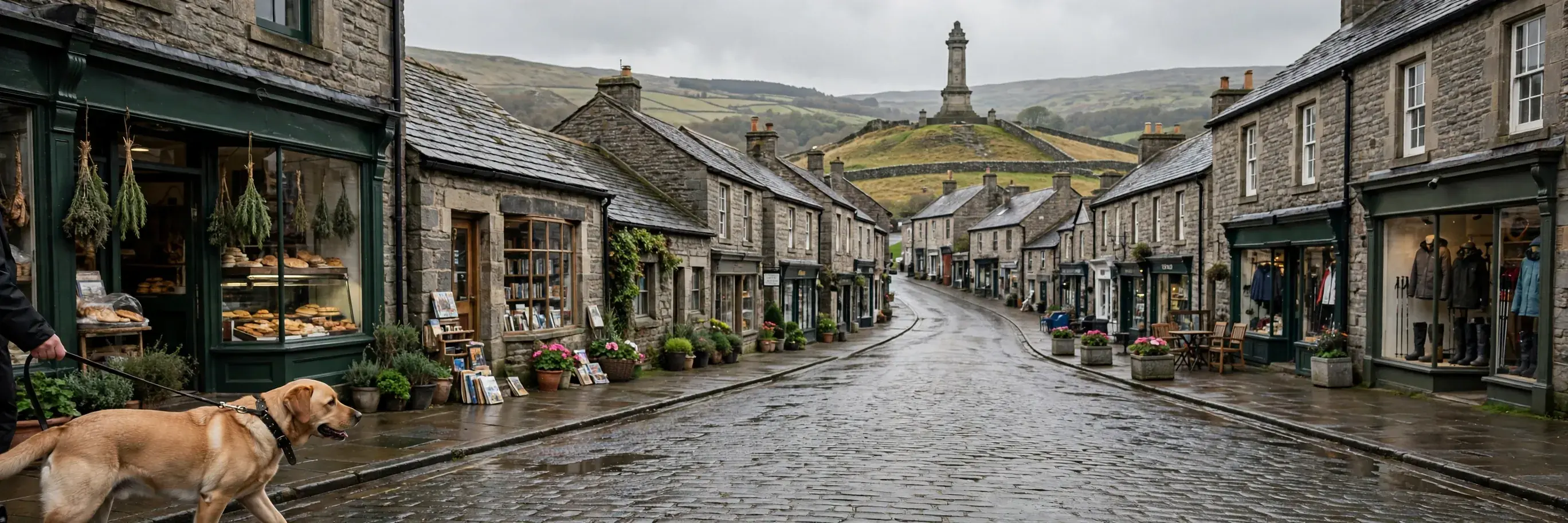
The route from Ulverston to Hoad Hill is best understood as a climb with a clear destination, not as a long-distance walk. The Sir John Barrow Monument stands on the hill above the town, a tall, lighthouse-like tower that is visible from many streets below. That visibility is helpful: you can keep the destination in sight, judge the remaining height, and show a tired dog that the walk has a purpose. It is also misleading, because a monument that looks close from the town can still involve a sustained uphill pull, and the final approach is more exposed than the sheltered streets at the bottom.
Start the climb slowly, even if the first stretch feels easy. Dogs, like people, often set off too fast on a hill and pay for it halfway up. Keep the lead short, keep the pace conversational, and stop before the dog has to stop for you. A good rule is to pause at every clear change in the path: where a lane becomes a track, where the gradient steepens, where the town drops away behind you, and where the wind first reaches you properly. At each pause, offer water, let the dog sniff, and check the lead, the harness and your footing. These pauses are not wasted time; they are how a steep walk stays enjoyable rather than becoming a test of endurance.
Expect the path to change character as you gain height. Lower sections are more enclosed, with walls, hedges and buildings breaking the wind and giving a dog places to investigate. Higher sections are more open, with wider views and fewer shelters. That transition matters for dogs that are sensitive to wind, noise or open space. A dog that was confident in a lane may hesitate on an open slope, not because it is tired, but because the world has suddenly become bigger and louder. Keep your voice calm, keep moving at a steady pace, and do not drag a hesitant dog forward. A short pause, a treat, and a step to one side of the path often restores confidence better than encouragement shouted into the wind.
Near the top, the monument itself becomes a landmark for behaviour as well as navigation. Other walkers, families and dogs often gather there, and the ground is open and exposed. This is the place to shorten the lead, move to one side, and let your dog take in the view without approaching every other dog. Not every dog wants to greet at the summit, and a dog that has just climbed a hill is not necessarily in a social mood. Give other walkers space, keep the dog close while you take photographs, and remember that a summit photograph is a poor reason to let a dog off lead on an exposed hilltop. The view will still be there from a safe position a few steps back.
Check the official guidance before you travel for any current access information about the monument itself, including whether the tower is open, whether there are temporary closures, and whether any local restrictions apply on the day. Monument opening arrangements can change with the season, with maintenance, and with weather, and a guide written in advance cannot guarantee them. Plan the walk as worthwhile even if the tower is closed: the hill, the views and the town below are the main reward, and a closed door should not turn a good walk into a disappointment. If you are hoping to go inside, check before you climb rather than discovering the position at the top with a tired dog beside you.
Gradient, footing and what you can see
Hoad Hill is a short, steep climb, and that description deserves unpacking. Short means the walk does not require the planning of a full fell day: you do not need a mountain map, a full rucksack of emergency kit, or hours of daylight in reserve. Steep means the gradient is sustained enough to raise heart rates, test knees, and tire small legs and older joints. The combination suits fit adult dogs and active owners, but it is not a gentle stroll, and it should not be presented as one. If your dog is recovering from illness or surgery, is very young, is very old, or has a known joint condition, check the official guidance before you travel and consider whether a town walk plus a lower viewpoint is the better day.
Footing matters more than distance on a hill like this. Paths can be firm in dry weather and slippery after rain, and a dog that scrambles on loose ground will use far more energy than one walking steadily on a good surface. Choose footwear with grip, keep the dog on a short lead so it cannot lunge sideways on a loose section, and avoid cutting corners across grass banks that may be steeper and less stable than the path. If your dog wears boots, test them on flat ground first; a hill is a poor place to discover that a boot twists or slips. If your dog does not wear boots, check paws after the descent for grit, small stones and soreness, especially in dry, stony conditions or after walking on rough surfaces.
The views from Hoad Hill are the reason most people climb it, and they repay the effort. From the top, the town sits below in miniature, with its streets, rooftops and church towers laid out in a pattern that is hard to appreciate from ground level. Beyond the town, the eye travels across the Furness peninsula towards Morecambe Bay, and on a clear day the wider Lake District fells form a backdrop to the north. Water, bay, town and fells in one panorama are unusual, and they explain why a relatively modest hill attracts so many walkers. Take time to look properly rather than rushing to the next photograph: point out the bay, the town and the distant fells, and let the dog rest while you do so.
Views also change with light, and light changes quickly in Cumbria. Morning light can make the bay sparkle and the town look crisp, while late afternoon light can soften the fells and lengthen shadows across the slopes. Low cloud can hide the distant view entirely, and that is not a failure of the day. A climb in mist still offers exercise, fresh air and a sense of height, but it does not offer the panorama that many people climb for. If the view matters to you, check the forecast for cloud base as well as rain, and be prepared to swap the hill for a town and lakeshore day if the hilltop is likely to sit in cloud. A dog does not care about a view, but a disappointed owner can easily turn a misty walk into a rushed one.
For dogs, the summit experience is different from the human one. Dogs read the hill through scent, wind and sound, not through a panorama. The wind carries smells from the town, the bay and the surrounding fields, and an exposed summit can be intensely stimulating. Some dogs will stand alert, ears forward, taking it all in. Others will press close to their owner, seek shelter behind a wall, or ask to move on. All of these are normal. Do not force a dog to pose on the most exposed point for a photograph, and do not interpret a dog that wants to descend as ungrateful for the view. The dog's summit is the wind, the smells and the feeling of open ground underfoot, and that experience is complete without a perfect photograph.
Wind, weather and when to turn back
Wind is the defining weather factor on Hoad Hill. The town below can feel calm while the summit is gusty, because the hill stands exposed above surrounding streets and fields. Wind affects dogs in ways that are easy to underestimate: it dries eyes and noses, carries sudden sounds, makes loose clothing and bags flap, and can unbalance a small dog on an open slope. It also affects owners, making conversation difficult, chilling hands, and turning a pleasant pause into a cold one. Before you climb, check a forecast that gives wind speed and gusts, not just a general description, and remember that a forecast for the town may understate conditions at the top.
Plan for wind in your clothing and your equipment. A windproof layer for yourself, a coat for a short-coated or older dog if that dog normally wears one, and a lead you can hold securely with gloves on are all worth packing. Avoid a long line on a windy summit: it can tangle, catch gusts, and give a dog enough slack to be pulled off balance. A short, secure lead, a harness that fits well over a coat, and a pocket for treats that you can reach without removing gloves all make a windy climb easier. If you wear a hat, choose one that will not blow away; chasing a hat across an exposed hilltop with a dog on a lead is a poor combination.
Rain changes the calculation in a different way. Light rain on a firm path is manageable, but heavy rain makes surfaces slippery, soaks a dog's coat, and reduces visibility for everyone. A wet dog also cools quickly when it stops moving, especially a small, short-coated or older dog. If rain is forecast to strengthen during your climb, start earlier, shorten the route, or choose a town-only day. Pack a towel and a drying coat if you have them, and plan a warm, dry place to stop afterwards. A dog that is wet, cold and tired at the end of a walk is not being difficult; it is telling you that the weather plan needs adjusting.
Know your turn-back signals before you need them. For the dog, these include repeated stopping, lagging behind, panting that does not settle during a pause, limping, shivering, or a sudden loss of interest in sniffing and moving forward. For the owner, they include unsteady footing, difficulty holding the lead in gusts, or a feeling that the path ahead is more exposed than you expected. For the group, they include a child or companion who is cold, tired or anxious. Any one of these is enough reason to turn back. Turning back is not a failed walk; it is the skill that makes future walks possible, because a dog that is pushed too far on one hill may be reluctant on the next.
Summer brings its own cautions, even on a short hill. Heat builds quickly on a steep climb, and dogs cannot shed heat as efficiently as people. Walk early in the day, carry more water than you think you need, and watch for heavy panting, drooling or a dog that seeks shade and refuses to move. Do not leave a dog in a parked car while you climb, even for a short time, and do not assume that a hilltop breeze will make a hot climb safe. In winter, the cautions reverse: short daylight, cold wind and icy patches. Start early, carry a torch if there is any chance of dusk, and remember that a descent in fading light is harder than an ascent in daylight. In every season, check the official guidance before you travel for local conditions, and let someone know roughly where you are going if you are walking alone.
Descent routes and quiet retreats
Descent deserves as much planning as ascent, because knees, paws and confidence are all tested differently on the way down. A steep descent loads joints, encourages dogs to pull forward, and can feel more exposed than the climb, especially if the wind is now behind you and pushing you downhill. Keep the lead short, keep the pace slow, and use zigzag steps on the steepest sections rather than marching straight down. If your dog pulls downhill, stop, reset, and start again at a slower pace. A descent that takes longer than the ascent is not a sign of weakness; it is often a sign of good control.
Choose your descent route before you reach the summit, and choose it for the conditions you actually have, not the conditions you hoped for. The most direct route down may be the steepest and most exposed, while a slightly longer route may offer shelter, better footing and fewer other walkers. If the wind has strengthened, a sheltered descent is worth extra minutes. If your dog is tired, a gentler gradient is worth extra distance. If rain has made one path slippery, a surfaced or less steep alternative is worth the detour. The best descent is the one that brings a tired dog back to town calmly, not the one that looks shortest on a map.
Build retreat points into the plan. A retreat is not the same as giving up; it is a pre-agreed place where you can pause, reassess and, if needed, turn back without drama. A wall out of the wind, a sheltered corner of the path, a bench on a lower slope, or simply a flat stretch where the dog can drink and rest all count as retreats. Use them. A dog that rests at a retreat is more likely to complete the walk happily than a dog that is urged past every resting place in pursuit of the summit. Retreats are especially valuable for dogs that are anxious in wind or open space, because they break the climb into manageable stages.
After the descent, give the dog a proper recovery period before expecting anything else. A town walk immediately after a steep hill can be too much for a tired dog, especially if it involves more crowds, traffic or greeting other dogs. Instead, find a quiet place to sit, offer water, check paws and harness rubs, and let the dog settle. A short, calm stroll back to the car, a drink, and a rest are a better ending than a second attraction squeezed in for the sake of a busy itinerary. If you plan to visit another place afterwards, make it short, flat and optional, and be prepared to skip it if the dog is tired. The hill is the main event; everything after it should be a gentle epilogue.
For a longer day in the area, the southern Lake District offers gentler complements to Hoad Hill, and the contrast is useful. A lakeshore walk after a hill climb should be flat, unhurried and close to the car, so the dog can sniff and paddle without another climb. Readers planning a wider trip may find our guides to Ambleside with a dog and Coniston with a dog helpful for judging how a hill day compares with a lake day, and our guide to Keswick with a dog is a useful comparison for a busier market town further north. The point of comparison is not to pack every town into one trip, but to choose the right town for the dog you have on the day you are travelling.
Dogs in the town: streets, shops and settling
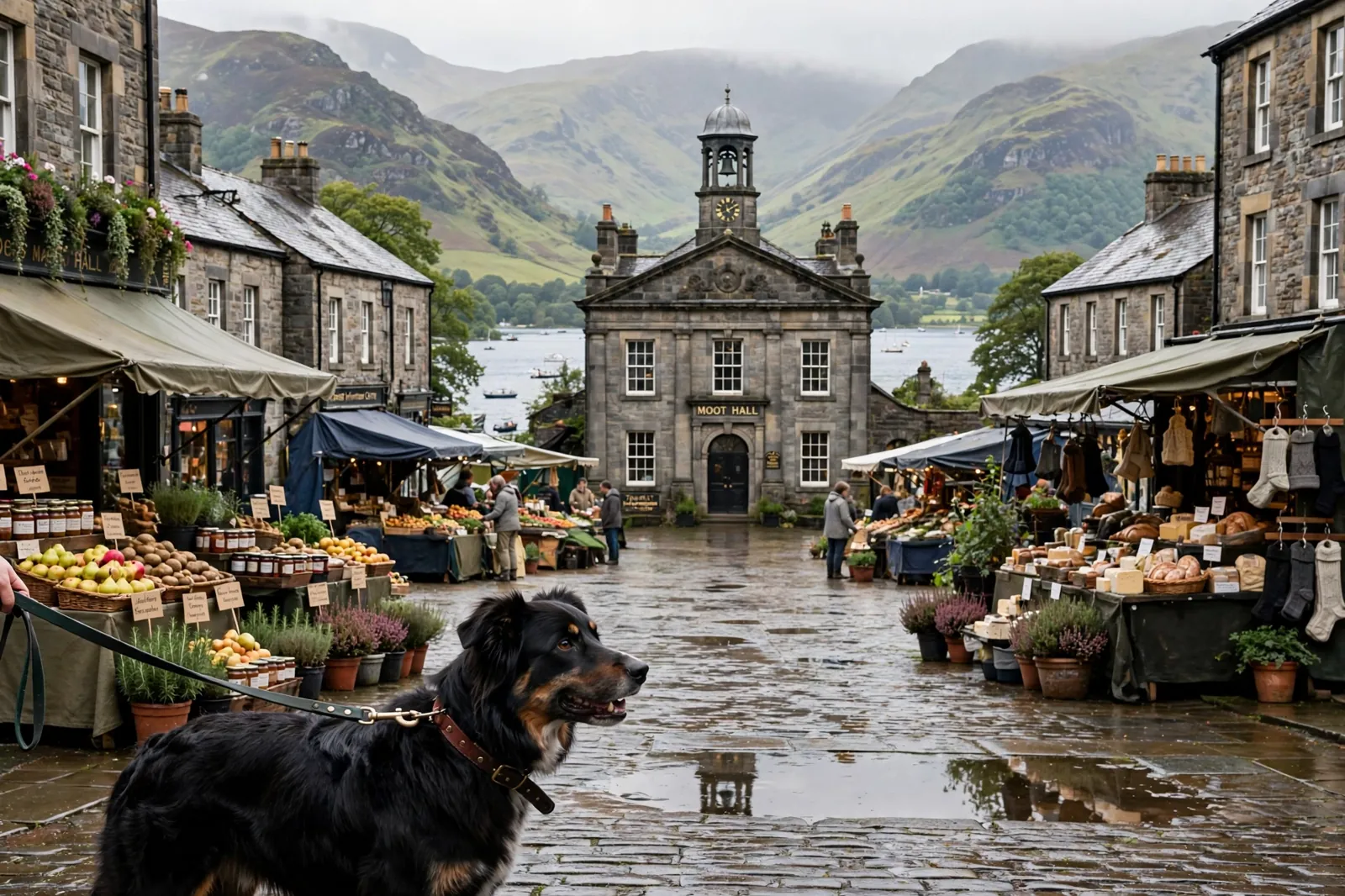
Ulverston's town centre rewards a dog that is comfortable with ordinary street life, and it is worth preparing for that life rather than assuming it. Pavements can be narrow in places, doorways open suddenly, and market-day stalls narrow the walking line. A short lead, a dog that walks close beside you, and a habit of stepping aside to let others pass will make the town far more pleasant for everyone. If your dog lunges at other dogs, bicycles or prams, choose quieter streets and quieter times, and practise passing at a distance before you arrive. A market town is a training ground, not a test, and a dog that passes calmly on a quiet street today may pass calmly on a busier street tomorrow.
Shop and cafe policies vary, so do not assume a blanket rule. Some places welcome dogs inside, some welcome dogs in an outdoor area only, and some ask dogs to wait outside. Check before you travel where you can, and always ask politely on the day rather than assuming a sign from a previous visit still applies. If a dog must wait outside, never leave it tied up alone in a busy street: a tied dog cannot move away from an approaching dog, a child or a loud noise, and it can become anxious or defensive. Instead, take turns with a companion, choose a place with outdoor seating where the dog can sit beside you, or save the shopping for a time when the dog is resting in the car in safe conditions, which itself requires care with temperature and time.
Toileting in a town needs a plan, not just bags. Carry enough bags, use bins where they are provided, and steer the dog towards grass verges, quiet corners and other appropriate spots rather than shop doorways and narrow pavements. Clean up promptly and thoroughly, including on paths and grass, because town walks depend on the goodwill of residents and businesses. If your dog is a marker, keep the lead short near doorways and displays, and move on calmly rather than allowing prolonged marking. These small courtesies are what keep towns genuinely dog-friendly, rather than merely tolerant for a season.
Settling is a skill, and a town visit is a good place to practise it. Find a bench, a low wall or a quiet cafe table, settle the dog on a mat or blanket if it uses one, and reward calm lying down rather than constant scanning. Start with a few minutes, not an hour, and build up over the visit. A dog that can settle for ten minutes in a town is a dog that can enjoy a coffee stop, a lunch break and a rest after a hill climb. A dog that cannot settle yet is not failing; it simply needs shorter stops, quieter locations and more practice. Choose the stop that suits the dog, not the stop that looks best in a photograph.
Noise-sensitive dogs deserve particular care in a market town. Church bells, market announcements, delivery lorries, children playing and other dogs barking can combine into a soundscape that is far louder than a country lane. Watch for signs of stress: lip licking, yawning when not tired, panting without heat, tucked tail, ears pinned back, or a sudden desire to pull towards home. If you see these signs, move to a quieter street, increase distance from the source, and give the dog time to recover. Do not flood a sensitive dog with the busiest street in the hope that it will get used to it; gradual exposure, with retreat always available, builds confidence far more reliably.
A practical day plan and packing list
A realistic Ulverston day with a dog might look like this: arrive, park, and take a calm town walk of twenty to thirty minutes. Pause for water and a settling break. Climb Hoad Hill slowly, with pauses, allowing an hour or more for the ascent and descent combined, depending on fitness and weather. Rest again at the bottom, check paws, and take a short, flat stroll before driving on. That is a full day for most dogs, and it leaves room for lunch, for weather changes, and for the simple pleasure of sitting in a town square with a dog that is tired in a good way. Resist the temptation to add a second hill, a long drive and another town to the same day; a dog that has done one good climb does not need a second to prove anything.
Pack for the hill, not just for the town. The list below is short, but each item earns its place. Water and a bowl are essential, because a hill climb in any season increases thirst, and there may be no convenient water source on the path. A short lead and a well-fitting harness give control without restricting movement. Poo bags, a towel and a drying coat cover the practical aftermath of mud, rain or a paddle. A first-aid basics kit, including anything your dog normally needs, is sensible for any hill walk, however short. A phone with charge, a map or offline directions, and a note of where you parked all prevent small problems from becoming stressful ones. Food and treats are useful for recall, for pauses, and for rewarding calm behaviour, but keep them in a sealed pocket so they do not attract other dogs on a shared path.
Think about the car as part of the plan, not just transport. On arrival, park in shade if the day is warm, leave the car ventilated and safe, and never leave a dog alone in a car in heat. On return, check the dog before loading: paws, coat, harness rubs, and general demeanour. A dog that is limping, shivering or unusually quiet needs attention before a long drive home. Keep a spare towel and a blanket in the car for the journey, and allow time for the dog to drink and settle before setting off. A calm car journey after a hill walk is part of the walk, not an afterthought.
Seasonal planning changes the details without changing the shape of the day. In spring, paths can be muddy and lambing season brings particular care around livestock on surrounding land; keep dogs on leads and follow any local signs, and check the official guidance before you travel during lambing. In summer, start early, carry extra water, and watch for heat. In autumn, leaves can hide uneven ground, and shorter days mean starting earlier. In winter, daylight is short, wind is cold, and paths can be icy; a torch, a warm layer and a shorter route are all wise. In every season, the town offers a fallback: if the hill is unsuitable, the town walk, a cafe stop and a gentle stroll still make a worthwhile day.
Finally, remember that Ulverston is a place to return to, not a place to exhaust in one visit. A first visit that ends with a happy, tired dog and a calm drive home is a success, even if you turned back before the monument, even if the wind kept you off the summit, even if you spent more time in the town than on the hill. The monument, the views and the streets will still be there, and a dog that enjoyed its first visit will greet the second with confidence. Plan the day around the dog in front of you, not around an itinerary, and Ulverston will reward that patience with a walk that feels like a proper Cumbrian day out: town, hill, view, and a quiet journey home.
For wider planning, our guide to Windermere with a dog helps compare a busy lakeside town with Ulverston's quieter market-town feel, and the national rules in dog-friendly beaches in the UK are worth reading before adding a coastal stop to the same trip, because seasonal beach restrictions can change a plan quickly. Check the official guidance before you travel for any beach, boat or attraction you add, so the day stays as calm as the hill walk itself.
Practical questions
Before you go
Is Hoad Hill a hard climb for a dog?
It is a short but steep climb rather than a long mountain walk. Fit adult dogs usually manage it well, while older dogs, puppies and dogs with joint problems may find the gradient demanding. Take breaks, keep the dog on a lead, and turn back early if breathing, pace or enthusiasm changes.
Do dogs have to stay on a lead on Hoad Hill?
Keep your dog on a lead for the climb and around the monument. The path is shared with other walkers, there are open slopes, and livestock may be nearby on surrounding land. A lead also gives you control in strong wind, which is common on an exposed hilltop.
What should I do if it is too windy at the top?
Do not linger on the exposed summit. Move below the skyline, shorten the lead, and use a sheltered descent route rather than the most exposed path. If gusts make walking unsteady or your dog is anxious, turning back before the monument is the right decision.
Is Ulverston town centre easy to walk with a dog?
Yes, for most dogs. The centre is compact, with a market square, cobbled and paved streets, shops and places to sit. Use a short lead in busy stretches, watch for traffic at junctions, and give a nervous dog quieter side streets rather than forcing a route through the busiest part of town.
Can I combine Ulverston with a Lake District day out?
Yes. Ulverston sits on the southern edge of the Lake District, so it pairs well with a calmer lakeshore stop afterwards. Keep the day realistic: one hill climb plus one town walk is plenty for most dogs, and a second long walk should be short, flat and optional.