This guide is independent and contains no paid placement. If affiliate links are added later, they will be clearly marked and will not change our editorial checks.
Book the sprint before you book the scenery. A whippet short trip works when you have already found an enclosed place to run, a lead plan for everywhere else, and a warmth plan for the hour after running. Everything else, the cottage, the pub, the coastal path, is decoration around those three decisions.
Plan around the chase, not the walk
Most dog-trip planning starts with distance: how far is the walk, how pretty is the route, how long will it take. Whippet planning has to start somewhere else, with a reflex. A whippet is a sighthound, bred to spot movement at a distance and to pursue it at speed, and that sequence, see, lock on, run, is wired far more deeply than any recall cue taught in a kitchen. It is not disobedience and it is not a training failure when it fires. It is the dog doing exactly what centuries of selection shaped it to do, in an environment full of rabbits, squirrels, cats, deer, joggers and low-flying pheasants that the breeder never had to account for.
This changes the shape of a short trip in a practical way. A route that is perfect for a spaniel, a two-hour ramble across open downland with stiles and long views, can be the worst possible route for a whippet, because every long view is a sight line down which a chase can start, and every stile is a place where a dog at full stretch meets an obstacle it cannot judge. The whippet owner is not looking for the longest walk or the wildest landscape. They are looking for a landscape whose risks they can read in advance: enclosed ground, short sight lines broken by hedges and walls, no livestock on the far side of a thin fence, and an exit they can reach before the dog reaches the horizon.
That is why this guide treats the chase as a planning input rather than a behaviour problem to be solved before you travel. Recall training matters enormously, and later sections give it a proper place, but no responsible guide should promise that a weekend of whistle work will make a whippet safe off the lead on open ground. Some whippets do earn that freedom, slowly, in particular places, with particular owners, and the proof is always the same: repeated recalls away from real, fast-moving distractions, in that kind of terrain, not a single good recall in a quiet field. Until that proof exists, the honest plan is containment plus a legitimate outlet, not hope plus a long walk.
There is a second, happier consequence of planning this way. Once the sprint is provided for, whippets are exceptionally easy travelling companions. They are small enough for most cars and most cottages, they settle hard after exertion, they are generally quiet and clean indoors, and they ask for far less walking time than their speed suggests. A whippet that has had three short, safe sprints in a day is often a happier holiday dog than a high-energy breed that has walked for three hours and is still looking for a job. Short trips suit them precisely because the unit of a whippet day is the burst, not the march, and a weekend gives you enough bursts to build a good rhythm without ever needing to test the dog on ground you cannot control.
Start every whippet trip, then, with three questions answered in writing before you pay for anything. First, where will this dog sprint, by name and address, not by vague hope that a beach or a common will do. Second, what is the lead plan for every stretch of ground between the car and that sprint, including the car park, the lane and the cottage garden. Third, what keeps this dog warm and dry in the hour after the sprint, when a thin-coated, low-fat body cools fastest. If you cannot answer all three for a particular destination, that destination is not yet a whippet trip. It is a nice place that happens to allow dogs, and those are very different things.
A lead system, not a single lead
A whippet needs more than a lead. It needs a system: a small set of tools, each with a job, and a rule for when each one comes out. The usual failure on a trip is not that the owner forgot a lead. It is that they brought one lead and used it for everything, so the dog was either dragged around a village on a long line, or let loose in a place where a long line was the right answer. Four items cover almost every short trip, and they pack into a small bag.
The first item is a well-fitted harness, and fit matters more for whippets than for most breeds because of the shape: a deep chest, a tucked waist and a neck that is wider than the head, which is why whippets slip collars so easily. A harness should sit behind the front legs without rubbing the armpits, and the chest strap should not ride up into the throat when the dog lunges, because a whippet lunges at speed and a throat strap turns a lunge into a choke. Try the harness on at home, walk the dog in it for a week, and check for rub marks after a run, not after a stroll. A harness is also the anchor for the long line, since a sudden stop at the end of a long line on a neck collar can injure a small, fast dog.
The second item is a standard short lead, about 1.2 to 1.5 metres, for villages, lanes, car parks and pub gardens. This is the control lead, and its job is precision: keeping the dog at your side past a cat, a child on a scooter, or a gate where livestock are visible. The third item is a long line, typically 10 metres, for beaches, commons and fields where off-lead freedom is not safe but the dog still deserves to move, sniff and stretch. A long line is not a failed off-lead walk. Used well, with the handler paying attention and reeling in before hedges and corners, it gives a whippet most of the freedom that matters, the ability to run a short arc, to investigate a scent, to choose a line, without the ability to reach the horizon. Practise with it at home first, because a tangled long line around legs and brambles is its own hazard, and gloves help when a sprinting whippet hits the end of it.
The fourth item is the recall system itself, and it deserves the same seriousness as the hardware. A whippet owner should travel with two cues, not one: an everyday recall, used dozens of times a day for ordinary returns, and a separate emergency cue, a whistle or an unusual word, that is never used casually and is always followed by something extraordinary, a jackpot of high-value food or a favourite game. The emergency cue is only as good as its history, so it has to be rehearsed at home and in safe fields until it is automatic, and it has to be protected on the trip: never blow the whistle to end something fun and then leave, never use it three times in a row while the dog is already running, and never punish a dog that does come back, however late. A recall that is punished stops being a recall.
Then there is the question of when off-lead freedom is earned, and the honest answer is that it is earned place by place, not dog by dog in general. A whippet may be entirely reliable on a familiar enclosed beach in winter and entirely unreliable on a new stretch of downland in spring when rabbits are everywhere. Keep a mental ledger, or an actual note on your phone, of the places where your dog has recalled away from a real distraction, and the places where it has not. Freedom expands one field at a time, and it contracts again without shame when the conditions change: new place, breeding season, a deer seen yesterday, a dog in season nearby. Owners who treat off-lead status as a fixed badge, earned once and kept forever, are the ones who lose dogs. Owners who treat it as a daily decision, based on the ground in front of them, almost never do.
One more tool belongs in the system, and it is free: your own positioning. On a path, walk on the side from which distractions are most likely to appear, keep the dog on the inside away from the road, and shorten the lead before a corner, a gate or a gap in a hedge, not after the dog has already seen through it. Sighthounds hunt with their eyes, so the handler who manages sight lines manages the dog. If you cannot see what is beyond the hedge, assume your dog can, and act first.
The short-trip sprint budget
Whippets do not need long runs, and that fact is the key to a good short trip. What they need is brief, intense effort, followed by genuine rest, repeated a few times a day. Think of it as a budget rather than a distance target: a small number of sprints, spent deliberately, in safe places, rather than an open-ended amount of walking that leaves the dog either under-stimulated or dangerously over-aroused.
A useful starting budget for a healthy adult whippet on a weekend away is three to five short sprint sessions a day, each lasting only a few minutes of actual running, separated by at least an hour of rest, sniffing and settling. The running itself should be in bursts: a chase of a toy, a lure, a flirt pole in a garden, or a run with a known, steady dog in an enclosed field, then a pause while the dog pants, drinks and cools down, then perhaps one more burst if the dog is still keen and the ground is still safe. Puppies, older dogs and dogs returning from injury need far less, and the right amount is whatever leaves the dog loose, happy and keen the next morning, not stiff, flat or still wired at midnight. If you are unsure about your own dog, keep the budget smaller and ask a vet, since this guide cannot judge an individual dog.
The reason for short bursts rather than one long session is partly physical and partly mental. Physically, a whippet at full stretch is a fast, light animal on thin legs, and fatigue is when injuries happen: a misjudged turn on tired legs, a hole met at speed, a collision with another dog that was avoidable five minutes earlier. Mentally, arousal builds across a session, and a dog that was controllable in the first five minutes may be a different animal in minute twenty, when every rustle in the hedge is a trigger. Ending a session while the dog still wants more is not mean. It is the skill that keeps the next session safe, and it is also what makes a whippet settle afterwards instead of pacing the cottage looking for the next chase.
Warm-up and cool-down are not optional extras for a sprinting breed. Before any sprint, give the dog five to ten minutes of walking on the lead, some gentle turns and a chance to toilet, so cold muscles are not asked to go from standing to top speed in two strides. After the sprint, walk the dog on the lead for several minutes, offer water in small amounts rather than a huge bowl gulped at once, and watch for limping, stiffness or reluctance to bear weight, which are all reasons to stop for the day. On a short trip this routine is easy to keep, because you are never far from the car or the cottage, and it is one of the quiet advantages of the short-trip format: every sprint can be a planned event with a proper beginning and end, rather than a chase that starts by accident on a long walk.
There is also a non-running part of the budget that many whippet trips miss: sniffing, chewing and problem-solving. A whippet that has only sprinted is a dog with a fired-up chase system and nowhere for the rest of its brain to go. A scatter of kibble in grass, a chew back at the cottage, a short training game, or a slow sniff-walk on a long line all help the dog come down from arousal and settle. Owners sometimes report that their whippet is harder to live with on holiday than at home, and often the cause is not too little running but too little decompression around the running. Budget for both halves of the day: the sprint, and the long, boring, sniffy aftermath.
Where a whippet can safely sprint
The gold standard for a whippet sprint is a fully enclosed field with a fence you have personally walked before letting the dog off. Hired secure dog fields, now available in most parts of the UK, are the simplest way to buy this certainty on a trip: a fenced area, booked for a fixed slot, with no unknown dogs, no livestock and no road beyond the fence. Book before you travel, especially at weekends, and treat the listing with healthy scepticism until you arrive: check the fence height in the photographs, ask whether the gate latches securely, whether there are gaps underneath, and whether the field is genuinely enclosed on all sides or merely fenced on three. Whippets jump well and squeeze through gaps that would stop a heavier dog, so a fence that looks adequate for a labrador may not be adequate for a whippet, and a five-minute walk of the boundary before the first sprint is never wasted time.
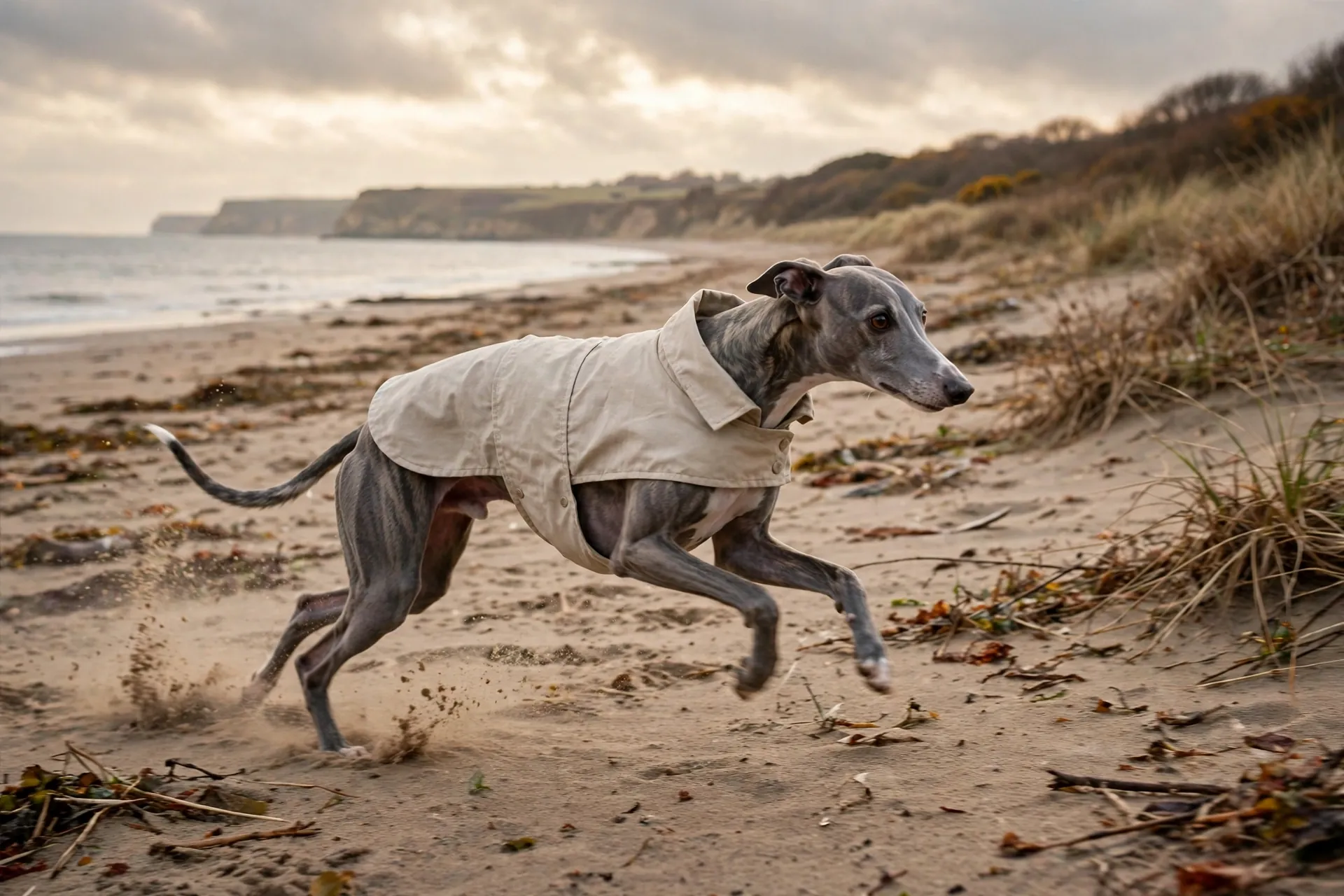
Beaches are the second classic whippet sprint ground, and they need a decision, not an assumption. Many UK beaches restrict dogs during summer months, often from around Easter to the end of September, and the rules are set locally, so two beaches in the same county can differ completely. Even where dogs are allowed, a beach is only a good whippet sprint ground if you can see the whole stretch ahead, if there are no cliffs or rock groynes the dog can be trapped against, if the tide state leaves a clear escape route, and if there are no nesting birds or seal colonies in season. A wide, flat, winter beach with firm sand and a long, clear view is close to ideal. A narrow beach backed by a promenade, with dogs, children, kites and fishing lines all sharing the same strip, is not a sprint ground at all, whatever the sign says. Our guide to UK beach rules, bans and fines explains how to check a specific beach, and the advice there matters doubly for whippets: check the official guidance before you travel, and recheck on arrival, because seasonal orders change and signs on the ground override anything you read online.
Parks and commons sit in the middle. A fenced urban dog area can be a useful sprint spot if it is large enough for a real run, if the surface is grass rather than churned mud, and if the other dogs in it are known quantities rather than a rotating crowd. A large, unenclosed common is a different proposition: it may be lawful to let a dog off the lead there, and it may still be unwise for a whippet with an unproven recall, because the ground is full of squirrels, joggers and other dogs, and the sight lines run for hundreds of metres. The test is not whether dogs are allowed off the lead. It is whether you can get your dog back before it reaches something it should not chase, and on most commons the honest answer is no.
Woodland and farmland need the most caution of all, because the hazards are not just the chase itself but what the chase runs into. Livestock, ground-nesting birds, deer and horses all appear in British woods and fields, and a whippet chasing through a wood can cross a road, a fence line or a farmyard in seconds. Dogs near livestock are also a legal matter as well as a safety matter: farmers have powers in some circumstances when dogs worry livestock, and the consequences can be severe for the dog, so this is one area where a lead is not a conservative choice but the only responsible one. If you are walking through farmland, keep the dog on a short lead, keep to marked paths, and keep the sprint for the enclosed field you booked. The woodland walk is for sniffing on a long line, not for testing recall.
Finally, consider the garden and the cottage itself. Many whippet trips are improved by choosing accommodation with a genuinely enclosed garden, and by checking the enclosure on arrival rather than trusting the listing: gate latches, gaps under fences, low walls a whippet can clear, and neighbours cats on the other side. A garden sprint with a toy, a flirt pole or a lure game can be the first sprint of the day before you even leave the property, and it sets the tone for everything that follows. If the garden is not secure, do not improvise with a long line tied to a tree, which creates a strangulation and entanglement risk. Use the hired field instead, and treat the garden as a toilet and sniffing space only.
The car-to-field routine
Short trips mean frequent car journeys, and the car-to-field routine is where many whippet trips quietly go wrong. The pattern is familiar: a long drive, a dog that has been still for two hours, a car park next to an exciting field, a door opened, and a dog exploding out at full speed before anyone has checked the gate, the fence or the other dogs. Everything in this routine exists to break that sequence into boring, controllable steps.
Start with the car itself. A whippet should travel restrained, either in a crash-tested harness or in a crate secured in the boot, because an unrestrained dog in a collision becomes a projectile, and a dog loose in the footwell is a distraction on every journey. This is not whippet-specific advice, but it matters more for a breed that is small enough to slip through a gap and fast enough to bolt from an opened door. Our guide to dog car safety compares harnesses and crates in detail. Whichever you choose, practise it before the trip, keep the boot or back seat familiar with the dog usual bed or blanket, and never open the car door in a car park until the lead is already attached and you have a hand on it. The rule is simple: lead on before door open, every time, without exception.
On arrival, do not go straight to the sprint. Give the dog a toilet break on the lead, a drink, and a few minutes of walking to shake off the journey. Then walk the boundary of the field or beach yourself, checking gates, gaps, holes, broken glass, discarded fishing line, barbed wire and anything the dog could eat or be cut on. Only then, with the dog still on the lead, walk into the middle of the space and release from a standing start, not from a run, so the first sprint is controlled rather than frantic. If other dogs are present, watch the first greetings on the lead before any off-lead play, and be ready to leave if the mix is wrong: a whippet playing chase with a much heavier dog, or with a dog that body-slams, is a vet visit waiting for a reason.
The return journey needs the same care in reverse. After the last sprint, walk the dog on the lead, offer water, towel off mud and sand, and check paws and legs before the dog gets back into the car. Put the coat on before the car, not after, because a wet whippet in a draughty boot cools fast on the drive home. If the dog is still highly aroused, give it a few minutes of sniffing or a chew in the car park rather than loading a wired dog straight into a small space, where arousal turns into barking, panting and carsickness. The routine sounds fussy written down. In practice it takes ten minutes, and it is the difference between a trip that feels controlled and one that feels like a series of near misses.
One more car habit is worth building: never leave a whippet in a parked car in warm weather, and be cautious even on cool, sunny days, because a car heats up far faster than people expect. On a short trip this is usually easy to avoid, because the dog is the point of the trip, but it becomes a trap when a plan changes, a pub turns out not to accept dogs, or a shop visit stretches. Always have a plan B for the dog before you set off, a shaded alternative, a dog-friendly stop, or a decision to skip the visit, rather than discovering the problem in a car park with a dog already in the car.
Warmth as a system, not a coat
Whippets feel the cold in a way that surprises owners of thicker-coated breeds, and the reason is structural. A whippet carries a short, fine, single coat with very little undercoat, and a lean body with little insulating fat, which is the same build that makes the speed possible. In still, mild weather that build is no problem at all. In wind, rain and cold, especially after exercise when the body is wet and cooling, heat loss is fast, and shivering is the visible sign of a dog spending energy just to stay warm. Warmth on a whippet trip is therefore a system that runs through the whole day, not a single coat bought once and forgotten.
The system starts before the sprint. A whippet that begins a run cold, straight out of a car on a frosty morning, is more likely to pull a muscle and more likely to chill afterwards, so build a warm-up walk into the routine and consider a light coat for the walk to the field if the wind is biting. During the sprint itself, the dog will usually be warm enough without a coat, and a coat that restricts the shoulders or flaps loose can be a hazard at speed, so most owners run the dog without one and keep the coat ready at the edge of the field. The critical window is the ten to thirty minutes after the sprint stops, when the dog goes from generating heat to losing it, and that is when the coat goes on, the towel comes out, and the dog moves out of the wind.
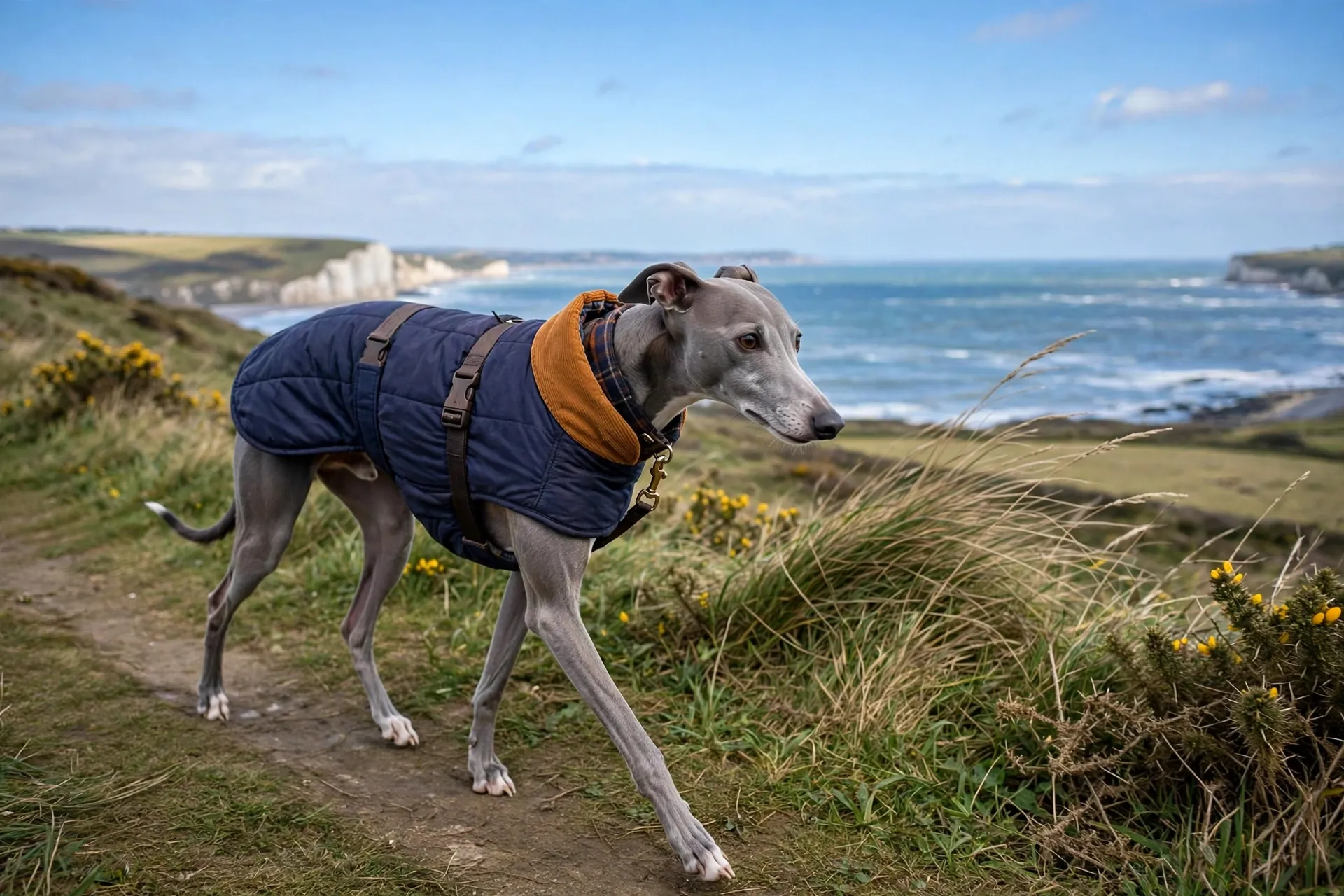
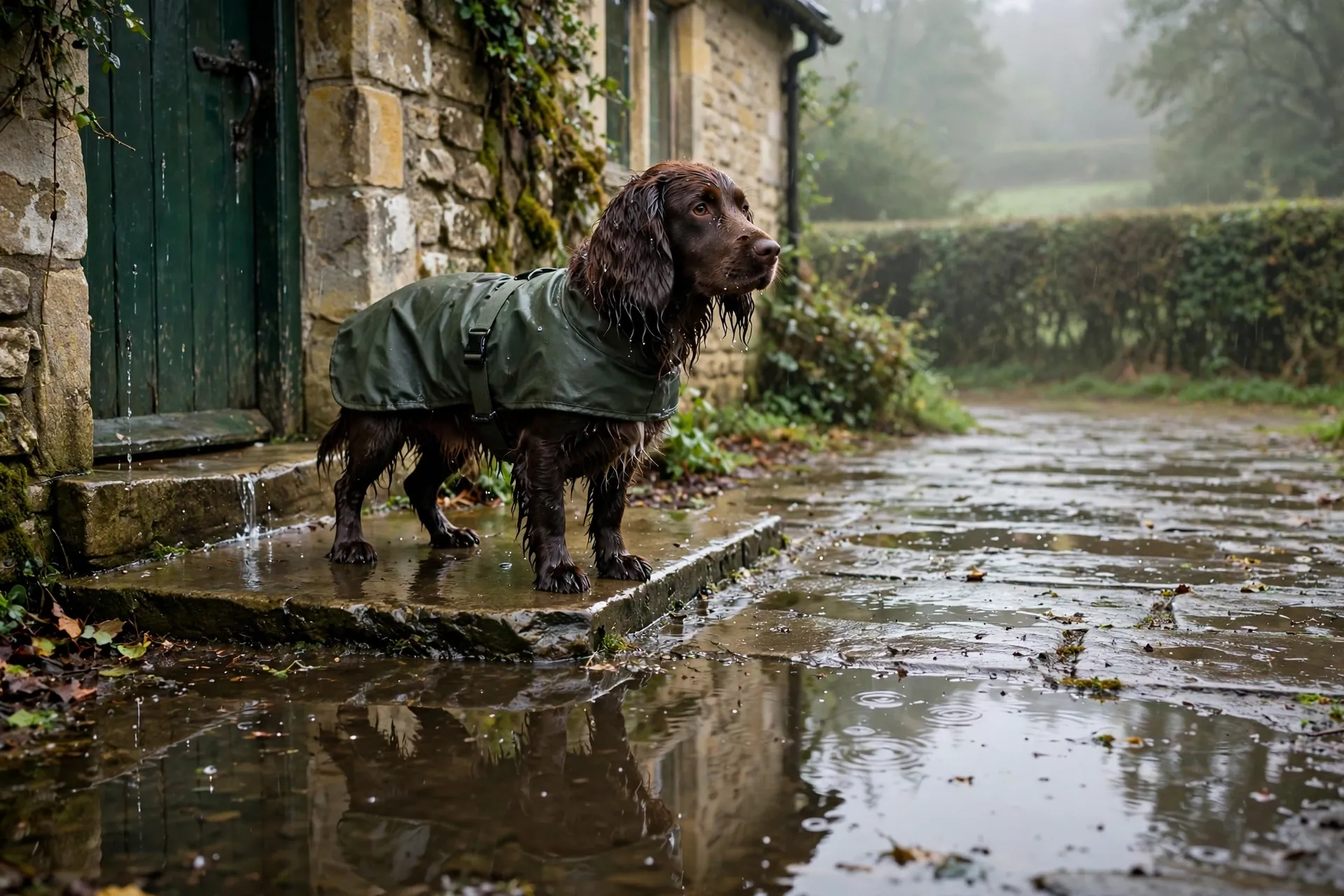
What coats, then, for a weekend? Three layers cover almost every UK trip. The first is a light waterproof, for drizzle, wind and the walk to the pub: it should cover the chest and belly, fasten securely, and not ride up over the shoulders when the dog moves. The second is a fleece or insulated coat, for cold, still conditions and for evenings in a draughty cottage: this is the coat that does the real warming work, and it should fit snugly without compressing the chest. The third is a drying coat or a proper towel system for afterwards, because a wet whippet in a fleece is a wet whippet, and drying first makes every other layer work better. Our guide to dog drying coats explains fabrics, belly coverage and measuring in detail, and the measuring advice matters for whippets: measure the back length, the chest and the neck, and check the fit on a moving dog, not a standing one.
Beyond coats, the warmth system includes the places the dog rests. A whippet on a cold floor, a draughty hallway or a damp car boot will lose heat through its belly even in a good coat, so travel with a raised or insulated bed, a blanket that smells of home, and a draught-free corner in the cottage. In the car, a blanket over the crate or a windbreak around the boot helps, and on a cold night, an extra blanket over the bed is worth more than a heavier coat the dog has to wear all night. If the cottage is cold, ask about heating before you book rather than discovering a single storage heater on arrival, and keep the dog usual sleeping arrangement as close to home as possible, because a dog that sleeps badly is a dog that chills badly.
Watch the dog, not the thermometer. Shivering, tucking the tail tightly, lifting paws off cold ground, seeking shelter or pressing against you are all signals to warm up, dry off and go inside, and they override any plan to stay out for another half hour. Older whippets, puppies, lean dogs and dogs that have recently been ill chill faster, and a dog that has been swimming or wading needs the full drying routine even on a mild day. Conversely, do not overheat a whippet in a heavy coat on a warm day or in a centrally heated cottage: panting, restlessness and seeking a cool floor are signals to take a layer off. The system works when it follows the dog in front of you, adjusting layer by layer through the day, rather than following a fixed rule about the season.
Thin skin, fast legs, small injuries
The same build that makes a whippet fast also makes it fragile in specific, predictable ways, and a short trip is the right length to plan for them without becoming anxious. Whippet skin is thin and tears more easily than the skin of a heavier-coated breed, so barbed wire, bramble, broken glass, sharp flints on a beach and the edge of a metal fence are all more likely to produce a cut, and the legs, with little protective muscle and coat, take the brunt of it. Most of these injuries are small, and most are manageable on a trip if you have a kit and a plan, but they are also the reason a sprint ground should be walked before use, and why a whippet should not be sprinted through dense bramble or over rough, unknown ground.
The trip first-aid kit for a whippet is small and specific: a few sterile gauze pads, a conforming bandage and tape, a small pair of blunt-ended scissors, tick removers, a saline wash or clean water for flushing a wound, and the phone number of a vet near your destination saved before you leave. Add any regular medication the dog takes, with a spare day supply in case the trip extends, and a muzzle or a way to keep the dog still if a painful injury needs handling, since even a gentle dog may snap when hurt. If you are travelling with a dog that is prone to a particular problem, such as corns on the feet or a recurring skin issue, pack for that problem specifically and ask your own vet before the trip what to do if it flares, because a weekend vet in an unfamiliar town will be working without the dog history.
Know the simple decision rule for cuts and limps. A small, clean cut that stops bleeding with gentle pressure, where the dog is bearing weight and behaving normally, can usually be cleaned, covered and watched, with a vet check if it deepens, reddens, swells or does not improve. A cut that keeps bleeding, a deep wound, a wound over a joint or tendon, a dog that will not bear weight, a swollen leg, or any injury after a road incident needs veterinary attention promptly, not the next morning. The same applies to limping that does not ease after rest, to a dog that is suddenly lethargic or off food, and to any suspected ingestion of something toxic on a walk, where the right move is to call a vet and describe what happened rather than to guess at a home remedy. Write the emergency vet number on paper as well as on your phone, because phones run out of battery at exactly the wrong moment.
Paws deserve a separate check on every whippet trip, because the feet do the work and show the damage first. After each sprint, look between the toes for sand, grit, thorns and ice in winter, check the pads for cuts and for wear on rough surfaces, and watch for a dog that starts to shorten its stride or lick a foot repeatedly. Sand between the toes after a beach sprint, salt on winter roads, and mud packed hard between pads are all small problems that become lameness if left, and a quick rinse and towel after each outing prevents most of them. If your whippet regularly gets sore feet on rough ground, talk to your vet about whether a protective wax or boots are appropriate, and practise with boots at home first, since a dog that has never worn boots will spend a whole walk trying to remove them.
One more fragility is worth naming, because it affects trip choices: whippets are sensitive to cold and to anaesthesia in ways that vets understand well, and they can be more affected by some routine medications than heavier breeds. That is a conversation for your own vet, not a reason to avoid trips, but it is a reason to keep the dog veterinary records accessible on a trip, to tell any unfamiliar vet that the dog is a whippet and what its normal weight and condition are, and to avoid improvising with leftover medication from another dog. A short trip with a small, well-packed kit and a saved vet number is a calm trip. A trip that discovers all of this in an emergency is not.
Settling after the sprint
The second half of a whippet day is the part that makes the trip enjoyable for everyone else, and it is where whippets quietly excel, provided the sprint has happened and the cool-down has been done. A whippet that has run, dried, warmed and eaten will usually fold itself onto the softest available surface and stay there, which makes pubs, cafes and cottages far easier than they are with a dog that is still full of unspent energy. The skill is in protecting that settled state rather than accidentally undoing it.
In a pub or cafe, choose the table, not just the venue. A corner table away from the door, with the dog bed or blanket on the floor beside you and a wall on one side, gives a whippet a den rather than a thoroughfare to guard. Arrive with the dog already exercised and already toileted, keep the lead short and under your foot or hand, and give the dog something to do for the first ten minutes, a chew or a stuffed toy, while it learns that this new room is a resting place. If the dog is restless, it is usually telling you something: it needs the toilet, it is cold, it is over-tired rather than under-exercised, or the room is too busy. A short walk outside and a return to the table solves most of these, and leaving early with a settled dog is a better trip than staying late with a stressed one.
In the cottage, settling is mostly about familiarity. Keep feeding times, bed position and the last-outing routine as close to home as you can, put the dog bed where the dog can see you but is out of the draught and away from the door, and resist the temptation to fill the evening with novelty, visitors, fireworks and late walks all at once. Whippets are sensitive to household noise and to changes in routine, and a dog that has coped brilliantly with a new beach all day can still be unsettled by a noisy evening in a strange house. A quiet evening, a chew, and a familiar blanket are not boring. They are the recovery that makes tomorrow sprint possible.
Other dogs and other people need a settling plan too. A whippet that greets every new dog with a full-speed chase invitation is not being rude, but it can be overwhelming for a small, old or nervous dog, so keep greetings on the lead, short and controlled, and let the whippet meet a new dog on a walk rather than in a confined space. With children, the same principle applies: a whippet is a gentle breed, but a fast, thin dog and a small child running in opposite directions is a collision risk, so supervise, keep the dog on a lead until the child has calmed down, and give the dog an escape route to its bed. None of this is about distrusting the breed. It is about recognising that speed plus excitement plus a small space is the combination that causes accidents, and removing one element of that combination keeps everyone safe.
Finally, protect the night. A whippet that has had a good day will sleep deeply, but a cold room, a hard floor, a late toilet trip missed, or a dog left alone in a strange house can turn a good day into a restless night. Do a final toilet trip on the lead, put the bed in the warmest, quietest corner, and keep the dog routine the same as at home for the first night especially. If the dog is not used to sleeping alone, do not start that experiment on a trip: sleep in the same room, or accept that the trip is not the place to change the sleeping arrangement. A well-slept whippet is a well-behaved whippet the next morning, and a well-slept owner is a better handler for the next sprint.
When the chase happens anyway
Every whippet owner should have a plan for the day the system fails, because even careful owners lose a dog to a chase occasionally, and the plan made calmly at home is worth far more than any plan improvised while watching a small dog disappear over a hill. The plan has four parts: what you do in the first minute, what you do in the first hour, what you do if the dog does not come back, and what you change afterwards.
In the first minute, do not chase the dog. A human cannot outrun a whippet, and a human running after a whippet looks like part of the chase, which keeps the dog running. Instead, use the emergency cue once, loudly and clearly, then stop, crouch if it is safe, and make yourself interesting: call the dog name, show food, make the sound the dog associates with home. If the dog is still in sight and moving away, note the exact direction, the last landmark, and the time, because that information is what you will need in the next hour. If the dog is heading for a road, shout, wave, and do whatever you can to make drivers aware, but do not run into the road yourself. Your safety matters too, and a second casualty helps no one.
In the first hour, work systematically. Return to the place where the dog was last seen, because lost dogs often circle back to the last known point, especially if that is where the car or the scent of the owner is. Leave an item of your clothing and the dog bed there if you can, and wait quietly for a period rather than walking miles in ever-widening circles, which spreads your scent and confuses the search. Tell other walkers, the landowner, the nearest houses and any dog walkers in the area, with a clear description, the dog colour and markings, the collar or harness colour, and your phone number. If the dog wears a tracker, use it now, and if it does not, consider whether a tracker is worth adding before the next trip: our guide to dog GPS trackers explains coverage, battery and fit, and for a sighthound the tracker is less about convenience than about recovering a dog that can cover miles in minutes.
If the dog does not come back within an hour, widen the response properly. Contact local vets, dog wardens, rescue centres and the microchip database to make sure your contact details are current, and post in local lost-dog groups with a photograph, the exact location, the time lost, and the direction of travel. Check the microchip registration before every trip, not after a loss, because a chip with an old phone number is no help at all, and make sure the dog wears an ID tag with a current mobile number on every outing, as required by law in most circumstances. Keep searching at dawn and dusk, when a lost dog is more likely to move, and keep checking back at the loss point, the car park and your accommodation, because whippets have been known to return to a car or a cottage hours later on their own.
Afterwards, and this part is often skipped, change something. A chase that happened once will happen again in the same kind of place unless the plan changes, so write down what went wrong: the sight line you missed, the gate you trusted, the recall you used too late, the long line you left in the car. Then change one concrete thing for the next trip, a different field, a shorter line, a stricter rule about that kind of ground, and keep the change. This is not about blame. It is about the fact that whippet ownership is a long series of small adjustments, and the owners who lose dogs repeatedly are usually the ones who treat each chase as bad luck rather than information. Treat it as information, and the next trip gets safer.
One last point on this subject: never punish a dog that comes back, however long it took, however muddy or exhausted it is. A dog that is shouted at for returning learns that returning is dangerous, and the next chase lasts longer. Greet the returning dog warmly, put the lead on calmly, check for injuries, offer water, and save the analysis for later, when the dog is safe and asleep. The recall is the most valuable behaviour a whippet owner owns, and it is protected by what happens in the seconds after the dog returns.
A short-trip calendar through the year
Whippet trips change with the seasons, and a short trip is the perfect format for playing those changes to your advantage, because you can choose the month for the dog rather than forcing the dog to fit a fixed holiday date. Each season has a different sprint ground, a different warmth problem and a different hazard, and the calendar below is a way to think about them rather than a set of fixed rules.
Spring is the season of maximum temptation and maximum caution. Rabbits and young wildlife are everywhere, daylight is lengthening, and a whippet that has been quiet all winter suddenly has a landscape full of movement. This is the season to be strictest about enclosed sprint grounds and to keep the long line as the default on open ground, even for a dog that was reliable in winter. It is also the season when ground-nesting birds are most vulnerable, so keep to paths, keep the dog on a lead near moorland and heathland, and check the official guidance before you travel if you are heading to a sensitive area, since local restrictions vary. Spring warmth is deceptive: a sunny day with a cold wind still chills a wet whippet fast, so pack the fleece even when the forecast looks kind.
Summer is the season when beaches and commons are busiest and most restricted. Many beaches ban dogs during the day in summer, parks are full of picnics and other dogs, and heat becomes a real limit on sprinting: a whippet should not be sprinted in the heat of the day, on hot sand or hot tarmac, or without shade and water nearby. Plan sprints for early morning or late evening, choose shaded woodland edges for sniff walks on a long line, and keep the car cool and ventilated. Summer is also the season for ticks, adders and blue-green algae in still water, so check the dog after walks, keep it out of suspicious water, and know the signs that need a vet. A summer whippet trip that works is often a short one, a morning sprint, a lazy afternoon in the shade, and an evening walk, rather than a full day outdoors.
Autumn is, for many whippet owners, the best season of all. Summer beach bans lift, commons empty, the light softens, and the ground is still firm enough for a good sprint before winter mud sets in. This is the season to book the coastal trip, to use the wide winter beaches, and to enjoy the long, sniffy walks that whippets love when the air is cool. The warmth system still matters, because autumn wind and rain chill a thin-coated dog quickly, and the first cold snap is the moment to bring out the insulated coat. Autumn is also the season for fallen fruit, mushrooms and conkers, which some dogs eat, so keep an eye on scavenging on woodland walks and know which common hazards need a vet call.
Winter is the season of short days, cold ground and quiet places, and it suits whippets surprisingly well if the warmth system is taken seriously. Enclosed fields are quieter and easier to book, beaches are empty, and a whippet that has had a morning sprint will happily spend a winter afternoon asleep by a fire. The hazards are cold, wet, ice and darkness: a whippet sprinting on icy ground can slip and injure a leg, so check the surface, keep sprints shorter on frozen ground, and use a lead on icy paths. Darkness matters too, because a whippet off the lead at dusk is a whippet you cannot see, so use a light on the harness or collar, keep the dog close, and finish the last outing before dark. Winter trips also need a warm cottage, not just a dog-friendly one, so ask about heating and draughts before you book.
Across all seasons, two habits keep the calendar honest. First, check the specific place, not the season in general: a beach that is dog-friendly in October in one county may still be restricted in another, and a common that is safe in February may be full of livestock in May. Second, let the dog set the pace on the day: a whippet that is stiff, flat or reluctant is telling you to shorten the trip, whatever the calendar says, and a whippet that is keen, loose and happy is telling you the plan is working. The calendar is a guide. The dog in front of you is the decision.
The short-trip packing list
A whippet short trip packs light, and that is part of the appeal, but the list below is worth running through before every departure, because the items that matter most for this breed are the ones most easily forgotten: the long line, the spare coat, the vet number, the emergency cue practised at home. Pack the night before, check the list at the door, and keep the dog bag by the car so nothing is left behind in a rush.
- Lead system: a fitted harness, a short lead, a 10-metre long line, and gloves for handling the line when a sprinting dog reaches the end of it.
- Recall kit: a whistle or emergency cue aid, high-value treats in a sealed pouch, and a favourite toy for rewarding a return in a distracting place.
- Warmth system: a light waterproof coat, a fleece or insulated coat, a drying coat or towels, and a spare blanket for the bed and the car.
- Car kit: a crash-tested harness or secured crate, a familiar bed or blanket, a water bowl and bottle, and a towel for muddy paws before the dog gets back in.
- First aid: sterile gauze, a conforming bandage and tape, blunt-ended scissors, tick removers, saline wash, regular medication with a spare day supply, and the emergency vet number for your destination written on paper.
- Identification: an ID tag with a current mobile number, a microchip registration checked before departure, and a recent photograph of the dog on your phone.
- Food and settling: the dog usual food measured for the trip plus a spare meal, a chew or stuffed toy for settling in a pub or cottage, and the dog bed or blanket from home.
- Field kit: a ball or lure toy for enclosed-field sprints, a poo bag supply, a small torch or harness light for winter evenings, and a spare lead in case one breaks.
- Paperwork: the booking confirmation for any hired secure field, the cottage pet rules, and the local beach or common rules you checked before travelling.
With that list packed, the trip itself can be simple. Choose a place with a sprint ground you have already found, travel with a lead plan for everything between the car and that ground, and keep the dog warm, dry and settled in the hours around the running. That is the whole whippet formula, and it is why short trips suit this breed so well: a weekend gives you enough sprints to build a rhythm, enough rest to recover, and no need to test the dog on ground you cannot control. Book the sprint first, keep the lead system ready, watch the dog for cold and fatigue, and let the rest of the trip, the coast, the pub, the quiet cottage evening, arrange itself around a dog that has run well and settled well. A whippet that has done both is the easiest travelling companion in Britain, and the reason is not that the breed is low-maintenance. It is that its needs are specific, small and completely manageable, once you plan for the chase instead of hoping it will not happen. For a related sighthound perspective, our greyhound holiday guide covers the retired-racer side of sighthound life, while this guide stays with the short-trip, chase-first planning that whippets need most.
Practical questions
Before you go
Can a whippet ever be let off the lead in an unenclosed area?
Only where it is lawful, where you can see the full ground ahead, and where your whippet has repeatedly recalled away from fast-moving distractions in that kind of place. For most owners on most trips, the honest answer is to use an enclosed field or a long line instead. A whippet that has recalled perfectly in a garden has not yet proved anything about a rabbit breaking cover on open downland.
What is the safest way to give a whippet a sprint on a short trip?
Book or find a fully enclosed space with a fence you have walked first, warm the dog up with a few minutes on the lead, then allow short bursts with rest breaks rather than one long chase. Check the surface for holes, glass and wire, keep sessions short, and end while the dog still wants more. A hired secure field is the simplest version of this on a weekend away.
How many coats does a whippet need for a UK weekend away?
Three layers cover almost every UK weekend: a light waterproof for drizzle and wind, a fleece or insulated coat for cold and still conditions, and a drying coat or towel system for afterwards. Add a spare if the first coat gets soaked, because a wet whippet loses heat fast. Fit matters more than brand: the coat must cover the chest and belly without restricting the shoulders or the run.
Why does my whippet shiver after running, and when should I worry?
Shivering after a sprint is often the body cooling quickly once the work stops, especially in wind or after rain, and it usually settles once the dog is dried, coated and out of the draught. Worry, and seek veterinary advice promptly, if shivering comes with lethargy, vomiting, collapse, pale gums, a limp that does not ease, or a cut that keeps bleeding. Do not wait out symptoms that are getting worse.
What should I do if my whippet chases livestock or a deer?
Stop the chase as soon as you can with a recall or an emergency cue, then put the dog back on the lead, check for injuries, and leave the area calmly. Do not chase after the dog through livestock or across roads yourself. Report any injured animal to the landowner if you can, and check the official guidance before you travel so you know the local rules on dogs near livestock, since they vary by place and season.
Does a whippet need a muzzle on walks?
Whippets are not a breed that the law requires to be muzzled in public in the UK, and most whippets never need one. A muzzle can still be a sensible tool for a particular dog, for example one that scavenges dangerously or that cannot yet be trusted near small animals on a lead, provided it is fitted well and introduced gradually at home first. It should never be used as a substitute for a lead or for training.