This guide is independent and contains no paid placement. If affiliate links are added later, they will be clearly marked and will not change our editorial checks.
Keep the drives short, the walks long and the bases few. The Borders works best as a string of market towns along the Tweed and its tributaries, with a riverside walk in the morning, a town stop at midday and a second short walk before dark.
Why the Borders rewards a slow trip
The Scottish Borders is easy to overlook precisely because it sits between two louder destinations. Travellers heading north often push on to Edinburgh, while travellers heading south aim for the Lake District, and the country in between becomes a corridor rather than a destination. For a dog, that is good news. The region is full of working market towns, wide river valleys and long, level riverside paths, and it rarely demands the kind of all-day driving that turns a holiday into a endurance test for an animal in the back seat. A slow Borders road trip is not a compromise version of a bigger tour. It is a different kind of trip altogether, one where the distance between stops matters less than what happens at each stop.
The character of the Borders comes from its rivers and its history, and the two are closely linked. The River Tweed runs through the heart of the region, joined by tributaries such as the Ettrick, the Teviot and the Leader, and the towns that grew beside those rivers still feel like working places rather than stage sets. Peebles, Melrose, Galashiels, Selkirk, Hawick, Kelso and Jedburgh each have a high street, a market tradition, local shops and places to eat, and each sits within easy reach of water. That matters for dog owners because it means practical things are close at hand: a vet, a shop, a cafe with an outdoor area, a riverside path that starts near the car park rather than after a long drive up a single-track road. The towns are also close together by British standards, so a day that includes two towns and two walks does not require a heroic amount of driving.
History gives the route its thread. The great Borders abbeys at Melrose, Dryburgh, Jedburgh and Kelso are the remains of medieval foundations that shaped the valleys around them, and the ruined towers, town museums and old bridges that follow are reminders of centuries when this was a contested frontier. For a road trip, a heritage thread is useful because it gives each day a reason to stop that is not just scenery. You can walk a riverside path in the morning, look around an abbey town at midday and finish with a short drive to the next valley, and the day feels complete without covering much ground. The point is not to tick off every abbey in a single rush. It is to use one or two historic places as anchors, and to let the walks and the towns do the rest of the work.
A slow pace also suits dogs better than a packed itinerary. Many dogs cope well with a car journey of thirty to forty-five minutes, especially when it ends with a proper walk, but they cope less well with repeated two-hour legs, multiple unfamiliar car parks and a new accommodation every night. Short hops reduce car sickness, restlessness and toilet anxiety, and they leave time for the unglamorous routines that keep a dog settled: a morning toilet walk before breakfast, a sniff-heavy walk rather than a forced march, a quiet evening in familiar accommodation. Older dogs, puppies, anxious dogs and dogs that struggle with steps all benefit from fewer moves and more repetition. If your dog settles better on the second night in a place than on the first, plan for two-night stays and day trips from a base rather than a different bed every night.
Finally, the Borders rewards travellers who are willing to use quiet lanes instead of main roads. The main routes through the region are perfectly usable, but the smaller roads that follow rivers, cross old stone bridges and thread between fields are often calmer, slower and more interesting. They also make stopping easier: a layby beside a river, a village green, a short footpath to a bridge. This guide therefore treats the car as a way to move between valleys, not as the main event. Drive a little, walk a lot, stop often, and let the towns and rivers set the rhythm.
The route at a glance
Think of this route as a loose eastward drift along the Tweed valley, with detours south into the Teviot valley and north towards the moorland edges when you want a change of landscape. A comfortable version takes three to five days. Day one centres on Peebles and the upper Tweed. Day two moves through Galashiels and Selkirk towards Melrose and the central abbey towns. Days three and four explore Kelso and Jedburgh in the east, with a return through the Teviot valley if time allows. You do not need to follow that order rigidly. Starting in the east and travelling west works just as well, and travellers coming from Edinburgh may find it easier to begin at Peebles or Melrose, while travellers coming from the south may prefer to start at Jedburgh or Kelso and work westwards.
The mileage is deliberately low. Most legs in this guide are well under an hour, and many are closer to twenty or thirty minutes. That leaves room for the parts of a dog trip that take longer than a map suggests: finding a car park, walking the dog before a town visit, waiting for a shower to pass, letting a dog sniff a particularly interesting hedge. Build a buffer into every day rather than filling it with a third town or a fourth walk. If a morning walk runs long because the dog is enjoying the river, that is the trip working, not the trip falling behind. A route that still feels relaxed when you drop one stop is a good route. A route that collapses if you drop one stop was too full to begin with.
Use two bases if you can. One base in the west, around Peebles or Melrose, and one in the east, around Kelso or Jedburgh, keeps most day trips short and avoids repeating the same stretch of road. Single-base trips are also workable, especially for a long weekend focused on one valley, but they do mean longer return drives at the end of the day. Whichever pattern you choose, pick accommodation with a practical dog routine in mind: a ground-floor room or a cottage with a garden gate that actually closes, a short walk to a toilet area for last thing at night, and parking close enough that unloading a tired dog is not a trek in itself. For wider context on walking in the region, see our guide to Scottish Borders dog walks, which covers abbeys, rivers and border towns in more detail.
The table below is a planning sketch, not a timetable. Distances and driving times vary with roadworks, weather and the season, so check the official guidance before you travel and treat every leg as an estimate to be confirmed on the day.
- Peebles to Galashiels: a short valley drive along the Tweed, with Selkirk as a possible detour for a town walk and a riverside stop.
- Galashiels to Melrose: a very short hop, ideal for a day that pairs a town walk with an abbey town and a riverside path.
- Melrose to Kelso: an eastward valley drive, with the Tweed and its tributaries never far away and several villages worth a brief stop.
- Kelso to Jedburgh: a short southern leg into the Teviot valley, with moorland edges and market-town streets as a contrast to the Tweed.
- Jedburgh back west: a longer return through Hawick or Selkirk, best split with a walk and a lunch stop rather than driven in one stretch.
None of these legs needs to be driven quickly. If a lane looks narrow, slow down and wait for a passing place rather than pressing on. If a village has a green or a riverside path, stop. The Borders is a region where the short cut is often the main road, and the long way round is the better day out.
Peebles and the upper Tweed
Peebles is a natural opening act for a slow Borders tour. It is a handsome market town on the Tweed, with a high street that rewards an unhurried wander, independent shops, cafes and places to eat, and riverside paths that start close to the town centre. For a dog, Peebles works because the town walk and the river walk are not separate expeditions. You can park, walk the high street, drop down to the river, follow a level path for a while and return to the car without ever needing a second journey. That simplicity matters on the first day of a trip, when the dog is still learning the new routine and the humans are still learning where everything is.
Start with the river rather than the shops if the dog has just come out of the car. A riverside walk lets the dog toilet, stretch and sniff, and it gives you a sense of the valley before you decide how far to go. The upper Tweed around Peebles is broad and green, with bridges, riverside trees and open stretches where the valley widens. Keep the dog on a lead near roads, bridges and other walkers, and be ready for livestock on farmland paths, cyclists on shared routes and anglers on the banks. A long line can be useful on wider, quieter stretches if local rules allow it, but a short lead is the safer default where the path narrows or passes through a town. Check the official guidance before you travel for any seasonal restrictions, because riverside access can change with farming, fishing and wildlife seasons.
Peebles also makes a good base for exploring the upper valley without long drives. Short trips to nearby villages, woodland edges and tributary valleys give variety without mileage, and returning to the same accommodation each evening helps a dog settle. If you are staying for two nights, use the second day for a longer riverside walk in one direction and a town-based day in the other, rather than trying to cover two valleys. The upper Tweed is at its best when it is not rushed: a morning walk, a cafe stop, an afternoon wander and an evening toilet walk by the river is a full day, even if the car barely moves.
Practical points for Peebles are the same as for any Borders market town. Confirm dog rules for cafes and shops before you assume the dog can come inside, and carry a plan for one person waiting outside with the dog if a particular shop is not suitable. Take water for the dog on warm days, even on a short town walk, and pack a towel if the riverside path is muddy after rain. The upper valley can be wet underfoot in winter and after heavy rain, and a muddy dog is much easier to manage if the car already has a boot liner, an old towel and a spare lead. None of this is dramatic, but it is the difference between a relaxed town day and a damp, improvised one.
Melrose and the abbey towns
Melrose is the most obvious heritage stop on this route, and it is worth building a day around it rather than treating it as a photo stop on the way somewhere else. The town sits below the Eildon Hills, near the Tweed, and its abbey ruins are a landmark that gives the whole central Borders a sense of place. The abbey towns as a group, including Melrose, Dryburgh, Jedburgh and Kelso, are best approached as a theme spread across several days, not as a checklist to complete in one afternoon. Choose one abbey town per day, pair it with a riverside walk and a town lunch, and let the others wait for another day or another trip.
Dog access at historic sites needs checking rather than assuming. Rules can differ between the outdoor ruins, the grounds, a visitor centre and an indoor exhibition, and they can change by season. The safe approach is to check the official guidance before you travel, plan for the dog to be on a lead in outdoor areas, and have a fallback if an interior is not suitable for dogs. That fallback might be a riverside walk while one person visits, a second visit later in the day, or simply admiring the exterior and the town around it. A dog does not need to go inside every building to enjoy a heritage town. The streets, the river, the views and the smells of a market town are usually more interesting to a dog than an exhibition hall in any case.
Melrose also shows why the abbey towns work so well as short-hop stops. The town itself is compact, with shops, cafes and places to eat within a short walk of the abbey area, and the surrounding countryside offers both riverside paths and hill views for dogs that want a longer walk. The Eildon Hills are a famous backdrop, but they are not a casual stroll for every dog. Steep, exposed and longer than they look from the town, they suit fit dogs on a clear day and are best avoided in poor weather or with older, very young or unfit dogs. A riverside walk and a town walk are a better default, with a hill walk as an optional extra only if the dog, the weather and the daylight all suit it. Check the official guidance before you travel for path conditions and any local restrictions.
Dryburgh, a short distance from Melrose, offers a quieter version of the same theme, with riverside paths and a more secluded feel. It is a good example of the Borders principle that the smaller stop is often the calmer one for a dog. Fewer visitors, fewer cars and a slower pace can suit a nervous dog far better than a busy honeypot, even if the larger town has more facilities. When you are choosing between a famous site and a quieter neighbour, ask which one your dog will enjoy more, not which one photographs better. The answer is often the quieter place, and the Borders has plenty of them.
Galashiels and Selkirk, between Peebles and Melrose, add working-town variety to the central valley. Galashiels is a larger town with shops and services, useful for stocking up, while Selkirk has a strong local character and access to the Ettrick valley. Neither needs a full day on its own in a slow itinerary, but both make good lunch stops or afternoon bases for a riverside walk. Their value is in breaking up the journey and giving the dog a fresh set of smells and streets, without adding a long drive. That is the whole logic of a market-town tour: frequent, short, interesting stops beat rare, long, tiring ones.
Kelso, Jedburgh and the eastern valleys
Kelso feels different from the upper Tweed towns, and that difference is part of its appeal. It sits where the Tweed meets the Teviot, with a broad market square, a handsome town centre and a sense of openness that comes from the wider eastern valley. For a dog trip, Kelso is a good eastern base because it offers town walks, riverside paths and a central square where you can pause without feeling rushed. It is also a useful place to break the journey if you are travelling between the central Borders and the east coast, and it keeps Jedburgh and the Teviot valley within a short drive.
Jedburgh, to the south, brings the Teviot valley and a more rugged border character into the route. Its abbey ruins dominate the town, and its streets have a steeper, older feel than the Tweed valley towns. A day based in Jedburgh can combine a town walk, an abbey visit checked in advance for dog rules, and a riverside or valley walk, without needing to drive far. The surrounding countryside includes farmland, woodland edges and moorland approaches, so the walks change quickly with a short drive. That variety is useful if you are staying for several days, because it stops the trip feeling like the same riverside path repeated in different towns.
Hawick, further up the Teviot valley, is another working town worth a stop, especially for travellers who want to understand the Borders as a living region rather than a heritage trail. It is larger and more industrial in character than Melrose or Kelso, with shops, museums and a strong textile history, and it makes a practical stop for supplies and a town walk. Hawick also sits closer to the moorland edges, so a day that includes Hawick can naturally combine a town stop with a wilder walk, provided the dog and the weather suit it. As with every town on this route, check dog rules for individual attractions and cafes in advance, and do not assume that a dog-friendly town means every venue is dog-friendly.
The eastern valleys reward the same slow habits as the rest of the route. Park once, walk the town, walk the river, eat, walk again, and only then move on. If you are based in Kelso, a day trip to Jedburgh and back is a short drive each way, and it leaves plenty of time for walks at both ends. If you are based in Jedburgh, a day trip to Kelso works the same way. The point is not to maximise the number of towns visited, but to give each town enough time for the dog to settle into it. A dog that has walked the same town twice knows where the river is, where the quiet streets are and where the best sniffing spots are, and that familiarity makes the second walk calmer than the first.
For travellers continuing east or north after the Borders, the region also connects naturally to other Scottish dog trips. East Lothian offers a coastal contrast to the inland valleys, and our guide to East Lothian dog beaches covers year-round beach walks from Gullane to Belhaven Bay. Heading west, the forests and Solway shore of Dumfries and Galloway offer a different kind of Scottish landscape, covered in our Dumfries and Galloway with a dog guide. Neither needs to be bolted onto a Borders trip, but both show how a slow Borders tour can sit inside a longer Scottish holiday without turning into a driving marathon.
Moorland edges and quiet lanes
The moorland edges of the Borders are the wild counterpoint to the river valleys, and they are best used sparingly in a dog road trip. A short drive from a valley town can take you to open moor, heather, rough grass and wide skies, and the change of landscape is refreshing after a day of riverside paths. But moorland walks are also more exposed, more uneven and harder to cut short than a valley walk, and they can be difficult for older dogs, small dogs and dogs that are not used to rough ground. Treat a moorland-edge walk as a deliberate choice for a clear, calm day, not as a default, and always have a valley walk as a fallback if the weather turns or the dog tires sooner than expected.
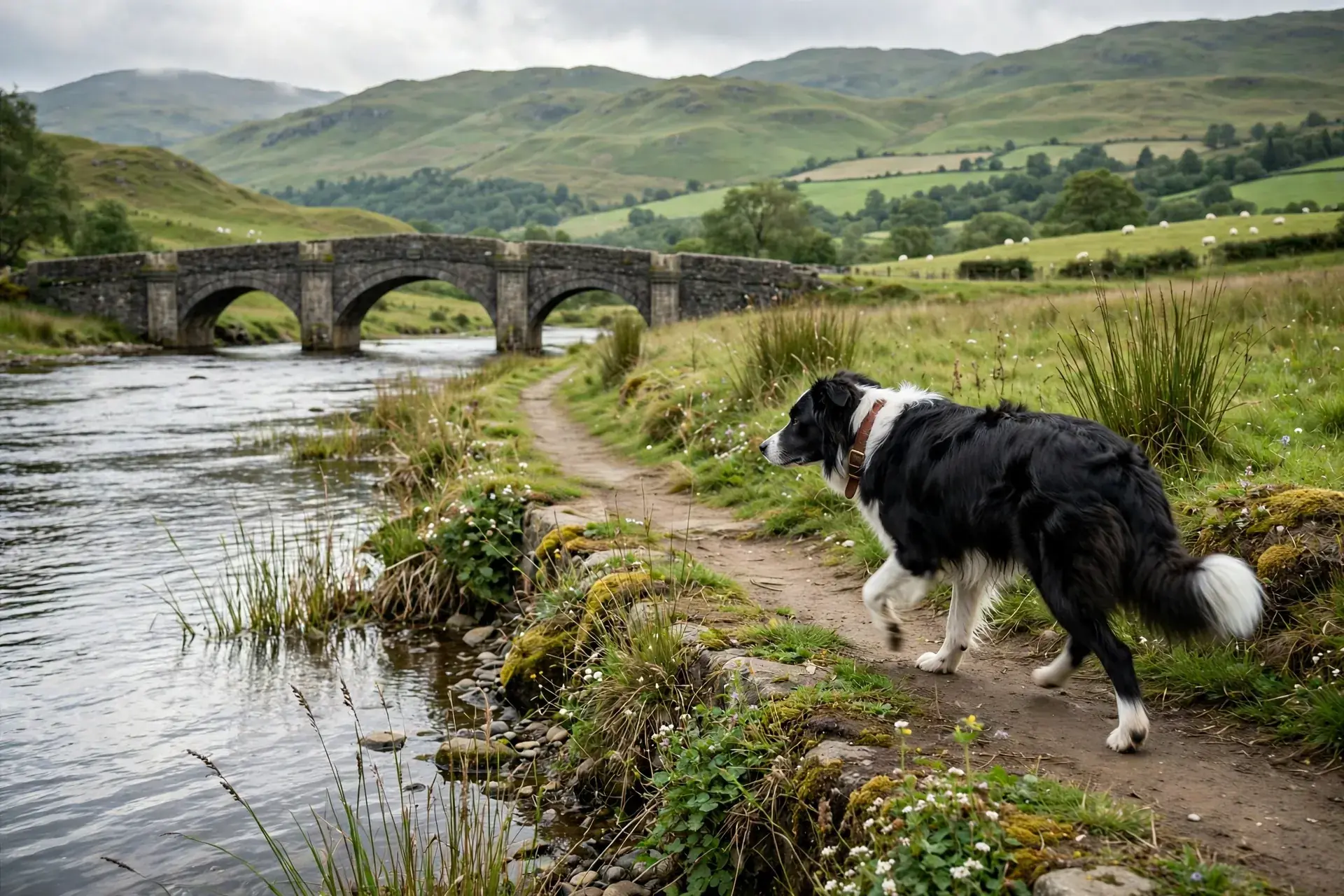
Quiet lanes are the link between the valleys and the moorland edges, and they deserve as much attention as the walks themselves. A good Borders lane follows a river, crosses a stone bridge, passes a farm and a small village, and arrives at the next town without ever feeling like a motorway. Driving these lanes well means driving slowly, expecting walkers, cyclists, horses, tractors and sheep, and using passing places properly on single-track sections. It also means accepting that a lane that looks like a shortcut on a map may be slower than the main road, and that this is fine. The lane is not a delay. It is part of the day, and it is often where the dog, looking out of the window, sees the countryside that the main road hides behind hedges and embankments.
Planning a moorland-edge day starts with the car park, not the summit. Choose a walk with a clear start, a clear turning point and a clear return, and tell someone where you are going if you are walking alone in a remote area. Carry water for the dog, a lead, a towel and a phone with charge, and check the weather forecast for the hills rather than just for the valley town, because conditions on exposed ground can be very different. In lambing season, in grouse season and during any local access restrictions, keep the dog on a lead and follow local signs. Check the official guidance before you travel, because access rules on moorland and farmland can change, and a sign at the car park is worth more than a general rule remembered from another region.
For dogs that love open running, moorland edges can be tempting, but off-lead freedom needs the same care as anywhere else. Ground-nesting birds, livestock, adders in warm weather and hidden drops or boggy ground are all real hazards on open moor, and a dog that runs far ahead can be hard to recall in wind. A long line, a reliable recall and a willingness to keep the dog close are more useful than a large open space with no plan. If your dog does not have a reliable recall, a moorland-edge walk on a lead is still a good walk. The dog gets new smells, new ground and a change of air, and you get the views without the worry.
Riverside walks that suit dogs
Riverside walks are the backbone of this route, and they suit dogs for reasons that go beyond scenery. River paths are often level, which helps older dogs and dogs with joint problems. They offer water for paddling on warm days, shade from riverside trees, and a steady stream of smells from other dogs, wildlife and the river itself. They also tend to be linear, which makes planning easy: walk out for twenty minutes, turn back, and you have a forty-minute walk with a known distance and a known return. For a road trip, that predictability is valuable, because it means you can fit a proper walk into a morning before a town visit, or into an evening after a drive, without guessing how long it will take.
The best riverside walks on a Borders trip are not necessarily the longest ones. A short, sniff-heavy walk beside the Tweed, with time to paddle, to watch the water and to rest on a bank, often tires a dog more effectively than a long, brisk march on a hard surface. Let the dog set the pace where it is safe to do so, and build in pauses rather than treating every stop as lost time. Dogs gather information through smell, and a walk that allows sniffing is a walk that satisfies a dog in a way that distance alone does not. If you have a young, high-energy dog, add a second short walk later in the day rather than extending the first walk until the dog is exhausted. Two moderate walks beat one very long walk for most dogs, especially on a multi-day trip.
Safety beside water needs the same attention as safety on a road. Rivers can be fast, deep and cold, even when they look calm from the bank, and banks can be slippery after rain. Not every dog is a confident swimmer, and even confident swimmers can tire quickly in a current. Keep the dog on a lead near fast water, weirs, locks and steep banks, and only allow paddling or swimming where the water is slow, shallow and safe, and where local rules allow it. After a river walk, check paws for cuts, check the coat for ticks in season, and dry the dog before the next car journey. A wet dog in a car is uncomfortable for the dog and messy for the car, and a quick towel-down at the car park saves a longer clean later.
Riverside etiquette matters too, because these paths are shared. Anglers have a right to fish in peace, and a dog splashing through a fishing beat or barking at a rod is not a minor annoyance to the person fishing. Give anglers a wide berth, keep the dog close and quiet near fishing spots, and follow any local signs about dogs and fishing. The same courtesy applies to other walkers, cyclists, horse riders and families with children. A dog on a lead, under control and with its waste picked up is welcome in far more places than a dog that is allowed to roam, and good behaviour on one riverside path helps keep the next one open to dogs as well.
Driving gently: lanes, not motorways
A slow road trip still involves driving, and the way you drive shapes how the dog experiences the trip. Short legs are the single biggest improvement you can make. A dog that travels for thirty minutes, walks for an hour and then travels for another thirty minutes will usually arrive at the next stop calmer than a dog that has spent two hours in the car with only a service-station break. If a leg has to be longer, break it with a proper walk rather than a five-minute toilet stop in a car park. The walk does not need to be long, but it should be a real walk: grass underfoot, smells to investigate, a chance to stretch and toilet properly.
Car safety is not optional, and it is worth getting right before the first leg. Dogs should travel restrained, whether in a crate, with a harness attached to a seat belt, or behind a dog guard in the boot, and the restraint should be fitted and tested before a long trip rather than improvised on the morning of departure. Keep the car at a comfortable temperature, never leave a dog alone in a car on a warm day, and plan stops for water on longer legs. For the legal position in the UK, including the requirement that a dog must be suitably restrained so it cannot distract the driver or injure occupants, see our guides to dog car safety and driving with a dog and UK law. Those guides cover restraint options, heat, breaks and the rules that apply on the road, and they are worth reading before you set off.
Motorways have their place at the start and end of a Borders trip, when you are travelling to and from the region, but inside the Borders they are rarely the best choice. The main A roads are useful for longer hops, but the quieter B roads and unclassified lanes are where the region reveals itself. They are also slower, narrower and more likely to include single-track sections, farm traffic and walkers, so they demand more attention from the driver. That is a fair trade. A driver who is watching the lane, the hedges and the passing places is also a driver who is noticing the countryside, and a passenger who is navigating a lane is more engaged than a passenger watching motorway signs. Keep speeds low, be ready to reverse to a passing place, and never assume that a lane is empty just because it is quiet.
Navigation on quiet lanes needs a backup. Mobile signal can be patchy in valleys and on moorland edges, so download offline maps for the region before you leave, and carry a paper map or at least a note of the town names in order. If a lane is closed or flooded, a paper map makes it much easier to find an alternative valley route than a phone that has lost signal. The same applies to accommodation and attraction details: save addresses, phone numbers and dog-rule confirmations offline, so you are not relying on a signal in a car park to check whether a cafe allows dogs. A little offline preparation turns a minor detour into a minor anecdote rather than a stressful scramble.
Where to stay and how to choose a base
Choosing a base for a slow Borders trip is less about finding the prettiest cottage and more about finding a place where the dog routine works. The best base is one where the morning walk, the evening toilet walk and the car are all easy. A cottage with a secure garden is ideal, but the garden must actually be secure for your dog: a low wall that a small dog can slip under, a gate that does not latch, or a gap beside a shed can undo the whole advantage. A hotel or bed and breakfast with a ground-floor room, a nearby grass area and parking close to the door can work just as well, provided the dog rules are clear and the room is genuinely dog-friendly rather than merely dog-tolerant.
Ask the right questions before you book. How many dogs are allowed, and is there a pet fee, and what does it cover? Are dogs allowed in all rooms or only in selected ones? Is there a secure outdoor area, and how high is the fence or wall? Where is the nearest practical toilet walk after dark, and is it lit? Are dogs allowed in the breakfast room, the bar or the garden, or only in the room? What happens if the dog barks, and what is the policy on leaving a dog alone in the room? The answers to those questions matter far more than a photograph of a dog on a bed. Get the answers in writing with the booking, and keep them with your confirmation, so there is no argument on arrival about a fee or a rule that was mentioned only on the phone.
Two-night stays are the sweet spot for most dogs on this route. The first night is for learning the new place: where the water bowl goes, where the bed is, where the toilet walk starts. The second night is for relaxing into it. A single night in each town sounds efficient on paper, but it means the dog is constantly relearning a new room, a new garden and a new walk, and the humans are constantly packing and unpacking. If you only have a long weekend, pick one valley and stay put, with day trips to nearby towns, rather than trying to cover the whole Borders. A deep visit to one valley, with two or three riverside walks and two market towns, is a better trip than a shallow visit to five towns with no time to walk properly in any of them.
Self-catering cottages suit many dog owners because they offer a kitchen, a washing machine for muddy towels and a living room where the dog can settle in the evening. Hotels and bed and breakfasts suit travellers who want breakfast provided and a host who knows the local walks. Campsites and caravan sites suit travellers with their own setup and a dog that is used to outdoor living. Each option has trade-offs, and the right choice depends on your dog. A dog that barks at unfamiliar sounds may do better in a detached cottage than in a hotel corridor. A dog that is used to people may do better in a friendly bed and breakfast than in an isolated cottage. Choose for the dog you have, not for the accommodation you imagine.
Car, kit and everyday routines
Packing for a slow road trip is mostly about routines, not equipment. The dog needs the same things every day: food, water, a bowl, a lead, waste bags, a towel, a bed or blanket that smells of home, and any medication. Pack those first, in a bag that stays accessible rather than buried under luggage, and keep a spare lead and a spare set of waste bags in the car. A boot liner or a waterproof cover protects the car from mud and wet coats, and a ramp or a step helps older or smaller dogs get in and out without jumping. None of this is specialist kit, but having it ready means you are not improvising at a muddy car park in the rain.
Everyday routines are what keep a multi-day trip calm. Feed the dog at roughly the same times as at home, walk before breakfast and after the evening meal, and keep the last toilet walk short, familiar and close to the accommodation. If the dog sleeps in a crate at home, bring the crate. If the dog sleeps on a particular blanket, bring the blanket. Dogs read consistency as safety, and a familiar bed in an unfamiliar cottage is worth more than a new toy. On driving days, walk the dog before the first leg, not after it, so the dog starts the journey toileted, stretched and a little tired. A dog that has already walked is a calmer passenger than a dog that has been waiting in a cottage while the humans packed.
Weather in the Borders can change quickly, especially on moorland edges and in the valleys, so pack for wet and cold as well as for sunshine. A drying coat or a couple of large towels, a waterproof jacket for the humans, and a spare set of clothes for the car all help. In summer, pack extra water, a portable bowl and a shade plan for the car, and never leave a dog in a parked car in warm weather. In winter, pack a warm coat for short-coated or older dogs, and check paws for salt, grit and ice after walks on treated roads. Ticks are a seasonal consideration on rough grass and moorland edges, so check the dog after walks in season and carry a tick remover if you know how to use one. If you are unsure about ticks, fleas or any health issue, ask a vet rather than guessing.
Finally, keep a small emergency kit in the car: the name and number of a vet near each base, a copy of the dog insurance details, any medication with clear instructions, and a basic first-aid kit for dogs. Rural vets can be some distance away, and practices may close early or run reduced hours at weekends, so save the details before you need them. A dog that cuts a paw on a riverside path or eats something it should not have on a town walk needs a calm, quick response, not a search for a phone number while the dog is distressed. Preparation does not make emergencies happen less often, but it does make them easier to handle when they happen.
Seasons, livestock and local rules
The Borders changes with the seasons, and a slow road trip can be planned to suit the season you are travelling in rather than fighting it. Spring brings lambs, nesting birds and longer days, but also muddy paths and livestock that need space. Summer brings long daylight, busy market towns and warm riverside walks, but also heat in the car, midges in some areas and busier car parks. Autumn brings colour, quieter towns and crisp walking weather, but also shorter days and wetter paths. Winter brings empty lanes, quiet towns and a different kind of beauty, but also limited daylight, reduced opening hours and exposed moorland roads in poor weather. Each season works, provided the itinerary is adjusted to it.
Livestock is the most important seasonal rule for dog owners in the Borders. The region is working farmland, and riverside and moorland paths often cross fields with sheep, cattle and horses. Keep the dog on a lead near livestock, even if the dog is normally well behaved, and be especially careful in lambing season and when cattle have calves. A dog that chases livestock can cause serious harm and can put itself in danger, and the legal position for livestock worrying is strict. If a path crosses a field with livestock and you cannot keep the dog under close control, choose a different path. There is always another riverside walk, and there is no walk worth a livestock incident.
Local rules also change by place and by season. Some paths have seasonal dog restrictions to protect ground-nesting birds or wildlife, some beaches and parks have different rules in summer and winter, and some attractions change their dog policy between seasons. The only reliable approach is to check the official guidance before you travel, read signs at car parks and path entrances, and follow the most restrictive rule if signs and websites disagree. If a sign says dogs on a lead, keep the dog on a lead, even if another walker tells you it is fine to let the dog off. Local signs reflect local conditions, and they are there for a reason.
Weather and daylight should shape the daily plan more than any list of attractions. In winter, plan the main walk for the middle of the day, when daylight is strongest, and keep the evening walk short and close to the accommodation. In summer, plan the main walk for the morning or evening, when it is cooler, and use the middle of the day for a town visit, a cafe stop or a rest in the shade. In all seasons, check the forecast for the valley and for the hills separately, and be ready to swap a moorland walk for a riverside walk if the weather turns. A flexible day that ends with a happy, dry dog is better than a rigid day that ends with a wet, tired dog and a long drive home in the dark.
The Borders rewards the traveller who treats the trip as a conversation with the landscape rather than a conquest of it. Drive a short leg, walk a river, stop in a town, talk to a shopkeeper, let the dog sniff, and then do it again in the next valley. That is the whole method, and it is enough. You will leave with a sense of the Tweed valley, the abbey towns and the market towns that a faster trip would miss, and your dog will leave with a set of familiar walks, familiar smells and a routine that felt more like home than like a holiday. In the end, that is what a dog-friendly road trip should do: not cover the most ground, but cover the right ground, slowly, with the dog beside you.
Practical questions
Before you go
How long should a Scottish Borders road trip take with a dog?
Three to five days suits this route best. Short drives of under an hour between market towns leave most of each day for riverside walks, town stops and rest, so a dog is not asked to spend long stretches in the car. A single overnight can still work for one valley, but rushing the whole Borders in a weekend defeats the point of a slow tour.
Are dogs allowed at the Borders abbeys?
Access varies by abbey, by season and by whether you are visiting the ruins, the grounds or an indoor exhibition, so check the official guidance before you travel. In general, plan for dogs on a lead in outdoor areas, bring a plan for one person to wait outside if an interior is restricted, and never assume that a dog-friendly town means every historic interior is dog-friendly too.
Do we need to keep dogs on a lead by the River Tweed?
Often yes, and always near livestock, anglers, nesting birds and other walkers. Riverside paths in the Borders pass working farmland and fishing beats, so a lead is the safe default even where a longer off-lead stretch exists nearby. Check the official guidance before you travel, watch for local signs, and keep a short lead ready for bridges, gates and narrow towpath-style sections.
What is the best base for a slow Borders road trip?
Peebles and Melrose both work well as first bases because they sit on or near the Tweed, have town walks from the door, and keep the next market town within a short drive. Moving base once, for example from the upper Tweed to the Kelso and Jedburgh area, cuts repeated backtracking and gives the dog a fresh set of local walks without adding long driving days.
Can we drive the Borders in winter with a dog?
Yes, with shorter days and muddier paths in mind. Winter suits quiet lanes and empty riverside walks, but daylight is limited, some attractions and cafes run reduced hours, and moorland-edge roads can be exposed in poor weather. Check the official guidance before you travel, pack drying coats and towels, and keep drives short so the dog is not waiting in a cold car.