This guide is independent and contains no paid placement. If affiliate links are added later, they will be clearly marked and will not change our editorial checks.
Enniskillen works with a dog because the best walks start where the town ends. Base yourself in or near the centre, walk the lakeshore in the morning, treat boats and castle interiors as check-first extras rather than promises, and use Castle Coole and Florence Court as lead-on parkland days. Keep the dog on a lead near water, livestock and swans, carry water and a towel, and check the latest official guidance before you travel for any venue or sailing you are counting on.
Why an island town suits dogs
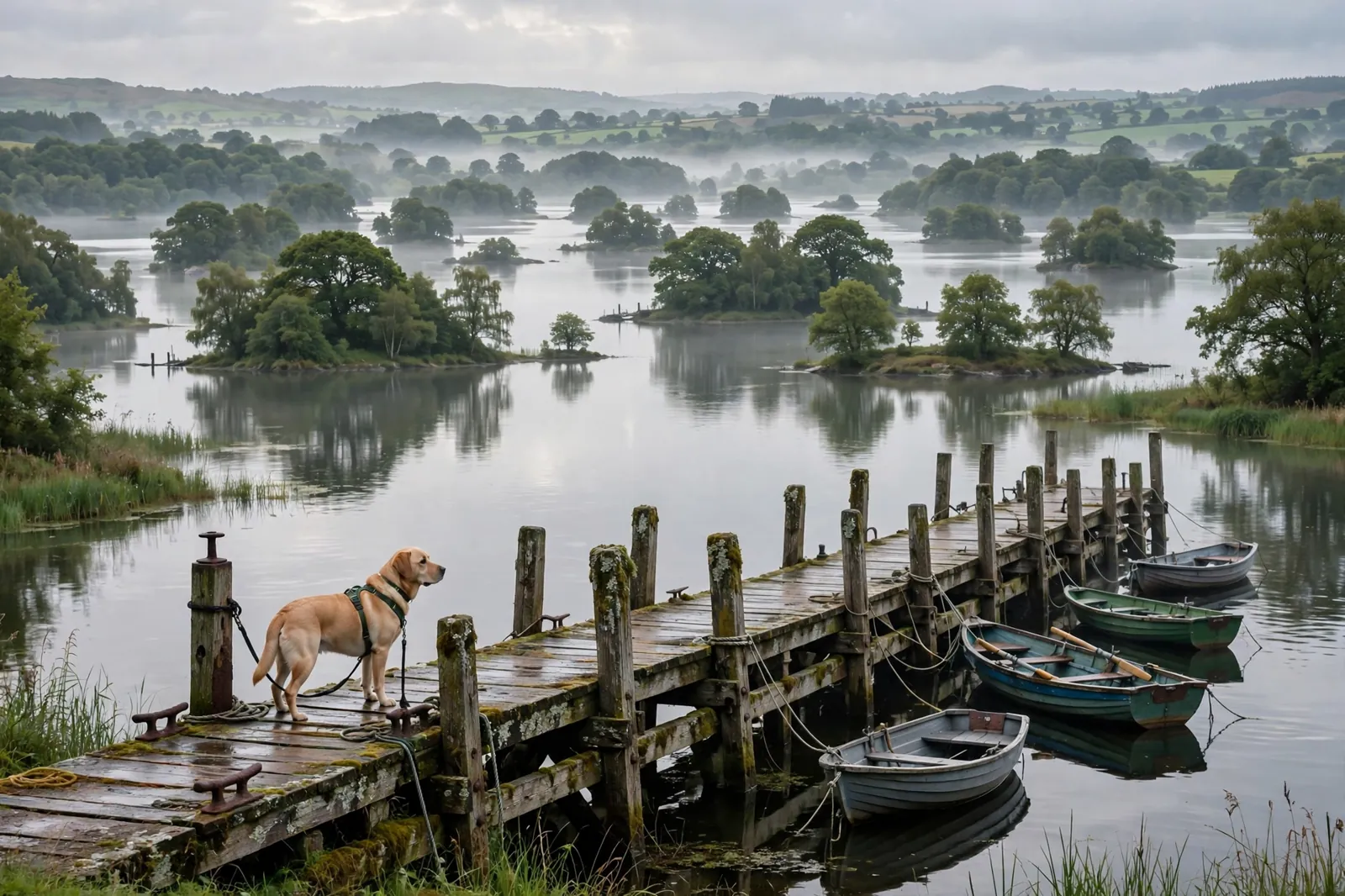
Start with the map, because the map explains everything else. Enniskillen sits on an island in the River Erne, between Upper Lough Erne to the south-east and Lower Lough Erne to the north-west. Bridges cross the water at both ends of the town, the main street climbs gently between them, and almost every useful thing a dog owner needs — food shops, fuel, a vet, somewhere to eat, somewhere to sleep — sits within that compact centre. For a dog, the payoff is simple: you are never far from the shore. A town that might look like a quick stop on the way to somewhere else turns out to have a walk at the end of nearly every street.
That compactness changes the rhythm of a trip. Instead of one long expedition per day, Enniskillen rewards a pattern of shorter outings: a proper lakeshore walk before breakfast, a slow loop through the castle grounds late morning, an afternoon drive to big-house parkland, and a last short stroll along the water in the evening light. Older dogs, puppies building stamina and dogs recovering from injury often do better on that pattern than on a single ten-mile march, and owners do too, because every outing ends a short distance from a kettle, a shower and a drying towel. If your dog travels better with routine, this is one of the easier towns in Ireland in which to keep one.
It also works as a base rather than just a stop. The wider county is covered in our companion guide to the Fermanagh Lakelands with a dog, which deals with the loughs, islands and shoreline drives at county scale. This guide stays deliberately local: what you can do from Enniskillen itself, on foot or with a drive of well under half an hour, without turning every day into a road trip. Think of the town guide as the daily operating manual and the Lakelands guide as the map for your bigger days.
One honest caveat belongs at the top. Enniskillen is a working town, not a resort, and that is mostly a strength — prices are saner, pavements are real and you will shop where residents shop — but it does mean the centre can be busy with traffic at school and commuting times, and the prettiest shore paths sit just beyond the busiest streets. Walk a nervous dog early or late in the day, cross at proper crossings rather than darting between parked cars, and save the middle of the day for parkland where the noise drops away within a few hundred metres.
Lough Erne shore walks: where the town meets the water
The signature Enniskillen walk is not a single named trail so much as a habit: follow the water. On the western side of town, paths run along the shore below the castle and out towards the open lough, giving you flat, surfaced walking with constant water views, benches at sensible intervals and grass verges where a dog can sniff without blocking the path. Surfaces matter here more than distance. After rain, unsurfaced spurs and grass edges soften quickly, while the main surfaced lines stay usable for pushchairs, older dogs and anyone in ordinary shoes. On a first morning, keep to the surfaced line, note where it narrows or turns muddy, and save exploratory detours for a drier afternoon.
To the east and south, the river and the head of Upper Lough Erne give a different feel: narrower water, more reeds, more birdsong and, in season, more midges near still water at dusk. Distances can be built up gradually. A gentle thirty-minute out-and-back suits a senior dog or a puppy; linking shore sections with quiet town streets makes a satisfying hour; and confident walkers can string together a half-day by combining the western shore, the castle grounds and a café stop in between. Because the town is an island, navigation is forgiving — if the water is on your left going out, it will be on your right coming back, and the castle is a landmark you can re-orient by from most of the shore.
Water etiquette deserves a paragraph of its own. Lough Erne is a working and wildlife-rich lough: swans and cygnets near the shore in spring and summer, anglers casting from banks and jetties, rowers and paddleboarders launching from slipways, and reed beds that shelter nesting birds. Keep dogs on a short lead around swans, which are confident, territorial and entirely unimpressed by an enthusiastic spaniel. Do not let a dog crash through reed beds or chase waterfowl for a photograph. If your dog swims, choose a shallow, clear entry point away from boats and anglers, rinse afterwards, and read our guidance on dog swimming safety before the first dip of the trip — cold water, hidden drops off jetties and blue-green algae in warm, still spells are the three risks that catch visitors out. Where algae notices are posted, keep the dog out of the water entirely and on a lead at the edge.
Evening walks are the quiet glory of a stay here. Once day boats are back and the centre settles, the western shore catches the last light over Lower Lough Erne, and a twenty-minute stroll does the job that a much longer walk does elsewhere: new smells, moving water, birds coming in to roost. It is also the practical last toilet walk, well lit enough in the town-adjacent sections to feel comfortable after dark in winter, provided you stick to the surfaced path and carry a torch for the darker stretches beyond the street lights.
Boats, islands and dog rules: check first, promise nothing
From Enniskillen, the water is not just scenery. Sightseeing sailings head out onto Lower Lough Erne, water taxis and tour boats serve island sites such as Devenish with its round tower, and hire boats of various sizes can be taken out by the day from marinas around the loughs. For a dog owner, this is the part of the trip that needs the most careful handling, because there is no single rule that covers all of it. One operator may welcome a dog on deck and forbid the cabin; another may refuse dogs on scheduled sailings but allow them on a private charter; a hire company may allow dogs on larger cruisers and ban them from small open boats. Policies also change with season, vessel and crew.
So treat every sailing as a question, not an assumption, and check the latest official guidance before you travel — ideally directly with the operator, by phone, before you book anything non-refundable. Ask five specific things. First, are dogs carried at all on the exact sailing or boat type you want? Second, if yes, where must the dog stay: outside deck only, or inside in bad weather too? Third, is there a fare for a dog, and is a lead, a mat or a muzzle required on board? Fourth, what happens at the destination — can the dog land on the island, and under what lead rules among ruins, livestock and other visitors? Fifth, what is the cancellation position if weather stops the sailing, and can you rebook rather than lose the fare? Write the answers down with the booking reference; a screenshot of a general web page is weaker evidence than a named reply about your date.
On the day, set the dog up to succeed. Arrive early so boarding is unhurried, toilet the dog before you queue, and bring water, a non-slip mat for a wet deck and a towel you do not mind sacrificing. Lifejackets for dogs exist and are worth considering for small, elderly or non-swimming dogs on open boats, fitted snugly and tested on land first — a dog wrestling with a new jacket on a moving boat helps nobody. Keep leads short on pontoons, which rock, gap and clang in ways that spook otherwise steady dogs, and never tie a lead to a rail or cleat. If your dog is a determined swimmer, a harness with a handle gives you a chance of a calm intervention at the gunwale; if your dog hates engines, crowds or vibration, be honest about it and spend the boat money on a shore day instead. The lough will still be there on the walk.
Island stops need the same realism. Historic island sites combine low ruins, uneven grass, rabbit holes, nesting birds and, on some islands, grazing animals. A lead is the default everywhere, a long line is rarely appropriate among stones and other visitors, and shade can be scarce on a bright day, so carry water for the dog rather than relying on a tap at the landing. Allow more time than the timetable suggests: getting a dog calmly off a boat, around a site and back to the jetty for a fixed return sailing always takes longer than the human-only version of the same trip.
Enniskillen Castle grounds: the town-centre anchor
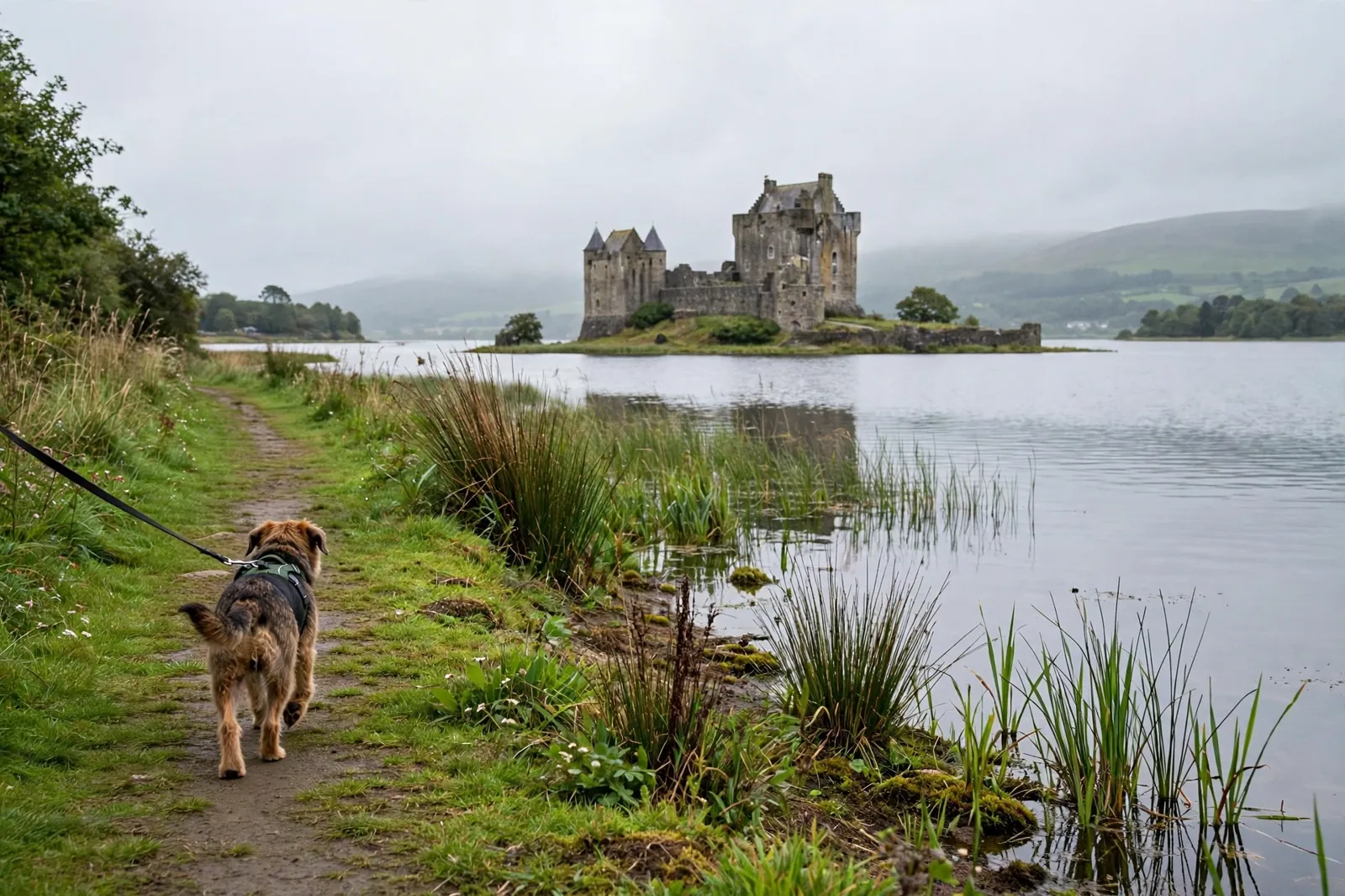
Enniskillen Castle stands at the western bridge, where the town meets Lower Lough Erne, and its grounds are the natural anchor of a dog day in town. The castle houses museum collections covering the county and its regimental history, and for dog owners the useful distinction is between the interiors and the grounds. Plan on the basis that the dog's visit is an outdoor one: riverside and castle grounds on a lead, space to sit, watch the water and let the town come to you, while the museum galleries are a human activity to be shared out if you are travelling as a pair, or saved for a solo hour. Venue rules on exactly where dogs may go can change, and assistance dogs are a separate category, so check the latest official guidance before you travel rather than relying on any guide, including this one.
Used well, the grounds solve several problems at once. They give a first-morning orientation point — stand by the water and you can read the whole town: bridge, main street, shore paths in both directions. They give a midday pause that does not require moving the car. And they give an evening destination with a sense of occasion, when the stonework warms in low sun and the river traffic slows. Benches and grass make it a humane place to wait with a dog while a partner visits the museum, provided one of you has brought a book, a coffee and a water bowl. Swap over halfway and nobody misses out; dogs, frankly, often prefer the grounds shift.
Practicalities are straightforward but worth stating. Keep the lead short near the water's edge and around the busiest paths at peak times, when school groups, tour parties and prams concentrate near entrances. Watch for cyclists using riverside routes at commuting pace. Carry waste bags even though bins are provided at main points — grounds this central stay pleasant only because most owners clear up, and the quickest way to get dogs restricted anywhere is a visible mess problem. If your dog is reactive, visit early: the grounds at nine on a weekday morning are a different proposition from the grounds at two on a festival Saturday.
Castle Coole and Florence Court: parkland days at the edge of town
Two great estates frame an Enniskillen stay, and both are at their best with a dog when you approach them as parkland walks with a famous house attached, rather than house tours with a dog problem attached. Castle Coole, on the eastern edge of town, is a neoclassical mansion set in wooded parkland above the shore of Upper Lough Erne, close enough to walk or make a very short drive from the centre. Florence Court, south-west of the town at the foot of Cuilcagh, pairs an elegant house with much larger grounds: forest tracks, a walled garden area, estate buildings and longer waymarked walking that can fill half a day. Both are cared for by the National Trust, and the general pattern across such properties — explained in detail in our guide to National Trust places with dogs — is that dogs are welcomed in grounds under control, usually on leads, while house interiors, and often formal gardens and indoor catering, remain dog-free apart from assistance dogs.
At Castle Coole, the dog-friendly shape of the day is a parkland circuit: mature trees, open grass, lake glimpses and surfaced paths near the house giving way to softer ground further out. It suits dogs that need a calm, legible walk without traffic noise, and owners who want a big-sky afternoon without a big drive. Allow time simply to sit: parkland like this rewards a bench, a flask and a dog asleep on a coat more than it rewards rushing a route. Keep leads on around livestock and deer, give grazing animals a wide berth even when they look placid, and be ready for the paths to hold water in low spots after a wet week — the dog will not care, but your shoes will.
Florence Court asks a little more of both of you and gives more back. The estate trails climb gently into woodland, surfaces vary from gravelled drives to forest track, and a fit dog can have a genuinely tiring outing without you ever leaving the grounds. The famous yew tree, the forge and sawmill buildings and the pleasure grounds give human interest at a dog's pace, outdoors, where you are not queueing or whispering. In wet weather the forest sections hold up better than open parkland and smell wonderful to a dog, which is its own form of enrichment. As at Castle Coole, treat the house itself as a take-turns extra if your party wants the tour, and confirm dog arrangements — lead rules, any areas that are dog-free, cafe seating, parking charges and opening days — before you set out, because estate opening is seasonal and policies are the Trust's to change. Check the latest official guidance before you travel.
Choosing between them is a matter of energy, not quality. Castle Coole is the gentle option: closer, flatter, easier with an older dog, a pushchair or limited time, and simple to combine with a town lunch. Florence Court is the expedition option: further, longer, better for a young dog that needs to move, and simple to combine with a south Fermanagh drive. Many stays happily do both on different days, and doing the gentle one first is a good way to learn how your dog is settling into the trip before you commit to the bigger outing.
Ardhowen and everyday parks: the walks you will actually use twice a day
Guides tend to celebrate the headline walk and ignore the one that saves the trip: the ordinary, repeatable, ten-minutes-from-the-door outing. In Enniskillen, the theatre and lakeshore around Ardhowen, on the western side of town where the road runs towards the Lower Lough, give exactly that kind of walking — water views, surfaced paths, parking nearby and a sense of space without an expedition. It is the sort of place you will use on arrival evening, when everyone is tired and the dog just needs grass, air and a horizon, and again on departure morning when time is short. Areas around performance venues get busy on show nights, with cars manoeuvring and audiences arriving in the dark, so time a last walk before the pre-show rush or keep the lead very short through the car park.
Around the town you will also find the small green spaces, riverside stretches and playing-field edges that residents use for daily dog walks. These are not destinations and do not need to be. Their value is reliability at seven in the morning and ten at night: a lit route you have already walked in daylight, a bin where you expect it, surfaces you trust in frost or rain. On your first day, deliberately rehearse the after-dark route before you need it. Note unlit gaps, loose surfaces and any stretch where off-lead local dogs may appear, and decide then — not at midnight in sleet — whether it works for your dog.
Two cautions apply to all everyday green space here. First, proximity to water is constant: river edges, marinas, slipways and unfenced lough shore appear where a town elsewhere would have a wall, so a dog with a swan habit or a diving habit stays on a lead until you know each spot properly. Second, shared space means shared manners. Youth football, anglers, runners and other dogs all have equal claim on these paths. A long line trailing across a cycle route, or a dog mugging a fisherman's bait box, creates exactly the friction that leads to restrictions. Keep the dog close when passing, step aside with a treat for bikes and buggies, and your welcome will outlast your stay.
Eating and sleeping with a dog in Enniskillen
Sleeping options cluster in and around the town in the usual Fermanagh pattern: hotels on the shore roads and in the centre, guesthouses and bed-and-breakfasts on the approach roads, self-catering apartments and houses in town and in villages a short drive out, and caravan and camping options around the loughs for those travelling with their own outfit. Dog policies vary in the ways they always vary, and the questions that matter are specific ones. Is the dog allowed in the room you are actually booking, or only in a small number of designated rooms that may already be taken? Is there a per-dog, per-night or per-stay charge, and a limit on number or size? May the dog join you anywhere for breakfast or an evening meal — a bar area, a terrace, a residents' lounge — or will one of you be eating in shifts? And is there a genuinely usable dog walk from the door after dark, or does the glowing description of lakeshore access mean a dark lane and a busy road crossing? Get answers in writing with the booking, as you would anywhere; our wider advice on comparing stays applies here unchanged.
Self-catering deserves a special note in a lakeland town. A house or apartment with a small enclosed yard, a hard floor by the door and a hosepipe outside will outperform a grander property without them across a wet Fermanagh week. Ask about fencing honestly — height, gates, gaps under hedges — and about the drying situation: where can a soaked dog be towelled, and where can wet gear live overnight? For stays of three nights or more, also ask about a mid-stay linen change and whether a washing machine is included; lough walks plus Fermanagh weather equals a laundry rhythm that hotels handle for you and cottages leave to you.
Eating out follows the familiar British and Irish pattern: pubs are generally the most promising ground for a dog under the table in a bar area, cafes often offer outdoor seating and sometimes indoor dog corners, and smarter restaurants are the least likely to accommodate a dog inside. None of that is a promise for any individual business, and arrangements change with refurbishments, seasons and new owners, so phone ahead for the one meal that matters rather than assembling a hungry party and a hopeful dog on a doorstep. In good weather, the town's takeaway-plus-lakeshore option is underrated: fish and chips or a deli picnic eaten on a shore bench, with the dog settled on a mat and the lough doing the decorating, is the meal many visitors remember best. Clear every scrap afterwards — gulls and swans learn fast, and chips are nobody's friend.
Grocery and supply runs are easy from the centre, which matters more than it sounds. Running out of the dog's usual food mid-trip is a classic cause of upset stomachs and midnight garden trips, so carry a day's buffer beyond the planned stay and note on arrival where you would replace food, bags and any medication essentials. Travellers arriving via ferry should also skim the rules in our guide to dogs on ferries well before sailing day, since kennel, cabin and car arrangements differ sharply by route and operator.
Day plans: putting Enniskillen together
A first full day, kept deliberately gentle, might run like this. Early shore walk on the western side while the town is quiet, breakfast, then the castle grounds mid-morning with a museum turn each for those who want it. Lunch in town, a rest, and Castle Coole's parkland in the afternoon when the light softens, finishing with the rehearsed evening stroll and an early night. Nothing in that day requires the dog to be brave, patient in a queue or quiet in a crowd for long, which is precisely why it works as an opener: it teaches you the town's distances, surfaces and busy times at low stakes.
A bigger second day can add the water. If — and only if — a boat operator has confirmed your dog in writing, build the day around the sailing: shore walk first, a calm wait on the quay with water and a mat, the trip itself, then a very undemanding afternoon, because boats are tiring for dogs in ways owners underestimate. Noise, vibration, novelty and enforced stillness add up. If no sailing fits, the Florence Court expedition fills the same slot: drive out mid-morning, take the longer forest circuit with a picnic, and be back in town for an evening shore walk. Either version leaves the dog pleasantly tired and the humans with the sense of a day spent, not a day survived.
A wet day, which Fermanagh will eventually provide, is not a lost day if you plan it honestly. Shorten, do not cancel: a blustery shore walk in proper waterproofs, drying coats on, then a parkland hour at Castle Coole between showers, hot drinks, and the town's indoor human options taken in turns. Dogs read weather through their owners; a party that treats rain as a scheduling detail rather than a disaster usually has a good wet day. What does not work is forcing the dry-day plan through horizontal rain at half speed — shorten the walks, add a food stop, and bank the bigger outing for the forecast's better half.
For stays of four nights or more, Enniskillen earns its keep as a hub. Alternate town days with one wider Lakelands day at a time — a Lower Lough shore drive, an Upper Lough loop, a forest park further afield — using the county-scale routes in the Fermanagh Lakelands guide linked earlier, and always coming back to the same bed, the same evening walk and the same breakfast arrangement. Dogs settle deeper with each repeated day, owners stop navigating from scratch every morning, and the trip gains the unhurried quality that a new base every night never quite achieves. When you do move on, you will leave knowing the town properly, which is more than most passing visitors can say.
Water, weather and practical checks before you go
Fermanagh weather is Atlantic weather: changeable within the hour, generous with rain in every season, and capable of soft, bright evenings that forgive everything. Pack for the dog as deliberately as for yourself. A well-fitting drying coat, a spare lead, a microfibre towel that lives in the car, paw balm if your dog does long surfaced walks, and a light long line for safe exploration where rules allow will cover most situations. In summer, add shade planning and water carrying rather than suncream gimmicks; in winter, add a torch, hi-vis for road stretches and a plan for ice on pontoons, bridges and shaded paths, which stay slippery long after open ground has thawed.
Water safety bears repeating in a county that is one-third water. Blue-green algae can occur in warm, still conditions in loughs and slow river sections; heed local notices, keep dogs out of affected water, and do not let them drink from scummy edges anywhere. After any swim, rinse the dog in clean water where you can, dry ears gently, and watch for the shivering, wobbliness or vomiting that means a vet, not a nap. Know before you arrive where the nearest veterinary practice is and how out-of-hours cover works locally — save the number in your phone on day one, alongside your own vet's details and your insurer's line if you have one. Microchip details should be current, with a mobile number you will actually answer on holiday, and an ID tag with that number is a cheap, fast route home for a dog that slips a collar on an unfamiliar shore.
Finally, the rules layer, kept short because it is mostly common sense written down. Dogs must be under control in public places, lead rules apply in many grounds, parks and estates, and livestock worrying is a serious offence as well as a genuine harm — Fermanagh's fields hold cattle and sheep right up to lough shores and estate fences, so if a field has stock in it, the lead stays on and the route gives them room. Clear up after your dog everywhere, including rural paths and shore grass; bag it and bin it, or take it back to your accommodation. None of this is onerous, and a town that sees well-managed dogs week after week stays a town that welcomes the next dog. That, ultimately, is the deal Enniskillen offers: bring a lead, a towel and a little consideration, and it gives you water, parkland and an island town that fits around a dog remarkably well.
Practical questions
Before you go
Can dogs go on boat trips from Enniskillen?
Some operators welcome dogs on board and others do not, and rules can differ between a scheduled sightseeing sailing, a water taxi to an island and a self-drive hire boat. There is no single town-wide rule, so confirm directly with the operator before you book: ask whether dogs are allowed inside the cabin or only on deck, whether a lead and a fare apply, and what happens in wet weather. Check the latest official guidance before you travel and keep a towel in the car for the return leg.
Are dogs allowed inside Enniskillen Castle?
Plan on the basis that dogs are generally for the grounds rather than the museum interiors, and that assistance dogs are treated separately. Grounds rules, lead requirements and any seasonal changes are set by the venue, so check the latest official guidance before you travel. If you are visiting as a pair, the simplest pattern is to take turns inside while the other person enjoys the riverside grounds with the dog.
Can I walk my dog at Castle Coole and Florence Court?
Both estates are best thought of as grounds walks with a dog on a lead rather than house visits. Dogs are typically not taken inside the historic houses, cafes may have outdoor seating only, and lead rules apply across parkland where livestock, deer and ground-nesting birds may be present. Facilities, opening arrangements and dog policies are managed by the National Trust and can change, so check the latest official guidance before you travel.
Where can my dog have an off-lead run near Enniskillen?
Keep expectations modest in the town centre, where lakeshore paths, roads, swans and other dogs make a lead the sensible default. Better off-lead chances tend to come on quieter stretches of lakeshore and in larger parkland away from livestock, waterfowl and picnic areas, and only where local signs allow it and your dog has a reliable recall. If in doubt, use a long line: it gives a young or energetic dog room to explore without risking wildlife, anglers or other walkers.
Is Enniskillen a good base for exploring Fermanagh with a dog?
Yes, for most households it is the most practical base in the county. It puts groceries, fuel, vets and evening food within a short walk or drive, while Lough Erne walks start at the edge of town and Castle Coole, Florence Court and the wider lakeshore are all short drives away. It works especially well for a first Fermanagh trip, for older dogs that need shorter outings with easy returns, and for anyone who wants one base instead of moving accommodation every night.