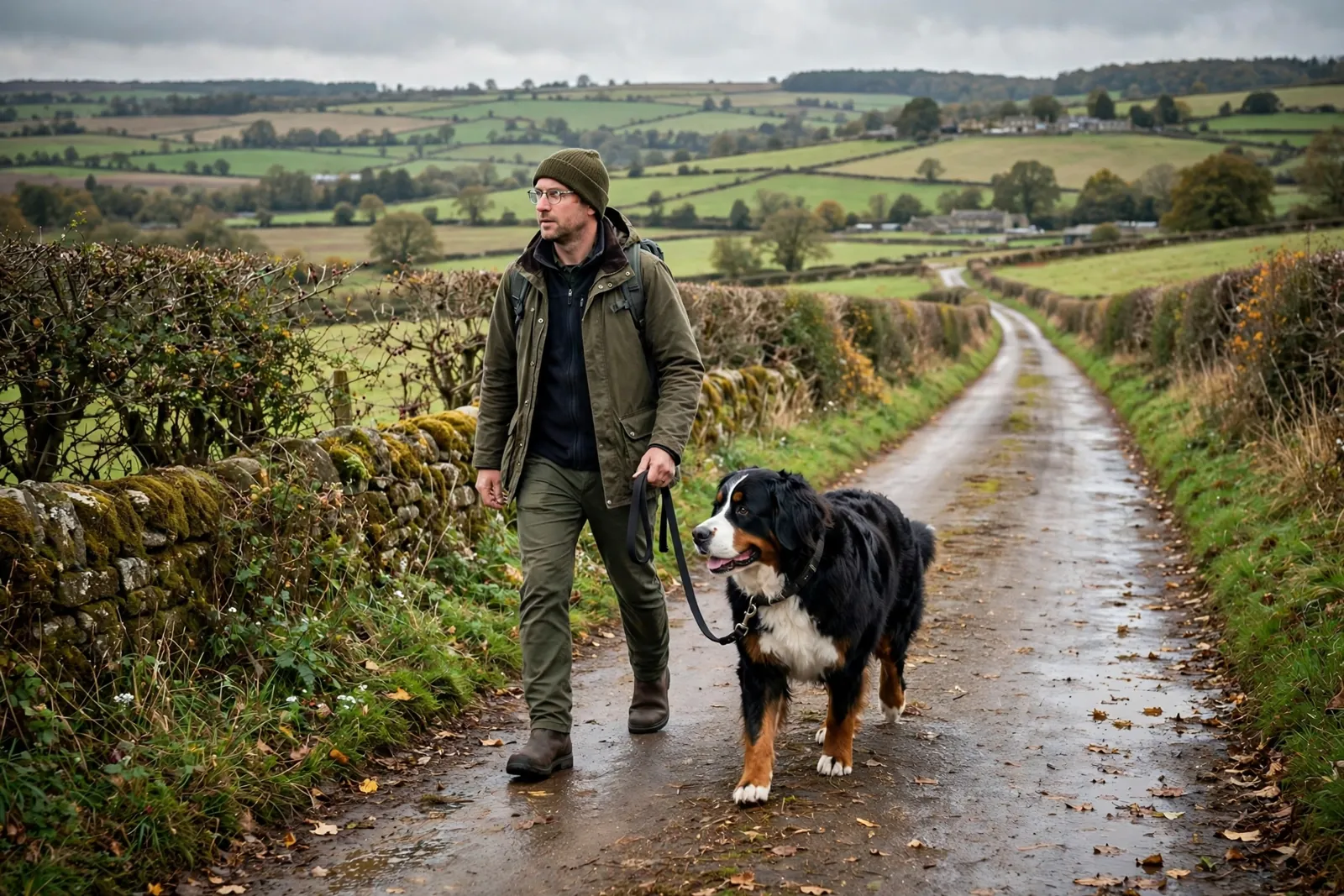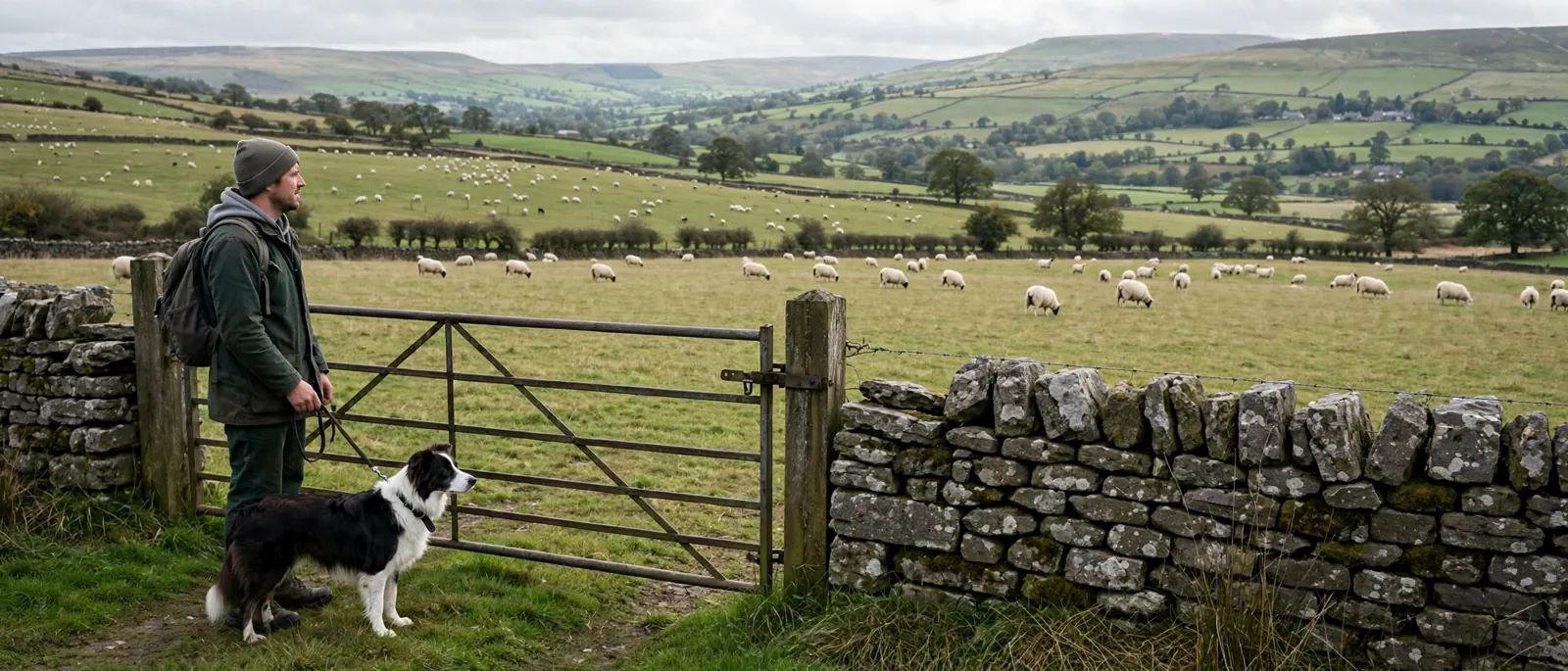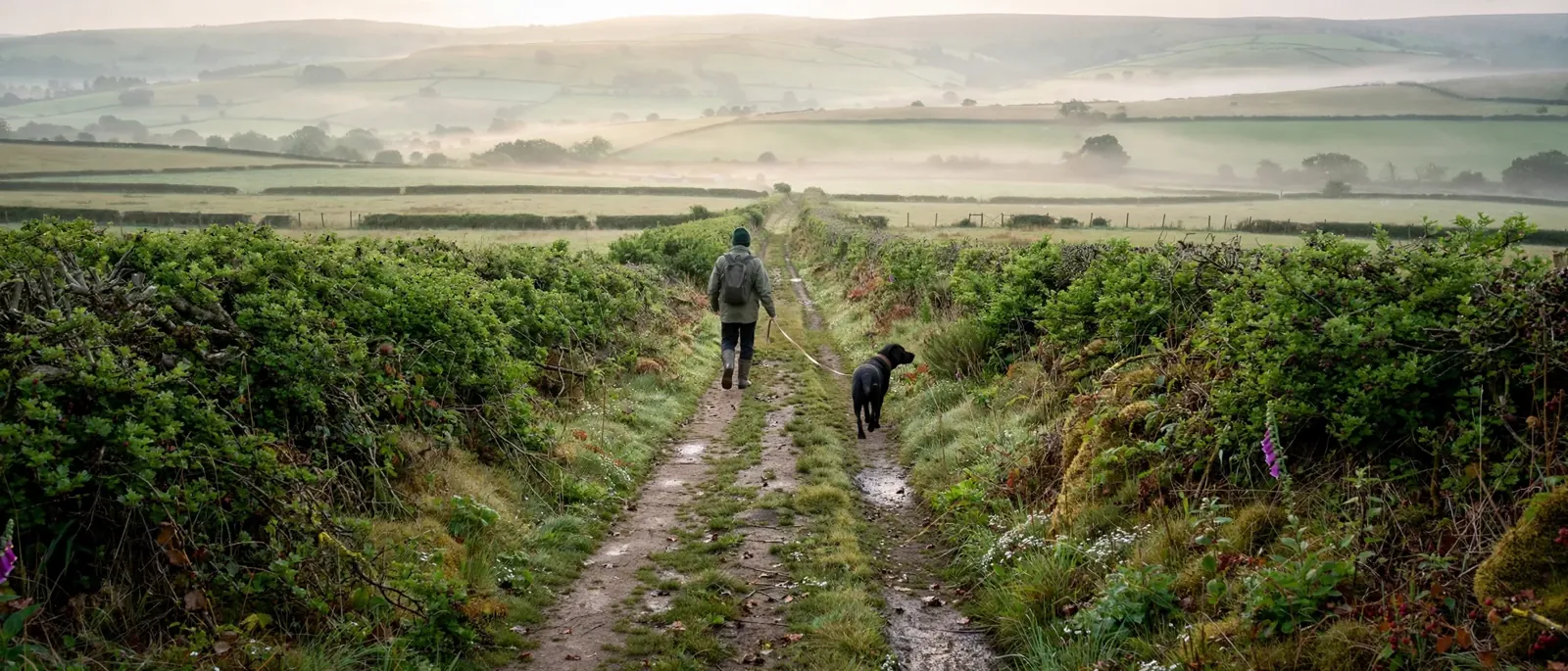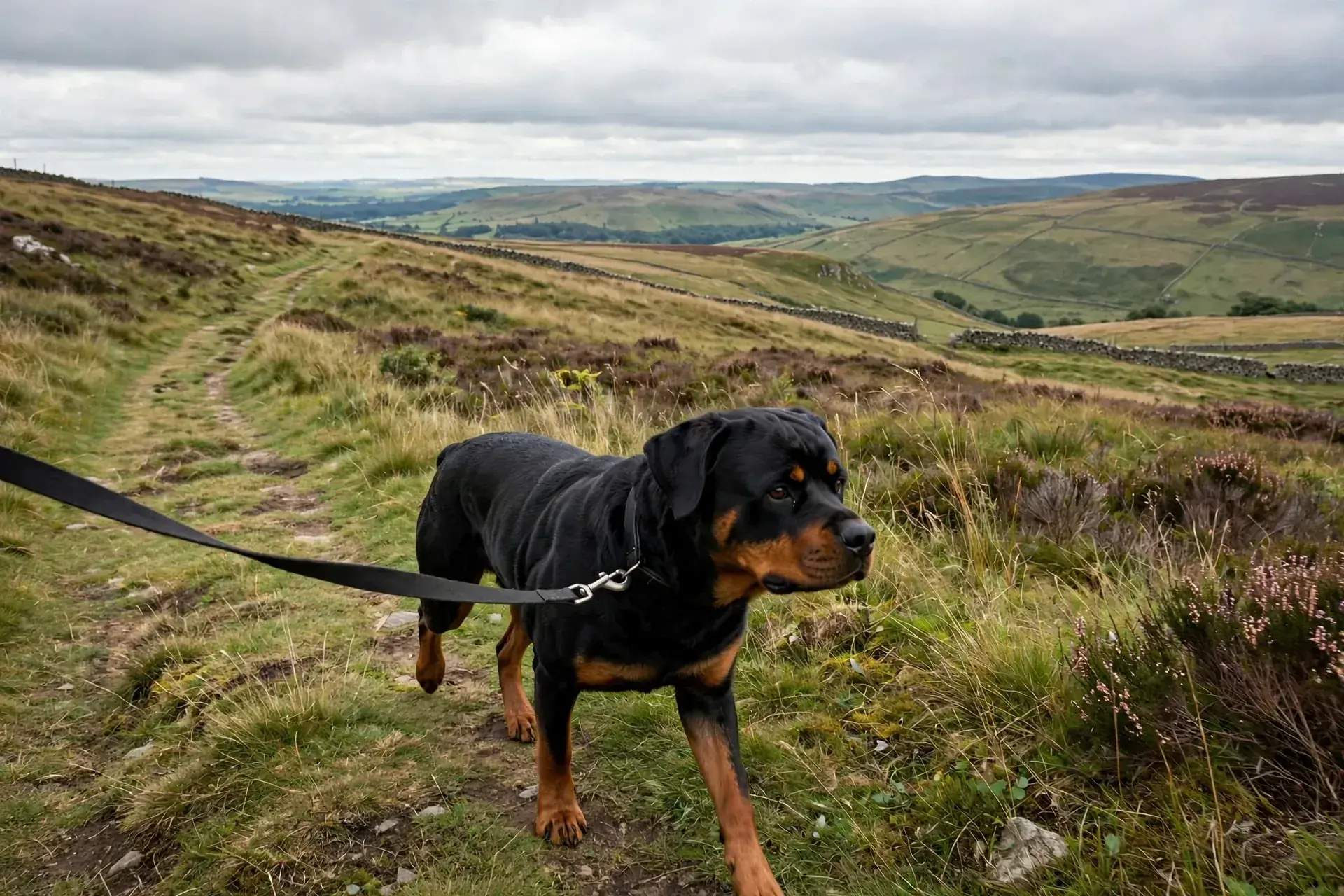
Travelling Britain with a Rottweiler goes smoothly when permissions come before plans: confirm the breed is accepted by insurers and stays in writing, travel muzzle-trained for courtesy, book roomy ground-floor accommodation, and choose wide open walking routes with a passing protocol for a large dog. The dog itself is rarely the problem — the paperwork and the square metres are.
Start with permission, not the destination
Most holiday guides begin with choosing a beautiful region. With a Rottweiler, the region matters last, because the trip usually succeeds or fails at the booking stage. A dog that is calm, trained and well-behaved can still be turned away at check-in if the property has a restricted-breed list nobody read aloud on the phone. Owners of Rottweilers learn quickly that “dog-friendly” is a label for dogs, not a promise for every dog — and that the pre-trip work is an exercise in written confirmation, not optimism.
Put the three permission gates in this order before you fall in love with any cottage. First, your own cover: third-party liability insurance that names or at least does not exclude your breed, since many insurers keep restricted-breed lists and some price Rottweilers differently. Second, the accommodation: the property's written breed policy, not the booking platform's dog icon. Third, the journey's moving parts: car hire or pet taxi rules, and any transport operator with a size or muzzle condition. Work through these in writing and the rest of the planning becomes ordinary holiday fun rather than damage control. Our liability insurance guide walks through what the cover actually means in practice — see dog third-party liability insurance in the UK.
The psychology of this ordering matters as much as the logistics. Nothing sours a break like discovering a problem at the gate with a dog in the boot and a family watching. Checking permissions first converts the trip from a hopeful gamble into a settled plan, and the dog picks up on that calm in you before you ever reach the footpath.
Where the breed name actually appears: insurance and booking small print
The word “Rottweiler” shows up in British holiday paperwork in two places, and neither is the law. The first is insurance exclusion lists. Pet liability policies and some travel policies carry restricted-breed schedules, and Rottweilers appear on many of them — sometimes under “Rottweiler”, sometimes folded into a “molosser” or “large guarding breed” grouping. The effect is the same: a claim involving your dog may be declined, or the breed may only be covered at a higher premium. Read the exclusion schedule itself, not the marketing summary, and declare the breed exactly as the vet records show it. An honest declaration answered with a surcharge is infinitely better than a cheap policy that quietly excludes your dog when something goes wrong.
The second place is accommodation terms. Some chains and platforms maintain UK-wide restricted-breed lists that apply to every property regardless of what the individual owner thinks. Independent cottages usually decide for themselves, which is why one listing can welcome your dog warmly while the identical listing on a different platform says no breeds “of fighting type or over 25 kg”. This inconsistency is not a contradiction to argue about; it is a signal to write before paying. Also note holiday cancellation cover: if you are booking an expensive peak-season week, insuring the booking cost is worth it precisely because a breed-related refusal at the property is a problem you want to catch in the email stage, not solve by rebooking at short notice.
Keep every answer in writing and filed with the booking. “Yes, we accept Rottweilers” in an email from the actual property beats any phone reassurance, and it is the document you produce if a stand-in manager on arrival day has never heard of your dog.
The confirmation email that ends the guesswork
Rottweiler owners benefit from one standard message sent before any deposit is paid. Keep it short, factual and specific enough that the reply is useful rather than a generic welcome. Address it to the property itself, not the platform's automated chat, and ask for the answer in the reply email so it forms part of the booking record.
- Is my breed accepted? Name the breed plainly: “We have a 45 kg neutered male Rottweiler, well-trained and quiet indoors.” Vague “a big dog” answers get vague replies.
- What are the weight, number and breed conditions for this specific property? Ask whether the rule you are reading applies to this cottage or the whole group, because group-level lists override friendly individual owners.
- Are there muzzle or lead rules in shared areas? Reception courtyards, shared gardens, on-site pubs and footpath exits all count.
- How secure is the outdoor space? Ask for fence height, gate latches and any gaps — a powerful dog leaning on a tired garden gate is a different risk from a terrier slipping through one.
- Where do large dogs sleep, eat and toilet? Ground-floor access, the route from the door to a toilet spot, and whether the dog is welcome on the terrace decide the week more than the thread count does.
Send this once, file the answer, and the property question is closed for the whole trip. Owners who skip it spend the first evening at every stay re-auditioning their dog for a manager who was never briefed — the written yes ends that ritual for good.
The muzzle as holiday equipment
No UK-wide law requires muzzling a Rottweiler in public, but the holiday muzzle is still one of the most useful items you can pack — not as punishment, but as social equipment. A muzzle-trained dog walking calmly past strangers reads as responsible, and that reading quietly opens doors: pub gardens where the landlord was on the fence, busy footpaths where other walkers relax instead of stiffening, and accommodation where the owner simply feels safer about the insurance. Treat the muzzle the way hillwalkers treat a map: you may not need it today, but carrying the habit costs nothing and changes how people respond to you.
Training it must happen at home, not on the trip. A well-fitted basket muzzle that the dog wears happily for treats during everyday walks is equipment; a muzzle wrestled onto a stressed dog in a crowded car park is a signal of trouble. Build the association weeks ahead with short sessions, food rewards and normal walks, until the muzzle predicts good things. The dogs that benefit most are also the dogs whose owners least want the bother — which is exactly why starting early matters.
Use judgement about when it goes on. Narrow busy paths, crowded beaches on a warm day, pub gardens with off-lead small dogs wandering between tables, and any place where children run past at dog height are the classic moments. On an empty moorland track at dawn, keeping it in the rucksack is equally sensible — the etiquette is about the situation, not a blanket rule. And note that a muzzle never replaces a lead: a muzzled dog that knocks someone over is still an incident. For dogs whose arousal around strangers is a known issue, our reactive-dog guide's quiet-walk tactics translate well to big breeds too — see reactive dog holidays in the UK.
Buy space, not style
For a Rottweiler, the quality of a stay is measured in square metres and floor surfaces, not décor. A 45 kg dog needs room to turn around without sweeping side tables, a floor that does not turn into an ice rink when paws are damp, and a sleeping spot that is not the only route to the bathroom. Ground-floor accommodation is the quiet hero of the big-dog holiday: no stairs to negotiate after a long walk, direct door-to-garden access for late toilet trips, and no thudding paws overhead to worry the neighbours below. Self-catering cottages with their own enclosed garden are usually the easiest and calmest format, and cottages designed with enclosed outdoor space are worth seeking out deliberately — see self-catering stays with secure gardens.
What to check in the listing and the email: the actual garden boundary (height, latches, gaps under fences), whether the garden is private or shared with neighbouring units, ground-floor entry, hard flooring in the main living area, and the distance from the door to a sensible toilet spot after dark. A garden that is “enclosed” by a two-foot picket fence with a gate that swings in the wind is a boundary in name only for a dog of this size; ask for the height and the latch. Also check the surrounding paths from the property: a cottage on a busy lane with no pavement forces every toilet trip onto the road, while one with a quiet lane or field margin lets the dog decompress without incident.
Hotels and B&Bs can work for short stops, but the format fights the breed. Ask where the dog sleeps, whether dogs are welcome in the bar or dining room, and how breakfast works when the dog cannot be left alone in the room. A ground-floor room with a direct external door changes everything. For a fuller look at the hotel format specifically, see dog-friendly hotels in the UK.
The car is a crate on wheels
A Rottweiler does not fit in the travel arrangements of smaller breeds — the boot space that swallows a spaniel leaves a 45 kg dog folded like luggage. The comfortable minimum is an estate-car boot or larger, with a fitted divider or a crash-tested crate sized for the dog to lie flat, turn and stand. Crate it, and secure the crate so it cannot slide in braking: an unrestrained 45 kg dog becomes a projectile that endangers everyone in the car. Measure your dog and your boot before the trip, not at the services on the M6, because the large-dog sizing rules are unforgiving — our large-dog travel guide covers the tape-measure checks in detail: travelling with a large dog in the UK.
Hire cars need permission before the dog ever climbs in. Rental agreements commonly exclude dogs or require written consent, and a Rottweiler-sized claim on an undeclared dog is an expensive argument. Get the consent in writing with the booking reference attached, bring seat and boot liners, and photograph the car's interior before loading — the deposit protects you only if the “before” state is documented. Electric hire cars add one more check: boot space is often smaller than the equivalent petrol car, so confirm dimensions rather than model names.
Plan the driving day around the dog's needs, not the sat-nav's. Stop every two hours for water, a toilet break and a short sniff, choosing service areas or lay-bys with a grass margin away from the lorries. Older Rottweilers with tired hips and elbows should get a ramp for the boot rather than a daily jump that shows up as stiffness the next morning. And never leave the dog in the car in warm weather, even briefly — large dark-coated dogs heat up fast, and a parked car becomes dangerous far sooner than most people expect.
Route planning for a big silhouette
Here is the part of the trip the Rottweiler genuinely excels at — and the planning simply needs to match the breed's physical reality. The best routes are the wide ones: open moorland, forestry tracks, canal towpaths, broad riverside trails and long sandy beaches out of season. Space in every direction does three things at once: it gives the dog room to move without constant close-quarters encounters, it gives other walkers room to pass without anxiety, and it gives you room to step aside gracefully — which, with a big dog, is the single most valuable etiquette skill you own.
The passing protocol deserves its own sentence. On narrow paths, step off the trail, shorten the lead, put the dog in a sit at your side and let others pass with a brief friendly word. This small ritual transforms the walker's experience from “large dog approaching” into “handled dog, nothing to worry about”, and it costs you about twenty seconds per encounter. The narrow routes to treat with caution are cliff paths with sheer drops, crowded shared-use paths at peak times, and busy promenades — not because the dog cannot manage them, but because a 45 kg dog that stumbles or surges has consequences a lighter dog does not.
Timing is part of route selection. Early mornings and late afternoons empty even popular trails, and weekday walks in school term are a different world from August Sundays. Check seasonal rules before you go: dog-control orders on beaches and some nature reserves apply by date, lambing season brings stricter expectations on farmland, and ground-nesting bird season affects moorland access — departure-day checks on official pages are worth the two minutes. When in doubt about the latest local rules, verify with the official source before you set out rather than relying on last year's memory.
Livestock country and the farmer's view
Britain's countryside is working farmland, and the livestock rules apply to every dog — but the Rottweiler's size changes how a farmer experiences your dog. A big black dog moving fast near sheep looks alarming even when it is merely excited, and a farmer who sees that from a Land Rover does not wait to find out which it is. The law on livestock worrying is strict, and farmers have legal powers to protect their animals; no one wants that conversation on holiday. Keep the dog on a lead wherever livestock are present or might be around the next corner, and treat “the field looked empty” as the sentence that precedes most incidents.
Practical precautions are simple and cheap. Walk field margins and bridleways with the dog on a short lead and your eyes up, not on the phone. If sheep appear suddenly, move calmly to the far side of the path, keep the dog close and keep walking — stopping to stare at the flock turns your dog into a statue of interest, which is worse. Know that during lambing season many areas expect dogs on leads on all open access land, not just near visible stock, and respect seasonal signage even when the lambs are nowhere in sight. The legal detail matters enough to read once: our livestock law guide lays out what the rules actually say — see livestock worrying law in the UK.
One habit earns goodwill everywhere: greet the farmer, not just the dog walkers. A wave and a word — “lovely flock, we'll keep to the path” — tells the person with the shotgun that you are a responsible owner, and farmers remember the owners who make an effort. The Rottweiler's reputation does some of your diplomacy against you; being visibly careful does it back for you.
The first-impression economy
A Rottweiler changes the social maths of every pub garden, café terrace and tearoom. The dog may be the calmest animal in the building, but the first thing a stranger registers is size, colour and breed silhouette — and then the tail wag. You cannot change the first three, so you manage everything around them: where you sit, how the dog is positioned, and how quickly you signal that the animal is under control. This is not about apologising for your breed; it is about spending a little social capital upfront so the rest of the visit is relaxed for everyone, including the dog.
The seating strategy is concrete. Choose a corner table with a wall or hedge behind it so the dog has one protected side and nobody has to step over a tail. Settle the dog on a mat under the table or tight beside your chair, lead short but not taut, before you order — a dog that is already lying down when people arrive reads as furniture, while a dog still pacing reads as a decision. Keep greetings controlled: not everyone wants a 45 kg nose in their lap, and children at dog height deserve extra care. A quick check with staff on arrival — “is he alright tucked under here?” — turns the pub team into allies rather than reluctant hosts.
Read the room honestly. A quiet village pub at three on a Tuesday is a different proposition from a packed beer garden on a sunny Saturday with off-lead small dogs weaving between tables. If the situation is wrong for your dog — too crowded, too many loose dogs, too much food at nose height — leaving is not a failure, it is the skill. The walk you take instead is usually the better memory anyway. And carry the basics: water bowl, a chew for under-table settling, and a towel for the muddy paws the country lanes guarantee.
Older Rottweilers: shorter days, gentler miles
Rottweilers are a breed where joints often retire before the spirit does. Hips, elbows and cruciate ligaments are common wear points, which means the older Rottweiler's holiday needs redesigning rather than cancelling. The arithmetic of the trip changes: fewer miles, softer surfaces, more rest, and equipment that compensates for what the body no longer does gladly. A six-mile moorland march becomes three gentle miles with a long pub stop; the dog will enjoy the revised version more, because it matches the dog in front of you.
Surface choice is the biggest lever. Soft forest tracks, sandy beaches and springy turf beat tarmac and rocky descents, and steep downhill sections should be planned out of the route entirely — descents punish elbows far more than ascents punish hips. A ramp for the car boot stops being optional equipment and becomes daily kit, as does a supportive bed brought from home so the dog sleeps on something familiar rather than a cold hard floor. Swimming is excellent low-impact exercise where it is safe and allowed, but keep sessions short and watch for the tired dog that does not want to admit it.
Build the day with rest as a feature, not a concession. A morning walk, a long lazy afternoon at the cottage with the garden door open, and a short evening loop suits most older Rottweilers better than one heroic expedition. Keep pain management and the vet's number to hand, watch for the lagging step or the slow sit that signals a sore day, and have a plan B for the cottage itself — a comfortable base with a view makes a rest day feel like part of the holiday rather than a failure of it. For more on travelling with ageing dogs, our senior dog travel guide covers ramps, routines and rest-day planning: senior dog travel in the UK.
Practical questions
Before you go
Is a Rottweiler classed as a dangerous dog breed in the UK?
Rottweilers are not among the types listed under the Dangerous Dogs Act 1991, so there is no blanket breed-specific law aimed at them. The practical catch is that private businesses and insurers are free to keep their own restricted-breed lists, and Rottweilers appear on many of them. Always check accommodation rules and insurance wording before you book, and confirm the latest official position before you travel in case regulations change.
Do I have to muzzle my Rottweiler on holiday in the UK?
There is no general legal requirement to muzzle a Rottweiler in public. Individual pubs, beaches, transport operators and local restrictions can set their own rules, so check the specific places you plan to visit. Many owners muzzle in crowded spots as a courtesy anyway: a muzzle-trained dog reads as responsible and opens doors that stay shut to an unmuzzled large dog.
Will UK hotels and holiday cottages accept a Rottweiler?
Many do, but some properties publish restricted-breed lists that include Rottweilers and others leave it to the individual owner's discretion. Never rely on a generic “dog-friendly” label — write and ask whether your breed is accepted by name, and get the answer in writing alongside the booking. Independent self-catering cottages with secure gardens are usually the easiest yes.
What insurance should I have when travelling with a Rottweiler in Britain?
Third-party liability cover matters more than ever with a powerful breed, because a claim can be large. Read the exclusion list before you buy: some policies exclude named breeds or incidents involving dogs over a weight limit. Declare the breed honestly and confirm in writing that Rottweilers are covered, and consider cancellation cover for expensive peak-season bookings.
Can I let my Rottweiler off the lead on countryside walks?
Only where it is clearly allowed and genuinely safe: reliable recall, no livestock, no ground-nesting birds in season and no local dog-control order. With a Rottweiler the visual impact matters too — other walkers and farmers judge a loose large dog harshly, so a long line on open ground often buys more freedom in practice than an off-lead dog that alarms everyone.
How do I transport a Rottweiler safely on a long UK drive?
Use a boot with a fitted divider or a crash-tested crate sized for a 40–50 kg dog, secured so it cannot slide. Estate cars and vans give a Rottweiler room to lie flat; small hatchback boots do not. If you hire, get written permission for the dog first. Plan a stop every two hours with water, and bring a ramp for older dogs whose hips and elbows no longer enjoy the jump.