This guide is independent and contains no paid placement. If affiliate links are added later, they will be clearly marked and will not change our editorial checks.
The southern coast line is the easiest first trip, the northern lakes line is the most dramatic and the most demanding, and the middle line is the best compromise when you want one trip that mixes gentle walking, a historic city and a wilder final day. Pick by driving tolerance and ground conditions, not by postcard scenery.
How to read the three routes
Most north-versus-south comparisons fail because they compare averages. The average southern beach and the average northern fell tell you very little about Tuesday morning with a wet dog, a car full of towels and a booking that cannot be moved. This guide therefore compares journeys, not regions in the abstract. Each route below runs for four days, moves base twice at most, and is built around one substantial walk a day rather than a checklist of attractions. That shape matters for dogs: a single good walk, a calm base and a predictable evening routine will beat three rushed stops almost every time, whatever part of England you are in.
Read the routes as templates, not as fixed timetables. The southern coast line starts in Brighton and ends in Devon, the northern lakes line starts in the Yorkshire Dales and ends on the Northumberland coast, and the middle line runs from the Cotswolds through the Peak District to York and the Yorkshire coast. Each day is described in the same order: where you sleep, what the main walk asks of the dog, where the practical problems hide, and what the evening looks like. Keeping that order lets you compare like with like. If a day on one route asks for a steep, exposed walk and a late finish, while the equivalent day on another route ends with a flat riverside loop and a pub garden, that difference is worth more than any general claim about the north being wilder or the south being softer.
A note on the geography is also needed. England does not split neatly at a single line, and the middle line in this guide deliberately crosses the usual dividing points. The Cotswolds sit in the south-west for many travellers, the Peak District straddles the Midlands and the north, and York is firmly northern while still being an easy train journey from London. That fuzziness is the point. The useful question is rarely whether the north or the south is better in general. It is whether a particular sequence of days suits your dog, your car, your budget and the season you can actually travel in. A family with a nervous rescue dog and a small car will experience the Lake District very differently from a couple with a fit spaniel and a camper van, even on the same path on the same day.
Finally, treat every rule quoted here as a starting point for your own check. Beach restrictions change by season and sometimes by section of beach, livestock rules vary by farm and by time of year, and accommodation policies change when a property changes hands. Where this guide is unsure, it says so directly: check the official guidance before you travel. That sentence is not filler. It is the difference between a plan that survives contact with a warden, a farmer or a receptionist, and a plan that unravels on the first morning.
Route one: the southern coast line
Base plan: two nights around Brighton and the South Downs, then two nights in Dorset, with Devon as an optional extension rather than a forced final leg. Driving days stay short, rarely more than ninety minutes between bases, and the route works well by train for the Brighton and New Forest sections if you do not want to drive at all. This is the route to choose when the trip itself needs to feel easy: a first holiday with a new dog, a break with older relatives, a dog that settles slowly, or a weekend stretched into four days without annual-leave gymnastics.
Day one: Brighton and the South Downs. Start with the downs rather than the seafront. The chalk paths above Brighton give a dog open running and long views without the crowds, bins and dropped food of the promenade, and they drain better than lowland clay after rain. Keep the first walk to about an hour, on a lead where livestock graze, and finish in the city so the dog learns that the base is calm after excitement. Brighton itself is famously dog-tolerant in cafes and on many terraces, but the beach rules change with the season: some stretches restrict dogs in summer months, and the rules are enforced more visibly when the beach is busy. Check the current beach map for your dates before you promise the dog a swim, and carry a lead even on stretches where dogs may run free, because a busy seafront is a poor place to test recall for the first time.
Day two: the New Forest. Drive west into the New Forest and the whole texture of the trip changes. The forest is open access land in many places, with ponies, cattle and pigs roaming freely, which means the dog stays on a lead far more than a first-time visitor expects. That is not a drawback if you plan for it: a long line on a forest track, a sniff-heavy wander rather than a forced march, and a picnic stop where the dog can watch the ponies from a safe distance will tire most dogs more honestly than an hour of chasing. The practical warning is about the ground and the animals. Ponies are not tame, pigs can be defensive with young, and dogs that chase livestock can cause serious harm and legal trouble. Keep the lead short near animals, never feed them, and use the forest car parks that have clear, short routes back to the car for a wet-weather fallback.
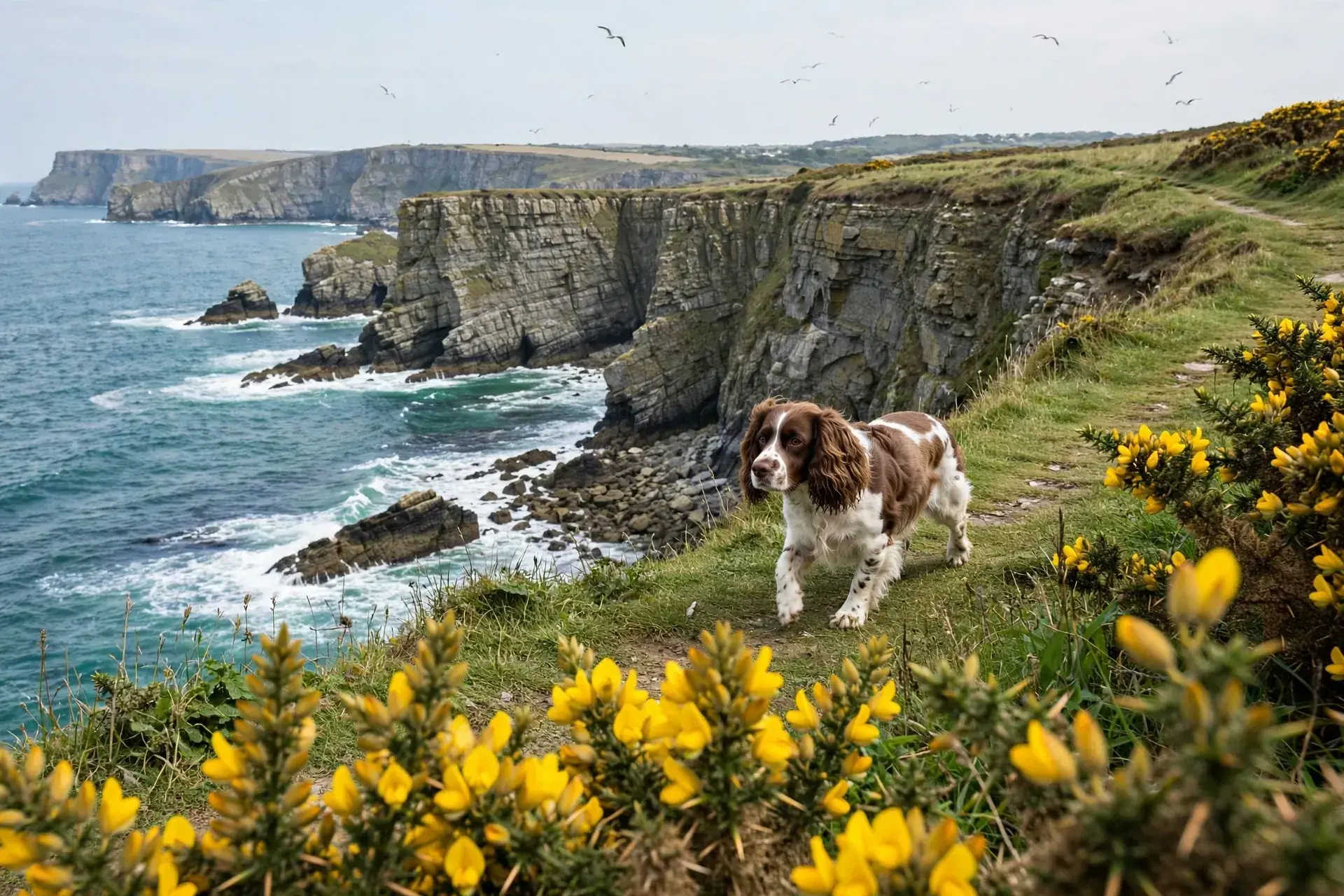
Day three: the Dorset coast. Move to Dorset for the Jurassic Coast, where the walking is a mix of cliff-top paths, shingle coves and village lanes. The classic mistake is to plan a long cliff walk as the main event and then discover that the dog is exhausted, the tide has cut off the return beach, or the only cafe at the end does not welcome dogs inside. Plan the Dorset day backwards from the finish: pick a village with a dog-welcome pub, check tide times if any beach section is involved, and choose a cliff section with a clear inland escape route if the wind picks up. Our Dorset dog guide covers beach rules, cliff safety and lead rules in detail, and it is worth reading before you choose a specific cove. The Dorset day also teaches the southern line's main lesson: the south rewards short, well-chosen walks far more than long, ambitious ones, because heat, crowds and cliff exposure all build up quietly.
Day four: Devon, or a slow Dorset repeat. The honest southern choice on day four is often not to push on to Devon at all. Repeating a Dorset walk the dog already knows, with a longer pub stop and an earlier finish, usually produces a calmer dog and a better last evening than a new county, a new base and a longer drive. If Devon does appeal, treat it as a day trip from Dorset rather than a base move: an early start, one coastal walk, and a return to a familiar bed. The broader comparison with the neighbouring county is covered in our Cornwall versus Devon guide, which explains why Devon often suits dogs better than Cornwall on beach rules alone. Either way, keep the final day short. The last day of a dog holiday is judged by the dog on whether it ends calmly, not on whether it added another county to the list.
What the southern line feels like overall. Evenings are the south's quiet advantage. Towns stay open later, more restaurants have terraces or dog-welcome rooms, and the after-dark toilet walk is usually a lit street or a short promenade rather than an unlit lane. The trade-off is price and pressure: summer accommodation in Brighton, the New Forest and Dorset books early, parking near popular beaches fills by mid-morning, and the best dog-welcome tables need booking. The southern line therefore suits planners. Book the base, the parking plan and the evening table before you travel, and the days themselves can stay relaxed.
Route two: the northern lakes line
Base plan: one night in the Yorkshire Dales, two nights in the Lake District, and one night on the Northumberland coast. This is the longest driving of the three routes, with the Lake District to Northumberland leg taking well over two hours, so it suits a full four days rather than a stretched weekend. It is also the route where the dog's fitness, the weather and the ground matter most. Choose it when the dog genuinely needs big, open walking, when you are happy to finish walks early in bad weather, and when the accommodation has a proper drying space rather than a single towel rail.
Day one: the Yorkshire Dales. Start gently, because the Dales look easy and can still tire a dog quickly. A riverside walk around Malham or a valley walk from a Dales village gives limestone scenery, dry-stone walls and open fields without the steep, exposed ground of the high fells. The rules here are livestock rules first and scenery second: sheep graze most open land, lambing season brings stricter expectations, and a dog that chases sheep is a serious problem, not a funny story. Keep the dog on a lead through fields, use gates properly, and treat every field as a working farm rather than a park. The Dales day is also the right place to test the kit: boots or paw care if the limestone is rough, a long line if the dog pulls, and a drying coat if the wind turns damp. Finding a weakness on day one, near a village with shops, is far better than finding it on a high fell on day three.
Day two: the southern Lake District. Move into the Lakes for a lakeshore walk rather than a summit. Windermere and Coniston offer shore paths, woodland tracks and easy boat-watching, and the dog can swim in places where it is safe and permitted, though cold water, algae and boat traffic all need checking on the day. The southern Lakes are also where crowds concentrate, especially around Bowness and Ambleside, so start early, park in a larger car park with a clear exit, and plan a quieter afternoon walk rather than a second busy one. Accommodation here varies enormously: some cottages have enclosed gardens and boot rooms, others have open gardens onto roads or shared courtyards. The garden question matters more in the Lakes than anywhere else on this route, because a wet dog returning from a shore walk needs a contained space to dry off before it reaches the sofa.
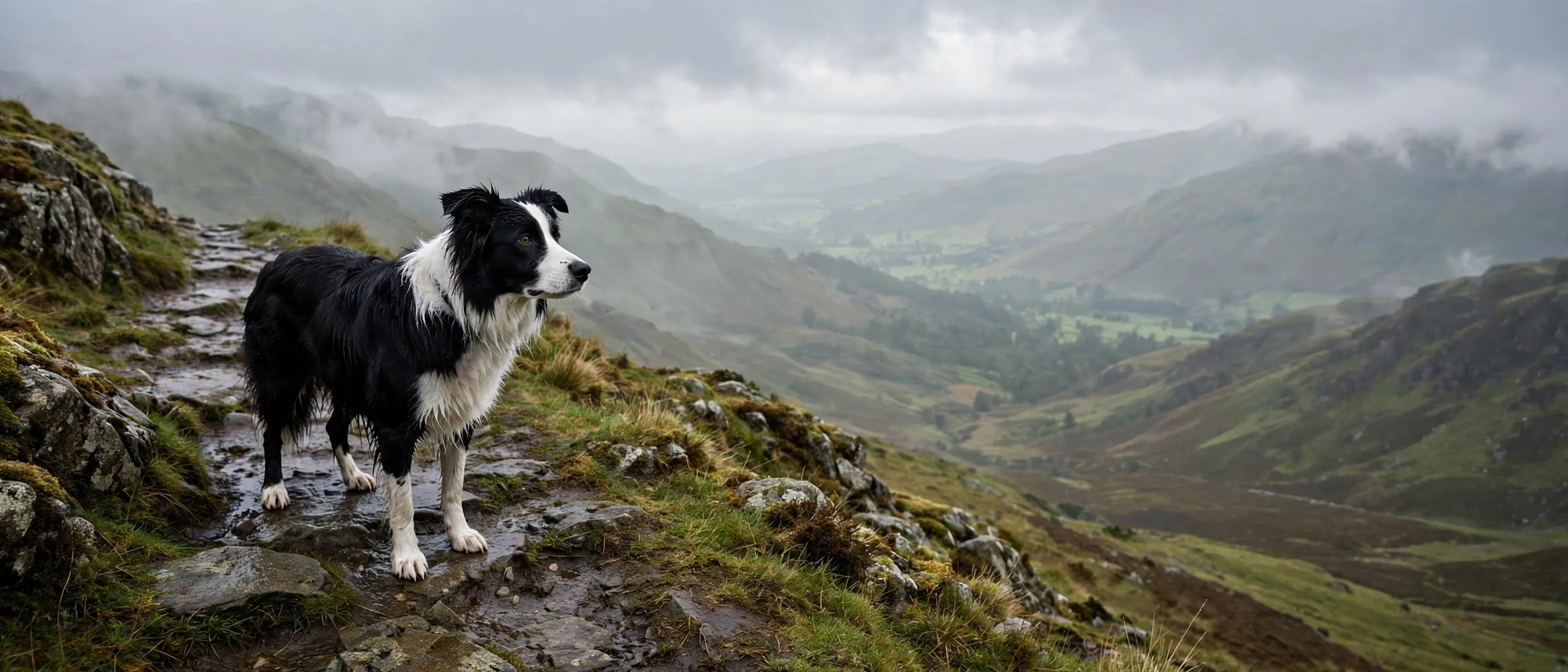
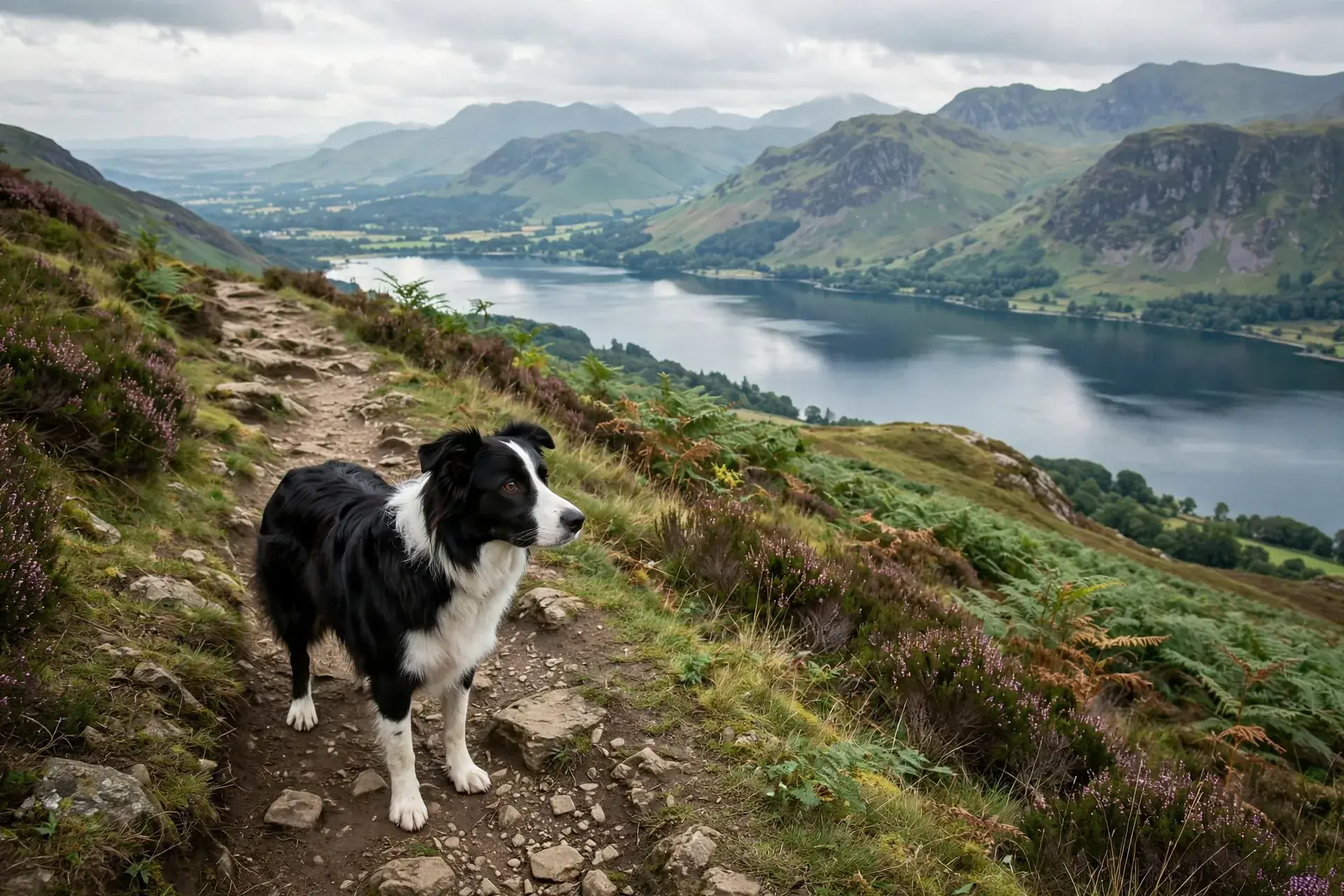
Day three: Keswick and the northern fells. Keswick is the natural base for the most dramatic walking on the route, and it is also the day that separates a good northern trip from a miserable one. A fell path above Derwentwater, such as the lower slopes around Catbells, gives a dog steep, rocky ground, wind and long views in a single morning. The same walk in rain, mist or high wind becomes a different undertaking: visibility drops, the rock gets slippery, and a dog that is confident on a dry path can become anxious on a wet ridge. The rule for the Keswick day is to choose the walk on the morning, not the night before, and to have a lakeshore fallback already parked in your mind. Our Keswick dog guide covers fell safety, lake shore walks and town stays in detail, and it is worth reading before you pick a specific fell. Finish the day early, dry the dog properly, and keep the evening short: a fell day followed by a late, noisy pub visit is how tired dogs become restless dogs.
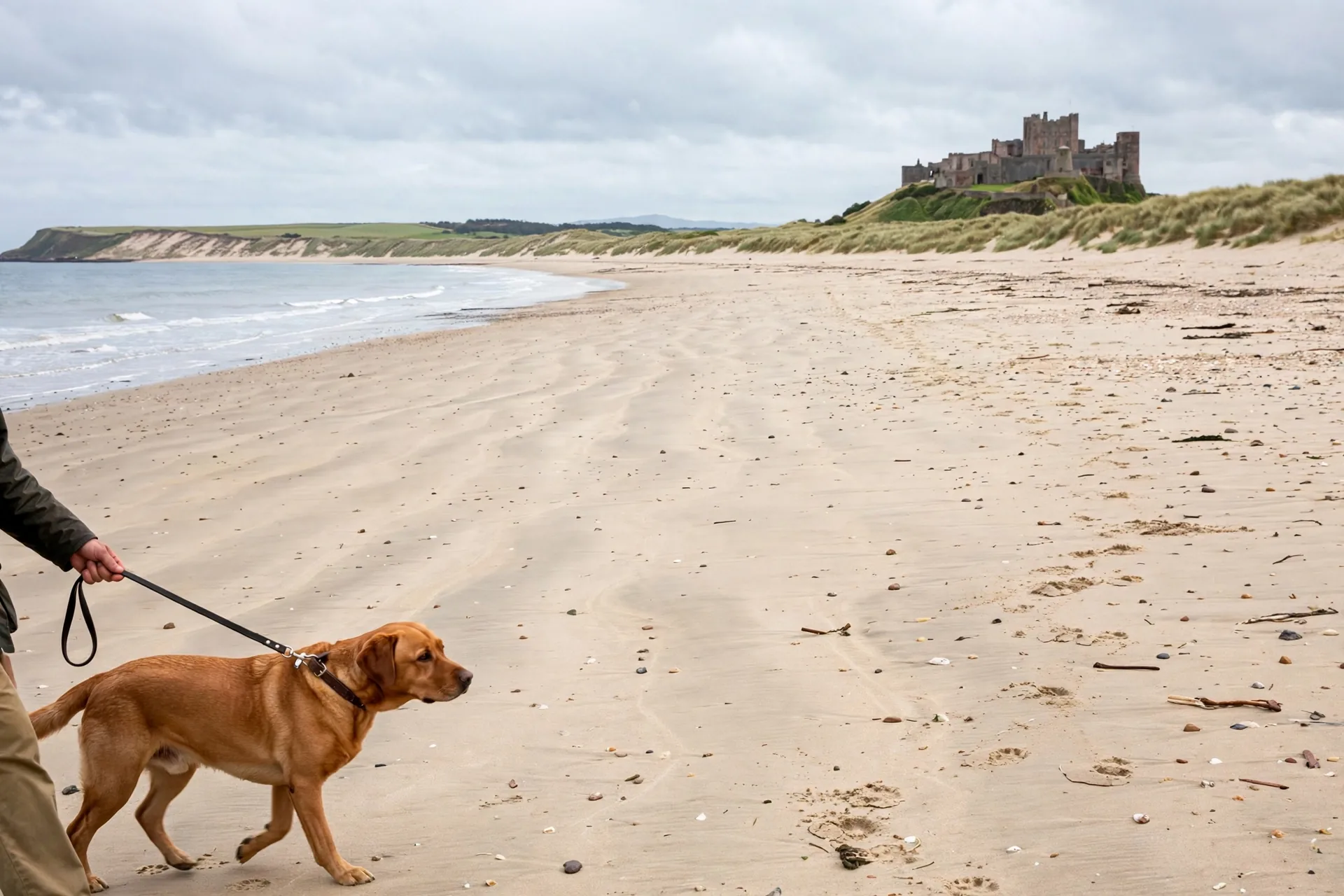
Day four: the Northumberland coast. Drive east to the Northumberland coast and the whole trip exhales. The beaches here are wide, often empty even in summer, and the walking is flat compared with the fells. Bamburgh, with its castle backdrop and long sand, is the obvious finale, but the practical star is the space: a dog that has spent three days on leads through livestock country can finally run, sniff and decompress. Check tide times and the castle area rules, because some sections have restrictions, and keep the dog away from nesting birds in spring and early summer where signs ask for leads. Our Northumberland dog guide covers castle rules, beach access and Holy Island tide safety, which matters if you are tempted to add the causeway. The Northumberland day works as a deliberate cool-down, and it is the strongest argument for the northern line: no southern route ends with this much empty sand.
What the northern line feels like overall. Evenings are quieter, earlier and more weather-dependent. Pubs are welcoming but smaller, many kitchens close earlier than southern visitors expect, and the after-dark walk may be an unlit lane with a torch. The trade-off is the walking itself: no other route in this guide gives a fit dog this much open ground, cold clean water and long, empty horizons in four days. The northern line suits owners who enjoy planning around weather, who do not mind a changed plan, and whose dogs are genuinely fit rather than merely enthusiastic.
Route three: the middle compromise line
Base plan: one night in the Cotswolds, one night in the Peak District, one night in York, and a final day on the Yorkshire coast. This is the busiest itinerary of the three in terms of base moves, so it suits confident travellers who enjoy a new town each night and a dog that settles quickly in new rooms. If your dog takes a full day to settle, slow this route down: drop the Yorkshire coast, spend two nights in York, and treat the Peak District as a day trip rather than a base. The middle line is a compromise, not a greatest-hits tour, and it works best when you accept that trade from the start.
Day one: the Cotswolds. Start with stone villages, commons and gentle valley walks. The Cotswolds give a dog easy, pretty walking without the exposure of the fells or the crowds of the south coast, and the villages are full of cafes with water bowls and terraces. The hidden problem is the road: many of the prettiest villages have narrow lanes, limited parking and through traffic, so a dog that lunges at cars or bicycles needs a short lead and a planned route that avoids the main street at school-run time. Choose a village walk that starts from the accommodation rather than a drive to a honeypot car park, and you will see the Cotswolds at their best: quiet, green and calm. The Cotswolds day is also the best day on any route for a dog that is still learning to settle in cafes, because the pace is slow and the tables are rarely rushed.
Day two: the Peak District. Drive north into the Peak District for a genuine contrast: open moorland edges, gritstone paths and reservoir walks, all within easy reach of Bakewell and Castleton. The Peak District is the middle line's proof that compromise does not mean dull. A dog can walk a moorland edge in the morning, paddle in a reservoir stream at lunch, and sleep in a market town in the evening, all without the long drives of the Lakes. The rules mirror the Dales: livestock, ground-nesting birds in spring, and moorland fire risk in dry summers all require leads and care. Our Lake District versus Peak District guide explains why the Peaks often suit dogs better than the Lakes on access and gentler terrain, and that comparison is useful if you are torn between this middle route and the full northern line. The Peak District day should end early enough for a proper town evening, because the next day's city walk starts sooner than most people expect.
Day three: York. York is the middle line's city day, and it changes the dog's job completely. Instead of open running, the dog needs to cope with streets, crowds, narrow lanes and waiting quietly while the owners split up for indoor attractions. Many historic buildings do not admit dogs, so plan split visits in advance: one person visits while the other walks the dog along the riverside or in Rowntree Park, then swap. The walls have their own rules and are not suitable for every dog, especially one that is nervous around heights, bicycles or crowds, so check the current guidance before you set out. Our York dog guide covers wall rules, riverside walks and dog-welcome stays in detail. The York day is a useful test for any dog that will travel in Britain regularly, because city manners, cafe settling and lead work in crowds are skills that pay off on every later trip, even if the day itself is less wild than a fell walk.
Day four: the Yorkshire coast. Finish at Whitby or Robin Hood's Bay, where the coast is wilder than the south but more sheltered than Northumberland. The cliff paths here are shorter and steeper than the Dorset coast, the beaches have their own seasonal rules, and the fishing villages have narrow streets that suit a short lead and a calm dog. The Yorkshire coast day is the middle line in miniature: a bit of drama, a bit of town, and a finish that feels like a holiday rather than an expedition. If the weather turns, Whitby has more indoor dog-welcome options than a remote northern beach, which is a genuine advantage on a final day when the car is already packed. Finish early, walk the dog properly before the drive home, and avoid the temptation to add a long detour: the drive from the Yorkshire coast to most southern homes is already long enough.
What the middle line feels like overall. Evenings vary more than on either of the other routes, which is both the charm and the cost. A Cotswolds pub, a Peak District market town, a York restaurant and a Whitby fish-and-chip terrace in four days is a lot of variety, but it also means four different settling routines for the dog. Owners who enjoy that variety will love this route. Owners whose dogs need sameness should slow it down, as suggested above, and let York carry two nights. The middle line is the best answer to the question most people actually ask, which is not whether the north or the south is better, but whether one trip can give a dog a bit of everything without exhausting anyone.
What changes from day to day
Compare the three routes on their first mornings and the differences are immediate. The southern line starts with a chalk downland walk and a city base, which means the dog's first experience is open but controlled, with cafes and shops nearby if anything goes wrong. The northern line starts with a Dales valley walk and a village base, which means the dog's first experience is quieter but more rule-bound, with livestock and gates from the first field. The middle line starts with a Cotswolds village walk, which is the gentlest first morning of all, but also the one most likely to lull owners into underestimating the Peak District day that follows. First mornings matter because they set the dog's expectations: a calm first day makes a bolder second day possible, while a frantic first day makes every later day harder.
By the second day, the routes diverge on driving and decision-making. The southern line's second day, in the New Forest, is about restraint: leads near ponies, short forest tracks, and a picnic rather than a summit. The northern line's second day, on a lakeshore, is about crowds and water: early starts, parking strategy, and checking whether swimming is safe. The middle line's second day, in the Peak District, is about terrain: moorland edges, gritstone underfoot, and a walk that can be shortened easily if the dog tires. None of these days is objectively harder than the others, but they demand different skills from the owner. A person who is good at reading livestock behaviour will find the New Forest easy and the Lakes fiddly. A person who is good at reading weather and water will find the opposite. Choose the route whose second day plays to your strengths, not the route whose photographs you liked most.
The third day is where the routes show their true character. Dorset's cliffs ask for tide awareness and a planned finish. Keswick's fells ask for a morning weather decision and a fallback walk. York asks for city manners and split visits. These are not interchangeable challenges, and they are the reason this guide avoids a single winner. A dog that loves swimming and hates crowds will have a wonderful Dorset day and a stressful York day. A dog that loves open running and ignores water will have the opposite experience. The third day is also where fatigue appears: by now the dog has had two days of new smells, new beds and new routines, and a third ambitious day can tip a tired dog into restlessness. On all three routes, the third day should be the one you are most willing to shorten.
The fourth day reveals what each route is for. The southern line ends calmly, either with a repeated Dorset walk or a short Devon trip, and the dog goes home rested. The northern line ends with empty Northumberland sand, which is a deliberate decompression after three days of leads and rules. The middle line ends with a Yorkshire coast day that mixes town and cliff, which feels like a holiday finale rather than a cool-down. If you only remember one comparison from this guide, remember the fourth days: calm, decompression, or variety. Whichever of those three words sounds most like the ending your dog needs is probably the route to book.
Across all four days, one pattern holds on every route: the best days have one main walk, one calm base and one planned evening, while the worst days have two bases, three attractions and a late finish. That pattern is more reliable than any regional stereotype. A southern trip packed with attractions will exhaust a dog faster than a northern trip built around a single fell walk and an early night, and a northern trip packed with driving will do the same in reverse. When you adapt any route in this guide, protect the one-walk, one-base, one-evening shape first, and let the scenery fit around it.
What the routes cost in practice
Headline accommodation prices mislead on all three routes, because the real cost of a dog trip is the total of the stay, the pet charges, the parking, the food and the driving. Southern coastal accommodation is usually the most expensive in peak season, especially around Brighton and Dorset, and the pet fee is often charged on top of an already high nightly rate. A typical pattern for self-catering stays is a pet charge of about 25 to 75 pounds per dog per week, though some properties charge per night or per stay, and two dogs can add 100 pounds or more to a week. Hotels vary more: some charge a flat nightly supplement, others include one dog free and charge for a second, and a few charge for cleaning separately. Get the all-in total in writing before you pay a deposit, and check whether the fee covers the whole stay or only the nights the dog is present, because that distinction catches people out.
The northern line is often cheaper on accommodation but more expensive on driving and kit. Fuel for the longer legs, especially the Lake District to Northumberland drive, adds up, and the kit list is longer: drying coats, extra towels, a boot liner and spare bedding are not luxuries on a fell trip. Parking also differs. Southern beach car parks can be expensive and time-limited, while northern rural car parks are often cheaper but fewer, which means a missed turn can cost half an hour rather than a few pounds. The middle line sits between the two on most costs, but it has its own hidden expense: moving base three times means three sets of cleaning expectations, three check-in windows and more chances to pay for a late checkout or an extra parking ticket. If budget is tight, the cheapest version of any route is usually the slowest version, with fewer base moves and longer stays in one place.
Food costs follow the same pattern as accommodation. Southern towns have more choice and more competition, which keeps cafe prices reasonable, but the most popular dog-welcome terraces in peak season can be pricey. Northern pubs and cafes are often better value, but choice is narrower and kitchens close earlier, which can push you towards a takeaway or a supermarket shop. York, on the middle line, has the widest food choice of any base in this guide, and it is worth using the York day to stock up for the coast. On every route, the cheapest food decision is also the kindest to the dog: a picnic on the walk, eaten where the dog can settle, beats a rushed restaurant visit where the dog is expected to lie quietly under a table after a long, exciting morning.
Finally, budget for the things that go wrong. A muddy dog in a car without a boot liner, a torn lead on a fell, a forgotten drying coat in a wet week, or a beach car park that only takes coins can each cost a small amount and a large amount of patience. Pack a spare lead, a spare towel and a small cash float for rural car parks, and keep a simple first-aid kit for paws. These items cost little and they protect the days that matter: the fell day, the cliff day and the final beach day are all much better when a small problem stays small.
Weather, ground and seasons
Season changes these routes more than region does. In late spring, all three routes are at their best: daylight is long, beaches are quieter before the summer restrictions tighten, lambing rules are easing, and the ground is usually firm enough for most dogs. Summer brings the sharpest differences. The south gets hot, crowded and restricted: beach bans apply on many popular stretches, south-facing accommodation can overheat, and a midday cliff walk can be genuinely dangerous for a brachycephalic or older dog. The north stays cooler and the fells stay walkable, but midges, busy honeypot car parks and sudden rain still require planning. The middle line in summer is a mixed bag: the Cotswolds and York can be hot and crowded, while the Peak District stays more comfortable, which makes the Peak District day the natural centrepiece of a summer middle-line trip.
Autumn is the underrated season for all three routes. September and October bring quieter beaches as summer restrictions lift, calmer accommodation prices, and cooler walking weather that suits most dogs better than August heat. The trade-offs are shorter days, wetter ground and earlier pub closing times in rural areas. Autumn also brings specific hazards: fallen leaves hide uneven ground, rivers rise after rain, and fireworks season in early November can unsettle noise-sensitive dogs, especially in towns. Check whether nearby venues host displays if your dog is sound-sensitive, and plan a quiet indoor evening on display nights rather than hoping the dog will cope.
Winter divides the routes most clearly. The southern coast line wins for most dogs in winter: milder temperatures, open towns, beaches with fewer restrictions, and shorter, flatter walks that suit older dogs. The northern lakes line in winter is beautiful but demanding: short daylight, icy higher paths, and a real need for a warm, dry base with a proper drying area. The middle line in winter is workable if you slow it down, with York and the Cotswolds providing town-based days when the Peaks are icy. Whatever the season, check the official guidance before you travel for path closures, beach restrictions and livestock rules, because a single closed path or a new seasonal ban can change a day completely, and that information is rarely in a printed guide.
Ground conditions deserve as much attention as weather forecasts. Chalk downs drain well but can be slippery when wet. New Forest tracks are sandy and forgiving, but boggy in winter. Dorset cliff paths are exposed and can be muddy after rain. Dales limestone is rough on paws and slippery when wet. Lake District fell rock is hard, steep and unforgiving in mist. Northumberland sand is gentle but tiring for small dogs over long distances. Cotswolds commons are gentle, Peak District gritstone is grippy but rough, York pavements are hard on older joints, and Yorkshire coast cliffs are steep and exposed. Matching the ground to the dog's paws, joints and confidence matters more than matching the scenery to the owner's camera.
Choose by your hardest constraint
If driving time is the hardest constraint, choose the southern coast line. Its legs are short, its bases are close to major roads and rail lines, and a tired driver can cut a day short without abandoning the route. The northern line punishes long driving days, because the legs are longer and the roads are slower, while the middle line sits in between but still requires a confident driver for the Peak District to York leg. A useful test is to add up the driving for the whole route, not just the longest leg: the southern line usually totals the least, the northern line the most, and the middle line the most base moves. If the total driving already feels like a lot before you leave home, it will feel like more with a dog in the car.
If steps, steep ground or joint problems are the hardest constraint, choose the southern line or a slowed-down middle line. Flat coastal paths, riverside walks and village commons are far kinder than fell paths and cliff steps. The northern line can still work for an older dog if you choose lakeshore and beach days and skip the fell day, but then you are paying northern driving costs for southern-style walking, which is rarely the best use of a trip. Ask every property about steps, garden access and the distance to a practical toilet walk at night, because those three details shape an older dog's trip more than any walk description. A ground-floor room with a garden door beats a beautiful first-floor apartment with a long staircase, every time.
If water is the hardest constraint, in either direction, the routes differ sharply. Dogs that love swimming will find the most opportunities on the southern coast line in the shoulder seasons and on the Northumberland coast at the end of the northern line, though cold water and algae need checking. Dogs that must avoid water, because of a medical condition or a fear of waves, will find the Cotswolds and Peak District days on the middle line easiest, because water is an option rather than the main event. On every route, check swimming safety on the day: river currents after rain, sea conditions, algae warnings and boat traffic all change faster than any guide can track.
If crowds and noise are the hardest constraint, choose the northern line outside peak season, or the middle line with the York day softened. The southern line in peak season is the busiest route in this guide, and a nervous dog will feel it in car parks, on promenades and in busy pubs. The northern line's advantage is space: even in summer, a Northumberland beach or a quiet Dales valley can feel empty. The middle line's risk is York, where crowds are concentrated, but that risk can be managed by walking early, using riverside paths, and splitting indoor visits. Whichever route you choose, build a quiet fallback into every day: a known short loop near the base, a calm cafe, or an early return to the room. The fallback is not a wasted day. It is the reason the next day works.
Book in this order
Book the base before the walk, the walk before the table, and the table before the extras. Start by confirming the property's dog rules in writing: the pet fee, the dog limit, the garden or boundary arrangement, and the cancellation terms. Then choose the main walk for each day and check its specific rules: beach restrictions for your dates, livestock expectations, tide times and path closures. Only then book evening tables, because a table that does not welcome dogs, or that sits far from a practical toilet walk, can undo a good day. Extras such as boat trips, castle visits and guided walks come last, because they are the easiest to drop when weather or tiredness changes the plan.
When you compare properties, compare the same things on each route. The checklist is short: total pet cost for the whole stay, garden security, distance to the first walk that needs no car, distance to a vet, and the after-dark toilet walk. A property that wins on all five is rare, so decide which two matter most and let the others be good enough. On the southern line, the after-dark walk and the garden usually matter most, because towns are busy. On the northern line, the drying space and the vet distance matter most, because weather and remoteness are real factors. On the middle line, the base-move logistics matter most, because three moves in four days is the route's main cost.
Finally, leave one day deliberately under-planned on whichever route you choose. The under-planned day is the one the dog will remember as the best day, because it will be shaped by the weather, the dog's energy and the owner's mood rather than by a timetable. It is also the day that absorbs delays: a late arrival, a closed path, a tired dog or a sudden downpour all fit into an under-planned day without breaking the trip. That advice sounds soft, but it is the most practical advice in this guide. Dog holidays fail when they are over-planned, not when they are under-planned, and a route with one loose day is a route that can survive Britain.
So, south or north? The southern coast line gives you the easiest, warmest and most serviced trip. The northern lakes line gives you the wildest walking and the emptiest beaches, at the cost of longer drives and harder weather decisions. The middle line gives you a bit of everything, at the cost of more base moves. None of them is the right answer for every dog. The right answer is the route whose hardest day your dog can enjoy, whose driving you can tolerate, and whose final day leaves the dog calm rather than exhausted. Pick that route, book the base first, and let the dog set the pace from there.
Practical questions
Before you go
Is the south or the north better for a first dog holiday in England?
For a first trip, the southern coast line and the middle line are usually easier because driving days are shorter, walks are gentler and there are more places to stop. The northern lakes line is superb but demands more planning around steep ground, livestock and changeable weather, so it suits a second trip better than a first one.
How long should each route take?
Each route in this guide is written as four days, which is long enough to settle a dog into a routine without turning the trip into a driving marathon. Add a rest day at the same base if your dog is older, nervous or travelling for the first time, and check the official guidance before you travel if beach rules or access arrangements may have changed.
Do I need a different car setup for the northern lakes line?
The car setup is the same, but the packing list changes: add a drying coat, a second towel, a long line for livestock areas, a portable water bowl and a torch for unlit lanes. Northern routes also reward a boot liner and a spare set of bedding, because wet fell walks happen even on otherwise fine days.
Can I mix the three routes into one longer trip?
Yes, but do it by joining bases rather than by chaining every stop. A practical combined trip is two nights on the southern coast line, two nights on the middle line and two nights in the north, with at least one full rest day in each base. Avoid moving base every single night, because dogs settle far more slowly than their owners do.
Which route works best in winter?
The southern coast line usually works best in winter because days are milder, many beaches drop their summer restrictions and towns stay open. The northern lakes line can be beautiful in winter but needs shorter walks, earlier finishes and a warm, dry base, and you should check the official guidance before you travel for path closures and ice on higher ground.
What should I check before booking any of these routes?
Check four things in writing for the exact property and dates: the pet fee and dog limit, the boundary or garden arrangement, the beach or path restrictions that apply on your dates, and the cancellation terms. Rules change by season and by property, so a listing that was dog-friendly last year is not proof for this year.