A springer holiday works on four rails: big physical output in the morning, a brain-tiring nose job every day, water time with proper safety checks, and a two-minute nightly coat routine. Get all four running and the dog sleeps through dinner; skip one and the dog will invent its own entertainment.
Know the engine first
English springer spaniels were designed for full working days in the field: quartering ground ahead of the gun in a tireless zig-zag, flushing game, then retrieving it softly to hand. That engine does not come out of the dog just because you crossed a county line. Show-bred and working-bred springers differ in looks and intensity, but both carry the same double fuel tank — body and brain — and both burn through it at a rate that surprises owners of calmer breeds. Plan a holiday for the dog's actual motor, not for the dog you wish you had.
Think of the springer's energy as two separate tanks, because an empty one of each produces different holiday problems. The body tank holds the running, swimming and jumping. The brain tank holds scent, problem-solving and hunting. A dog that has walked ten miles but never used its nose can still be restless; a dog that has done scent games all afternoon but never run can still bounce off the walls at 9pm. The classic springer holiday symptom — raiding the bins, re-lamping the furniture, rehearsing tricks nobody taught it — is almost always a tank that never emptied. Your daily plan needs a line item for each tank.
There is also a trap worth naming: tired but wired. Springers can look exhausted after a big walk while their nervous system is still buzzing, and the answer is not always more exercise. Some dogs need enforced calm — a crate or a settled mat, in a quiet corner, with a chew — to actually power down after excitement. If your dog is pacing, panting and unable to choose a bed after a huge day, try less stimulation and more structure before you add another walk.
Finally, be honest about which springer you own. A steady seven-year-old with a stop whistle is a different holiday companion from a fourteen-month-old rocket that has never seen a sheep. The honest dog is the one you pack for: the right mix of long lines, garden security and planned output turns an exciting young dog into a manageable one, while pretending the dog is steady creates the week where everything goes wrong on day three.
A day that spends energy on purpose
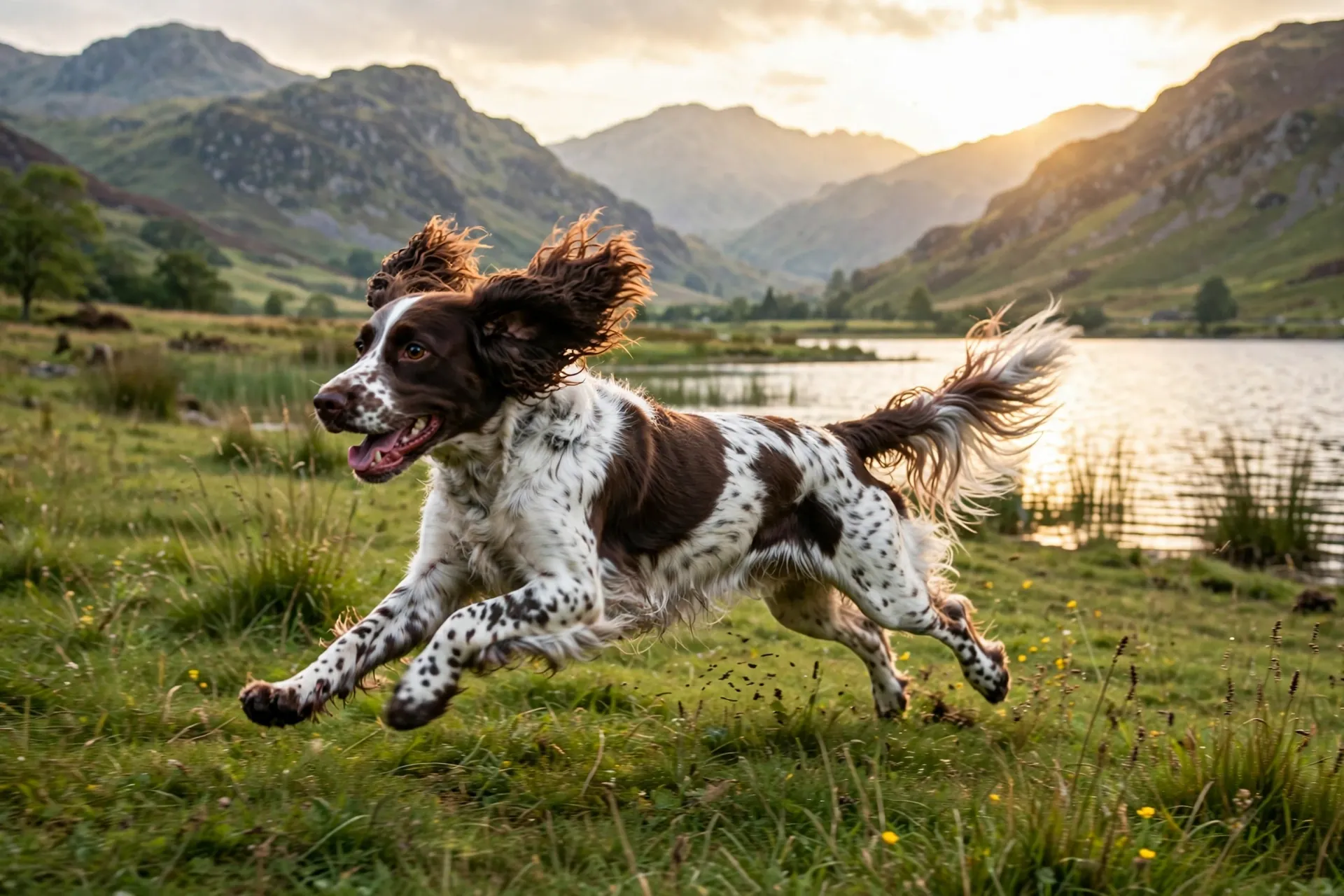
Springers do best on a day with a clear shape: hard work in the morning, a proper rest window in the middle, a second outing in the afternoon, and a settled evening. A workable default for a healthy adult dog is a big aerobic walk or run of 75 to 120 minutes in the morning — covering ground, off the lead where it is safe to do so — then a genuine rest of several hours, then a 45- to 60-minute afternoon outing that leans on sniffing, exploring or water rather than pure distance. The last walk of the day is short and boring: toilet business, then bed. Days with shape settle dogs; days of random stimulation do not.
The midday rest deserves defending. Springers will keep going on your enthusiasm long past the point where their bodies would like a pause, especially on a novel holiday where everything smells new. Build in an enforced nap the way you would for a puppy: back at the cottage, same mat or crate as at home, room cool and quiet, door closed on the world for an hour or two. Dogs that actually sleep at midday are calmer on the afternoon walk and dramatically better behaved at dinner.
Alternate hard and easy days across the week. A springer that does a five-hour fell day on Monday will enjoy a shorter woodland potter on Tuesday, and the owner's knees usually agree. Rest days are not wasted days: a ten-minute scent game in the garden and a riverside dawdle can leave a springer just as content as another epic, and the dog will be fitter and less foot-sore on the drive home. Watch the paws across the week, especially on rough fell ground or hot tarmac — gradual build-up beats a spectacular day one followed by three days of limping.
Warm days need their own plan. Springers in full feathered coats heat up faster than they look like they do, and a dog that is frantically happy at the start of a midday walk in August can be in trouble by the end of it. Walk early, carry water and offer it before the dog is gasping, and treat rivers and lakes as swimming opportunities only where they are genuinely safe — a hot dog will throw itself into water you would never have chosen.
Recall training that beats the nose
A springer's nose is wired directly to its legs: scent detected means scent followed, and scent followed can mean a dog three fields away with a deeply satisfied expression. Holidays put this wiring in front of stronger temptations than home — game birds, rabbits, deer slots, fishing bait, picnic remains — so the recall work you do before the trip decides how free the dog gets to be during it. A springer with a genuine recall gets a magnificent holiday. One without gets a long line and a wistful owner. Both can be happy; only one gets to roam.
The breed's native language is the whistle. A stop whistle — one firm blast that means sit, wherever you are — and a recall whistle — a pip-pip-pip that means come back now — are how working springers are run, and pet springers take to the same system fast because it carries further than a shout and arrives unaccompanied by your panic. Teach both at home with boring, high-value repetition: hundreds of easy wins for turning towards you, then sitting at distance, then coming away from mild distractions. On holiday the whistles become the interface between freedom and safety, and every reliable rep you banked at home pays out with interest in new country.
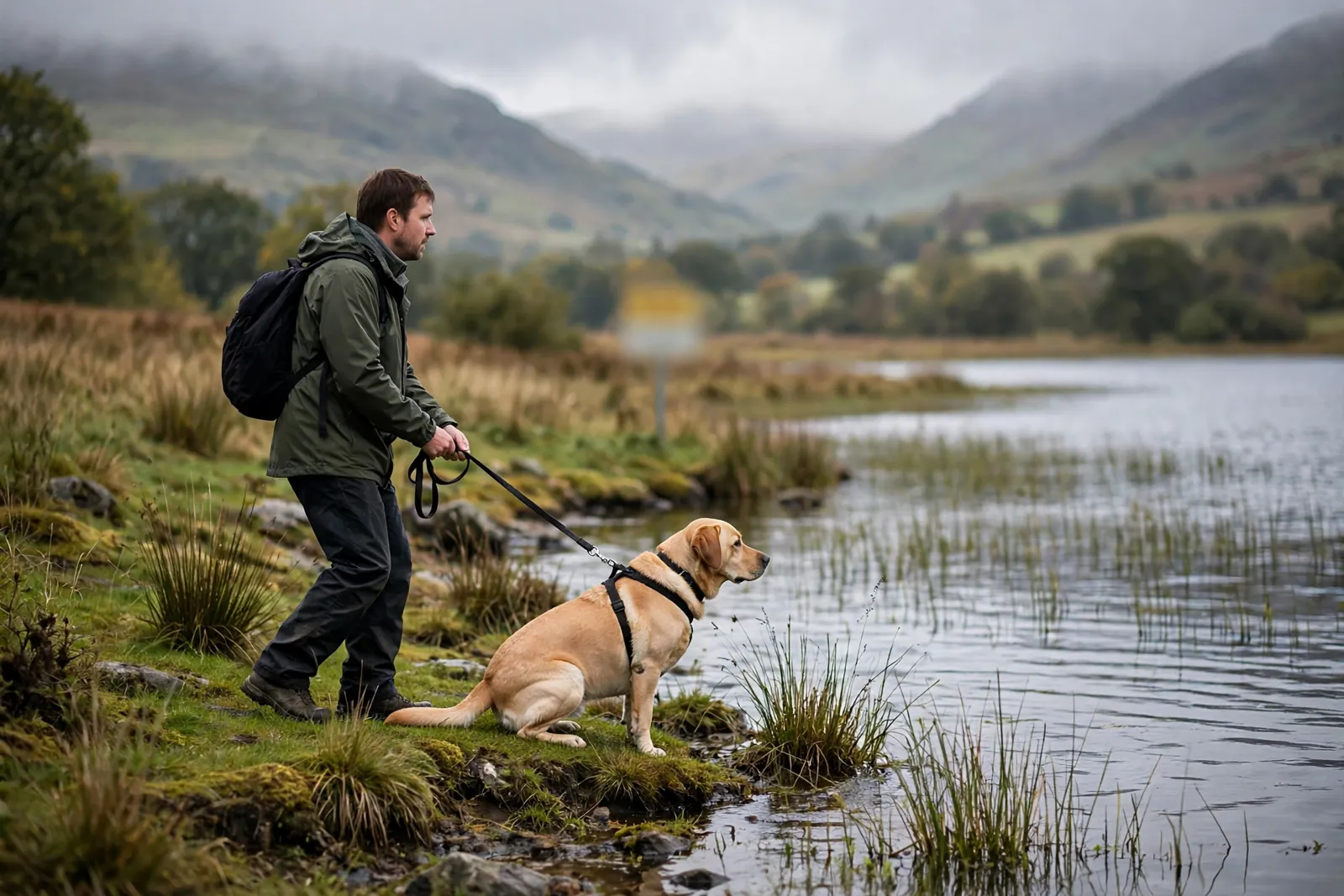
Until the recall is bombproof, the long line is not a punishment — it is the holiday enabler. A ten-metre line on a harness lets a springer quarter, snuffle and splash with real freedom while you keep the final say near roads, cliffs, livestock and cover that is thick with game. What the long line needs is technique: keep it off the ground as much as you can, learn to gather it smoothly, and never let it teach the dog that pressure on the neck is ignorable background noise. Pair the line with recall games so the dog practises succeeding rather than just being prevented from failing.
Manage the flushing instinct rather than hoping it naps. Springers are bred to push into cover and put birds up, which means hedgerows, reed beds, ditch lines and woodland edges are all launch pads on a holiday walk. Walk these on a lead or line until you have seen the area, keep the dog close with the stop whistle where you can see game, and reward the dog enormously for checking in voluntarily — a springer that learns the human is the source of the best game in the field will keep choosing you. If you are unsure whether a field holds birds or stock, default to the lead. Hope is not a recall strategy.
Schedule water like an activity
Ask a springer about water and you will get a unanimous answer: all of it, immediately. The breed's history is soaked — retrieving from cold water is in the job description — and most springers swim strongly with a confidence that can outrun their judgement. Your job is to turn that enthusiasm into planned swim sessions rather than constant, unsupervised plunges, because even a natural swimmer tires, chills and misjudges entries. Our full guide to dog water safety in the UK covers the general principles; here is the springer-specific version.
Start every swim spot with your own entry check, because the dog will not do one. Look for a safe way in and out: a gently shelving bank beats a vertical drop every time, and a springer that launches off a pontoon or a steep rock into unknown water is gambling. Check what is under the surface at the entry — old fishing line, shopping trolleys and sharp rubble turn up in the prettiest-looking lakes. Avoid water near weirs, sluices, reservoir outlets and fast river bends entirely, and give tidal water the respect it deserves: currents and outgoing tides are stronger than any dog.
Keep sessions short and structured. A springer will swim until it drops if the game continues, so the adult in the partnership has to call the breaks: five to ten minutes of swimming, then out, then a shake and a rest before the next round. Watch for the quiet signs of fatigue — slower paddling, a lower head carriage, glazed enthusiasm — and pull the dog out while it is still having fun. Tired dogs drown silently, and it happens to strong swimmers on ordinary lakes.
Cold water needs particular respect. British lakes and tarns stay cold well into summer, and a dog swimming hard in cold water can chill fast, especially smaller or leaner springers. Shivering after a swim is a signal, not a quirk: towel the dog down, put on a drying coat, and keep moving gently to rewarm. On genuinely cold days — early spring tarns, exposed Highland lochs — skip the swim in favour of bankside play, or keep dips very brief.
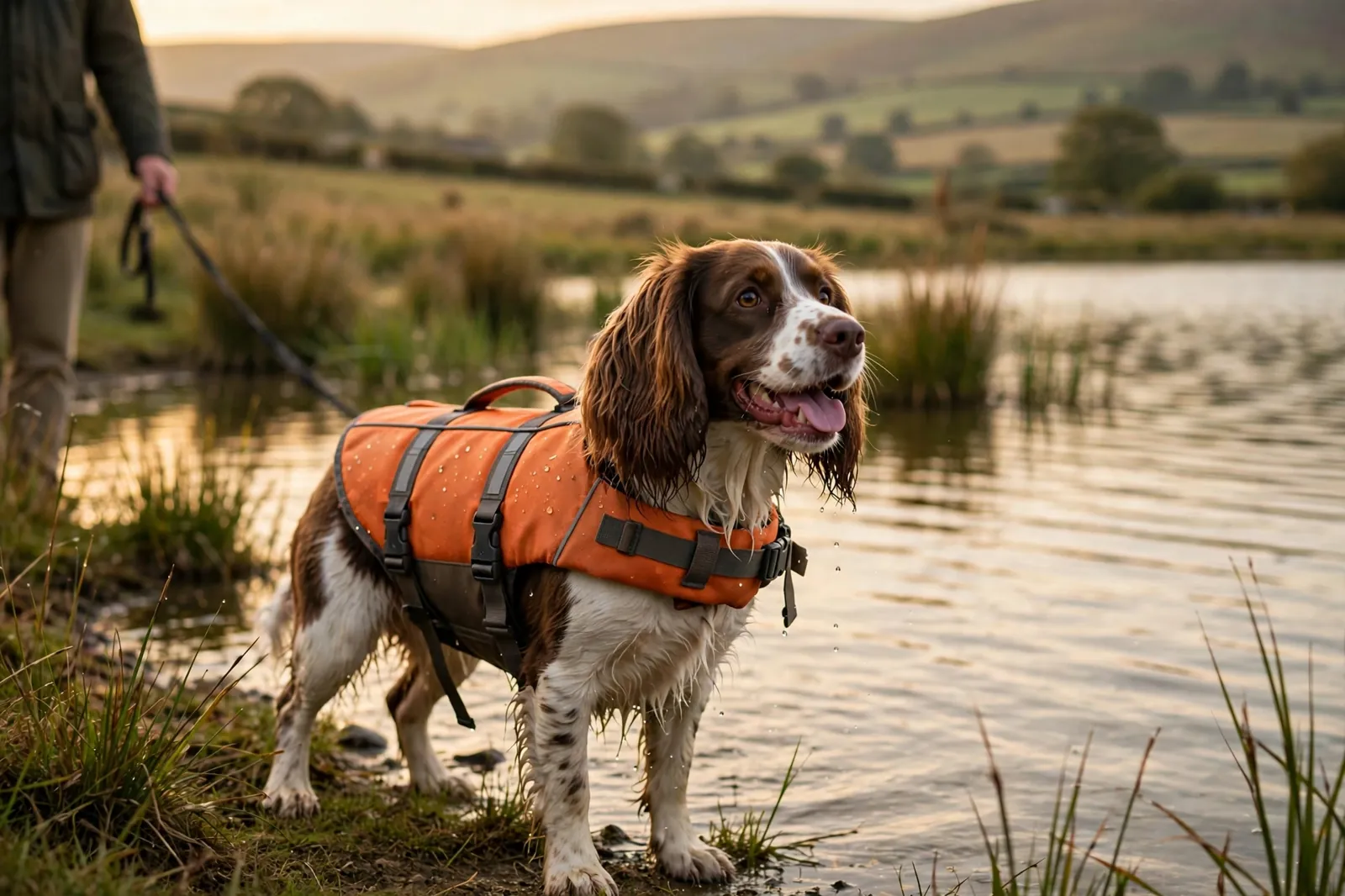
Consider a canine life jacket, especially for a young dog, an older dog, or any springer that treats deep water as a personal challenge. A well-fitted jacket with a grab handle does two jobs: it keeps the dog's head higher and swimming more efficiently, and it gives you something to hold onto in a rescue. It is cheap insurance for boat trips, tidal paddling and big cold lakes — and it does not replace the entry check, the short sessions, or your attention.
After the swim, run the exit routine. Rinse off lake and river water where you can, dry the ears, and let the dog shake properly before the car — a wet springer in a boot crate is a recipe for a musty dog and a musty car. Check between the toes for grit and the ears for trapped water, and keep an eye on appetite and energy over the next day or two: most post-swim grumbles are nothing, but a dog that is flat after swimming in dubious water deserves a vet call.
Read wetlands before your dog does
Lakeshores, reed beds, marshes and slow backwaters are springer paradise and also where the holiday's real water hazards live. The dog sees splashing fun; you need to see the three things that can turn a paddle into a veterinary emergency: toxic algae, infections from standing water, and the livestock that often shares these landscapes. None of this should scare you off wetlands — it should put your eyes on the job before the dog's nose takes over.
Blue-green algae is the one to know by sight. In warm, still water from late spring through autumn, certain algae can bloom into green, blue-green or brownish scums and paint-like streaks on the surface, sometimes with a musty smell. These blooms can be lethal to dogs, and fast. The rule is absolute: if the water looks scummy, discoloured or oddly thick, the dog stays out and on the lead along the bank. If you even suspect contact, rinse the dog immediately to stop it licking its coat and call the vet without waiting for symptoms. Our detailed guide to blue-green algae and dogs in the UK shows exactly what to look for and what to do.
Standing and slow-moving water carries a second risk worth a pre-holiday vet conversation: leptospirosis, a bacterial infection dogs can pick up from contaminated water, mud and the urine of wildlife and livestock. Wetland holidays put dogs in exactly this environment, so ask your vet before you travel whether your dog's vaccinations cover it — and check official guidance for the latest advice if you are unsure. Either way, discourage drinking from stagnant ditches and puddles; a springer that will drink anything needs a portable water bottle and an owner with quick reflexes.
Reed beds and damp margins are also prime tick country. Ticks wait on vegetation exactly at springer-nose height and climb aboard during the most joyful parts of the walk. Run a tick check every single evening on wetland days: ears, between the toes, armpits, groin and around the collar. Learn to remove them cleanly with a tick hook — twist, don't yank — and watch the bite sites over the following days. If you are heading somewhere famously tick-heavy, ask your vet about preventative treatment before the trip.
Finally, wetlands are working landscapes. Sheep, cattle and ground-nesting birds share these places, and a springer quartering a marsh in spring is a livestock-worrying incident waiting for a headline. Keep the dog on a lead anywhere near sheep or cattle — worrying livestock is a serious matter and farmers are within their rights to protect their animals — and be extra careful through lambing season. Nesting birds deserve the same courtesy: a springer that flushes a lapwing off its nest has not had a good walk, whatever the dog thinks.
The feathered coat on tour
The springer's feathering — the long silky hair on the ears, legs, chest and tail — is the breed's signature and the holiday's maintenance project. At home it is a weekly comb; on a week of wet walks, muddy tracks and swim sessions it becomes a daily one. Feathering collects burrs, grass seeds, thistles, sheep droppings and the entire contents of every ditch the dog admired, and left alone it mats into felt that has to be cut out. A two-minute evening routine saves a one-hour detangling battle at the end of the week.
Make it a nightly ritual: steel comb through the feathering on the legs, ears and belly, working from the ends inward so you are not pulling against the skin. Clear burrs and seeds while they are fresh — they tighten overnight. Check between the toes, where mud and small stones pack into the pad hair and cause limping that looks mysterious until you look. Many springer owners keep the hair between the pads trimmed short for exactly this reason; do it with blunt-ended scissors before the trip, or ask a groomer, rather than improvising with kitchen scissors in a holiday cottage.
Ears need their own attention, especially on water-heavy holidays. Springer ears hang long and trap warmth and moisture — perfect conditions for the infections this breed is prone to. After every swim, dry the ears gently and let air circulate; on drying days, lift and fan them. Know the warning signs: repeated head shaking, scratching at the ear, an unpleasant smell, or the ear flaps feeling hot. If any of those persist beyond a day, call a vet rather than hoping it clears — ear infections are miserable and they do not self-resolve.
Drying is half the battle. A wet springer holds an astonishing amount of water in its feathering, and a dog left to air-dry in a draughty cottage stays damp for hours. Towel thoroughly, then put on an absorbent drying coat — it works while hanging over a chair, which two towels cannot do. Rinse muddy legs at the cottage's outdoor tap before the dog comes through the door, and keep a washable mat by the entrance as the designated shake-off zone. Your damage deposit will thank you.
Pack a proper grooming kit and it lives in one small bag: a slicker brush, a steel comb, a tick hook, blunt-ended scissors, a dog-safe ear cleaner recommended by your vet, a couple of absorbent microfibre towels, and a drying coat. That is the whole list, and it is the difference between a coat that gets better through the week and one that gets booked in for a humiliating shave when you get home.
Book for the dog you have
Springers are not the breed for the delicate cottage with the unfenced courtyard and the white sofa. They are the breed for the place with a secure garden, a utility room, an outdoor tap and walks from the door. When you are comparing accommodation, run it through the springer filter: can this dog be dried, aired and exercised here without a military operation? For the full checklist on outdoor space, see our guide to self-catering stays with secure gardens.
Garden security is the headline. Springers are athletic, clever about gates, and motivated by whatever is on the other side — which is everything. Ask for the fence height, the gate latches and any gaps under fencing or hedges, and be suspicious of "enclosed" claims without measurements. A determined springer treats a low decorative fence as a hurdle and an open latch as an invitation. If the garden is genuinely secure, it becomes the evening toilet solution, the scent-game arena and the place where the dog can decompress without a lead — worth paying for.
Inside, look for washable floors, a boot-room or utility area, and easy access to the outdoors for the last outing of the night. Springers that sleep downstairs near the back door settle better than dogs marched past three bedrooms and a sleeping toddler. If you crate-train, bring the crate: familiar containment in a new place is how springers learn that this particular building is for sleeping, not for patrolling. Two dogs double the drying, the mud and the pet fee — declare both honestly, because the surcharge for a discovered second dog is always worse than the fee.
Location beats luxury. A modest cottage with a big walk from the door will make a springer happier than a spectacular lodge where every walk starts with a twenty-minute drive and a parking argument. When you are shortlisting, check the walk that starts at the front gate: is there open ground within ten minutes, is it safe for the dog's recall level, and does it stay usable in the rain? A springer holiday lives or dies on the default walk, not the famous one you drive to twice.
Give the nose a job every day
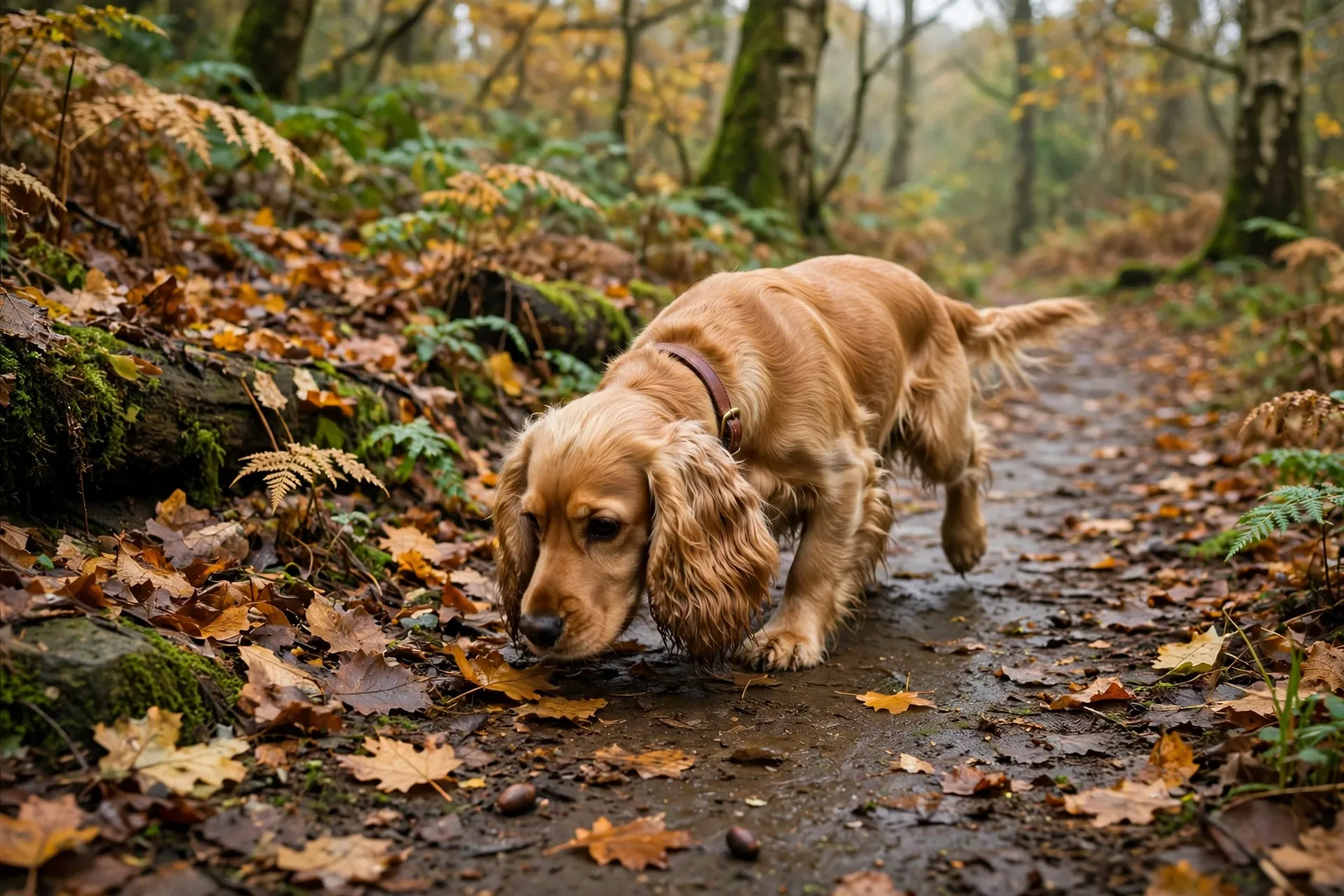
Here is the secret the best springer owners know: ten minutes of nose work can settle a dog more than an extra hour of walking. The springer's brain is a scent-processing machine built for a working day of finding things, and a holiday that never asks it to find anything is a holiday running on half the dog. Daily scent games are the cheapest, easiest and most portable part of the whole plan — and they work in a cottage garden, a lay-by field or a rainy afternoon when the fells are out of the question.
Start with the retrieve, the breed's mother tongue. A canvas dummy or a favourite ball, thrown into cover so the dog has to hunt it out, is more tiring than the same throw on open lawn — the searching is the point. Build it up: short visible retrieves, then retrieves into light cover, then a simple "lost" game where the dog watches you place the dummy and has to remember and find it. Keep sessions short, end while the dog is keen, and always let the dog win often enough to stay hungry for the game.
Add find games that need no equipment. Hide treats or the dog's dinner kibble around the garden or a quiet corner of a walk and send the dog to "find it" — a scatter of kibble in long grass buys twenty minutes of concentrated sniffing and a deeply satisfied dog. As the week goes on, make the hides harder: higher, further, in wind. You can lay a simple scent trail by dragging a smelly treat bag along the ground and letting the dog follow it to a jackpot at the end. The dog is doing, in miniature, the job its ancestors did all day.
Use nose work strategically on rest days and wet days. A springer that has had a proper scent session in the morning will sleep through an afternoon you spend in a pub or a museum, while a springer that has had nothing will spend the same afternoon rehearsing escape plans. Ten focused minutes before you leave the dog settled — with water, a chew and the radio on — turns "left alone in a strange cottage" from a risk into a nap. That is the whole trick of the breed: a worked nose is a quiet house.
Holiday shapes that suit a springer
Some holidays fit the springer shape better than others. The breed wants three things from a destination: big safe ground to cover, water to swim in, and interesting scent country. Britain delivers all three in several flavours — pick the one that matches your dog's recall level, your appetite for mud, and the season. Wherever you go, check local dog rules and seasonal restrictions against official sources before you travel, because access changes and the dog pays for your assumptions.
The lake-and-fell week. The Lake District is the classic springer holiday: tarns to swim in, fells to climb, and pubs that have seen muddier dogs than yours. It suits dogs with reliable recall and owners with legs, because the best ground is high and the weather turns fast. Keep dogs on leads where sheep graze the open fell — which is most of it — and treat every tarn with the entry check from the water section. Windermere and its surroundings make a good base; our Windermere guide with a dog covers the practicalities.
The big-beach week. Norfolk, Northumberland and the wilder Cornish coasts offer the miles of sand that let a springer run properly flat out — the one thing no inland walk quite replicates. Check seasonal dog restrictions beach by beach, because many popular sands limit dogs in summer and the rules vary cove to cove; out of season, the same beaches are gloriously empty. Tidal awareness matters: know the tide times, keep the dog off dangerous currents, and rinse salt and sand out of the feathering every evening or pay the matting price.
The moor-and-wood week. Dartmoor, the Peak District and the North York Moors give you vast open ground with fewer sheer drops and crowds than the high fells. This is prime scent country — game birds, rabbits, deer — so it rewards dogs with good stop whistles and punishes hopeful ones; bring the long line without shame. Moorland also means ticks and, in summer, adders on sunny banks, so the evening tick check is non-negotiable and dogs should be discouraged from nosing into rocky crevices. Our Dartmoor dog walks guide is a good starting point for that landscape.
The gentle-countryside week. Not every springer needs mountains. The Cotswolds, the Wye Valley and rolling East Anglian countryside offer long, waymarked trails, riverside paths and dog-welcoming pubs at civilised intervals — ideal for older springers, young dogs still building fitness, or owners who want the walking without the weather drama. The trade-off is more livestock, more roads and more other dogs, so lead discipline and recall manners matter more here than raw stamina.
Whichever shape you choose, do one unglamorous job before you book: save the number of the nearest vet and the nearest out-of-hours practice to your phone. Rural practices close early, holiday emergencies happen at 10pm on Sundays, and the springer's talent for finding trouble in water, cover and livestock means the number is not a formality. Five minutes of admin before the trip beats a panicked search with a limping dog.
Practical questions
Before you go
Can a springer spaniel cope with long hiking days in the UK?
Yes — healthy adult springers are built for long days and many outwalk their owners on multi-mile fell routes. Build fitness over the week rather than hammering day one, carry water and a snack on warm days, watch paw pads on rough ground, and keep at least one easier day in the plan so the dog fully recovers before you drive home.
How do I keep my springer from chasing birds or sheep on a holiday walk?
Train a whistle stop and a whistle recall before you travel, reward both heavily, and use a long line in new or stock-dense country until both are reliable. Keep the dog on a lead near livestock — sheep worrying is a serious offence — and expect cover, ditches and hedgerows to be irresistible, so walk with a plan rather than hoping for the best.
Is it safe to let my springer swim in lakes and tarns?
Often, but check every entry yourself: a safe in-and-out point, water that is not stagnant or scummy, and no strong current near outlets or weirs. Keep sessions short, rest the dog between dips, warm them afterwards, and never push a cold or tired dog into water. If you suspect blue-green algae, keep the dog out entirely, rinse any contact off and call the vet at once.
How do I stop the feathered coat from matting on holiday?
Comb the legs, ears and belly every evening with a steel comb after muddy or wet days, clear burrs and seeds before they mat, keep the hair between the paw pads trimmed, and dry the ears after swimming. A two-minute nightly routine beats a one-hour detangling session at the end of the week.
Will a springer spaniel settle in a holiday cottage after a big day out?
Almost always, once the day has spent both the body and the brain. Pair a long physical walk with a nose game — retrieves, hidden treats, a short scent trail — and most springers collapse happily for the evening. Under-exercised springers invent their own entertainment, usually involving your luggage, so plan the day's output before you plan dinner.
Should my springer wear a life jacket on water holidays?
A well-fitted canine life jacket is sensible insurance for a strong swimmer that overestimates itself: cold lakes, deep tarns, tidal water and any boat trip are all good reasons. It does not replace supervision, recall and common sense about currents, but it buys time if the dog tires or gets into trouble away from the bank.