This guide is independent and contains no paid placement. Operator policies change, sometimes without notice, so treat everything below as a starting point and check the official guidance before you travel.
Most UK open-top sightseeing buses accept dogs, usually free, but the deck they may use, whether a carrier is required, and how many dogs are allowed per passenger all vary by operator and route. London and Edinburgh offer the widest choice; smaller cities may have only one operator, so one rule change matters more. Default to the lower deck on a first ride, keep the lead short, and always have a walking backup for the stops that matter most.
London: the biggest choice, the most variation
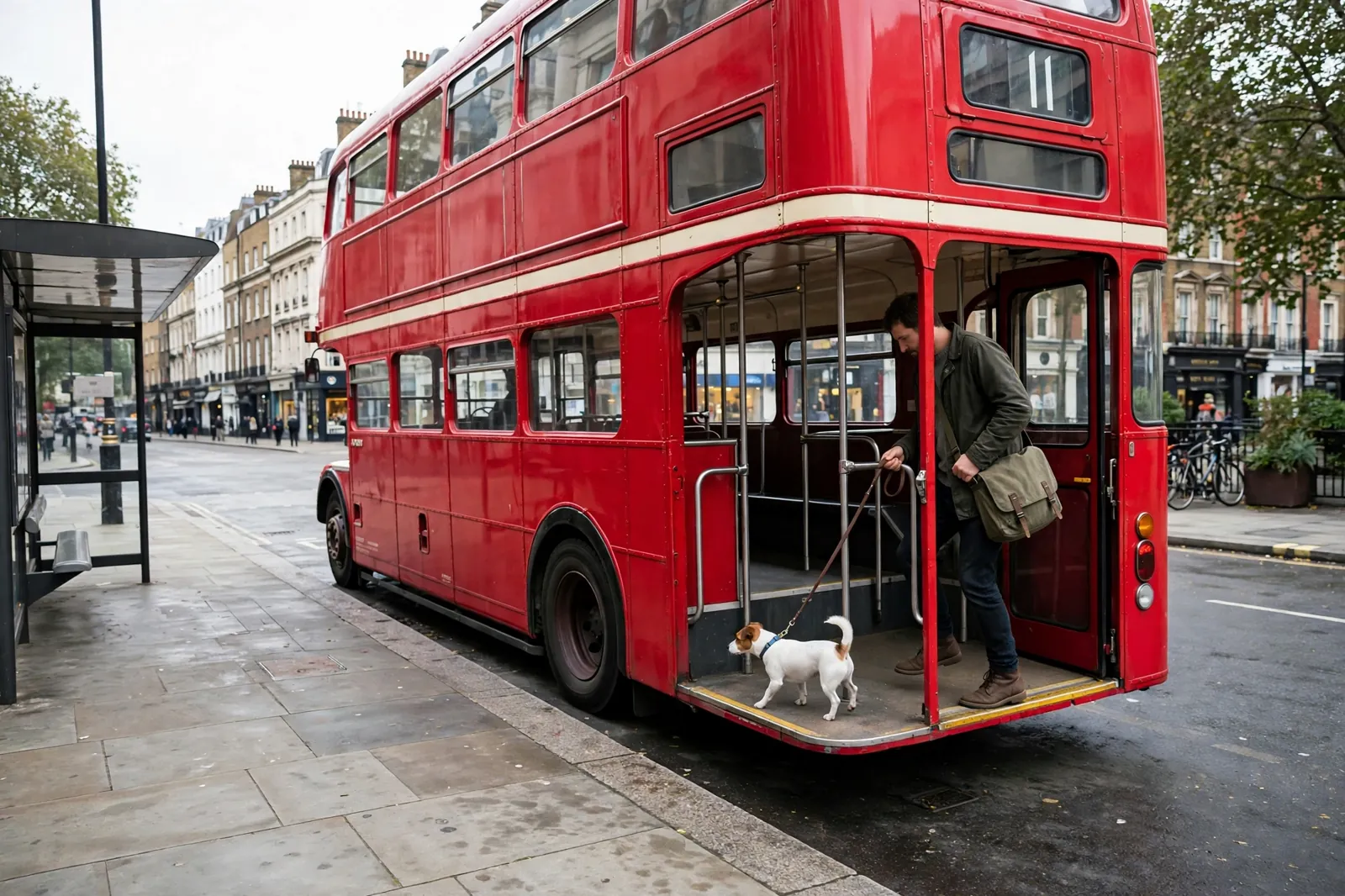
London is the easiest city in which to ride an open-top bus with a dog, and also the city where it is easiest to assume the wrong rule. Several competing hop-on hop-off operators run overlapping loops past the Tower, Westminster, Trafalgar Square, Buckingham Palace, the London Eye and the West End, and their dog policies are not identical. One operator may welcome dogs on both decks, another may restrict dogs to the lower deck, and a third may ask for a carrier on busy services. The difference is rarely advertised in big print on the ticket page, so the check that matters is the operator's own frequently asked questions page or its conditions of carriage for the exact ticket you are buying. General advice about dogs on London buses is a useful background read, but sightseeing buses are a separate product from Transport for London services, and the rules do not carry across automatically.
The practical shape of a London sightseeing day is a loop rather than a point-to-point journey. Most tickets are valid for 24 or 48 hours, which suits a dog far better than a single expensive ride, because you can hop off whenever the dog needs a toilet break, a drink or a quiet street, and hop on again later without paying twice. The full loop in London commonly takes around two to two and a half hours in traffic, which is too long for many dogs to sit still without a break, so plan to ride in sections. A sensible first section is a short stretch between two green stops, for example a park or a riverside walk, rather than the whole circuit. If your dog settles well, extend the next section; if not, you have lost nothing, because the ticket still covers the rest of the day.
Boarding in London is usually at a clearly marked stop with a member of staff nearby at the busiest points, which helps: you can ask before you step on, rather than discovering a restriction halfway up the stairs. At quieter stops there may be nobody to ask, so the driver is the decision maker, and driver discretion is a real factor on the day. Keep the dog close, the lead short and the ticket ready, and let the driver see a calm dog rather than hearing about one. Peak times, especially late morning on weekends and school holidays, are the worst moments to test a borderline policy, because a full bus leaves no spare seat for a dog and no patience for a negotiation. Travel early, travel on a weekday if you can, and sit near the front of the lower deck on a first ride so you can hop off quickly if the dog becomes restless.
London also offers the best fallback when a sightseeing bus does not work out. Ordinary buses, walking routes along the Thames, and large parks such as Hyde Park, Regent's Park and Greenwich Park give you alternatives within a few minutes of almost any sightseeing stop. That matters because the cost of a sightseeing ticket is high enough that a refused boarding stings, but the day is only ruined if the bus was the whole plan. Build the day around two or three places the dog can enjoy on foot, and treat the bus as the link between them rather than the main event. If you are combining the bus with a longer stay, our wider guidance on dogs on UK buses and coaches explains how local bus rules differ from sightseeing rules, which is worth knowing before you rely on an ordinary bus as a backup.
Edinburgh: hills, wind and a compact loop
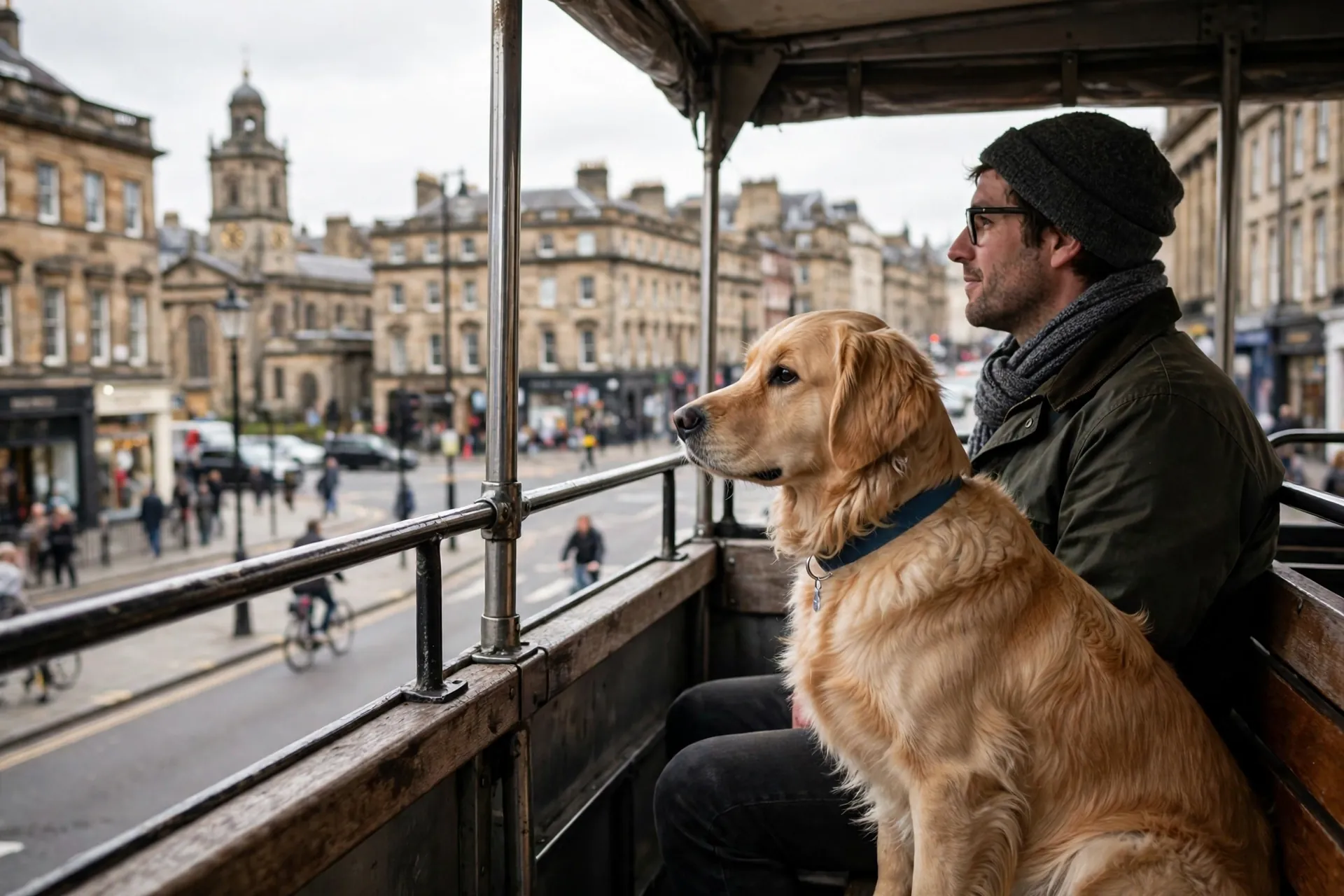
Edinburgh's sightseeing loops are shorter and more compact than London's, which often suits a dog better. The main routes circle the Old Town and New Town, pass the Castle, the Royal Mile, Holyrood and the Georgian streets of the New Town, and give a good orientation on a first day. Because the city is hilly and the weather changes fast, the open deck is more exposed here than in most English cities: wind funnels along Princes Street and the Royal Mile, rain can arrive sideways, and a sunny start at the boarding point is no guarantee of sunshine on the top deck twenty minutes later. A dog that is happy on a calm London loop may still dislike an Edinburgh loop on a gusty day, so judge the weather at the moment of boarding, not the forecast from the morning.
Operator policy in Edinburgh follows the same pattern as elsewhere: dogs are commonly accepted, but the deck rule and any carrier requirement vary, so check the official guidance before you travel for the operator you intend to use. The compactness of the city is your friend here. The loop is short enough that you can ride one section, hop off for a walk in Princes Street Gardens or around Calton Hill, and rejoin later, without committing the dog to a long stretch. It is also worth remembering that Edinburgh's streets are steep and cobbled in places, so the walk between stops can be harder work for a small or elderly dog than the bus ride itself. Plan stops with level ground nearby, and avoid asking an arthritic dog to climb from a bus stop up to the Castle and back in one stretch. Our Edinburgh with a dog guide covers the hills, parks and calmer walking routes that pair well with a short bus ride.
Festival season, in August, changes the calculation. Buses are fuller, stops are busier, street noise is higher, and queues at boarding points are longer, all of which raise the stress level for a dog that is fine on a quiet weekday. If you are visiting during a festival or a major event, ride early in the morning, choose the lower deck, and keep the ride short. Outside festival season, Edinburgh is one of the most rewarding open-top cities for dog owners, precisely because the loop is short, the views from the top deck are genuinely spectacular, and the city is walkable enough that the bus is a bonus rather than a necessity.
York: a small city that suits a short loop
York's sightseeing loop is short, flat and easy to understand, which makes it one of the best first open-top experiences for a dog. The route typically circles the city walls, the Minster, the Shambles area and the railway station, and the full circuit takes well under an hour in normal traffic. That short duration is a genuine advantage: a dog that would struggle with a two-hour London loop can often manage a York loop comfortably, especially if you sit on the lower deck for the first half and only move upstairs if the dog is settled. York is also a city where walking is a pleasure in itself, with the walls walk, riverside paths and large green spaces, so the bus works best as an orientation ride at the start of the day, followed by walking for the rest of it.
Because York usually has fewer competing operators than London, the dog rule you find is more likely to be the only rule in town, so check it carefully rather than assuming a rival operator will be more permissive. Ask specifically whether dogs are allowed upstairs, whether a carrier or a blanket on the seat is expected, and whether there is a limit on the number of dogs per passenger. Small operators sometimes apply a one-dog-per-adult rule that matters for two-dog households, and a rule that is relaxed on a quiet Tuesday may be enforced strictly on a busy Saturday. If you are planning a wider trip, our York with a dog guide sets out the walks, pubs and practicalities that fill the rest of the day once the bus loop is done.
One York-specific caution is the narrow streets and low branches on parts of the route. On the top deck, keep the dog seated and away from the edge of the seat, and keep the lead short enough that the dog cannot stand up and lean over the side. This is good practice everywhere, but it matters more in a city where the bus passes close to overhanging signs, hanging baskets and tree branches. A dog that loves to stand with its head up will enjoy the view far more safely from a seated position with a clear sightline than from a standing position at the rail.
Bath: Georgian streets from the top deck
Bath is a city that looks magnificent from the top deck, with the Royal Crescent, the Circus, Pulteney Bridge and the surrounding hills all visible in a single loop. The route is generally gentle, the traffic is slower than in London, and the stops are close to parks and riverside walks where a dog can stretch its legs between sections. That combination makes Bath a strong choice for a dog that is new to open-top buses, provided you pick a calm time of day. Mid-morning on a weekday, when tour groups are still forming and the streets are not yet crowded, is noticeably easier than a Saturday afternoon, when boarding queues and full buses make the whole experience tighter for everyone.
As in other cities, the dog policy depends on the operator running the route you choose, so check the official guidance before you travel and confirm the deck rule in particular. Bath's hills also deserve a mention: the bus climbs and descends more than a visitor expects, and a dog standing on a smooth seat can slide on a steep descent. A non-slip mat, a harness with a handle, or simply sitting the dog on the floor between your feet on the lower deck solves this neatly. If your dog is on the top deck, sit on the side away from the kerb where possible, keep the lead short, and avoid the front row on a first ride, because the front row combines the best view with the most wind and the most sudden braking sensation.
Pair the bus with the walks that make Bath work for dogs. The riverside path along the Avon, the Skyline walk above the city for fitter dogs, and the parks near the Royal Crescent all give the dog a proper outing, while the bus gives you the overview. Our Bath with a dog guide covers the split-visit problem at attractions that do not admit dogs, which is the other half of a Bath day: use the bus loop to decide what is worth a return visit on foot, rather than treating every stop as a place you must enter. A dog that has had a good walk before boarding will almost always settle better on the bus than a dog that has been waiting in a car or a hotel room all morning.
Oxford: colleges, crowds and narrow streets
Oxford's sightseeing loop runs past colleges, the Bodleian area, the High Street and the river, and it is a useful orientation tool in a city where walking routes can be confusing for a first-time visitor. The loop is relatively short, which suits dogs, but the streets are narrow, the traffic includes many cyclists, and the bus stops can be crowded with students and tour groups. That combination means the boarding moment matters more in Oxford than in a city with wide, quiet stops: a dog that is jostled in a queue is more likely to be restless for the first ten minutes of the ride. Arrive a few minutes early, stand to one side of the queue with the dog between you and the wall, and board last rather than first if that gives the dog a calmer entry.
Check the operator's dog policy for Oxford specifically, because a national operator may apply different rules in different cities, and a policy you relied on in London or Bath may not be the policy on the Oxford route. Confirm whether dogs are allowed on the top deck, whether there is a size or carrier condition, and whether the ticket allows hop-on hop-off use or only a single circuit. The distinction matters for a dog: a single-circuit ticket pressures you to stay on for the whole loop, while a hop-on hop-off ticket lets you break the ride at a park or a quiet college garden area. If you are staying longer, our Oxford with a dog guide covers the walking routes and dog-friendly stops that turn a bus orientation ride into a full day.
Oxford also rewards a seasonal eye. In term time, the streets are busy with cyclists and pedestrians, and a dog on a short lead is easier to manage than a dog on a long line. In the summer holidays, tour groups fill the top deck, so the lower deck is often the calmer choice. In winter, the top deck is cold and the lower deck is warmer and less windy, which suits older dogs. None of this is a reason to avoid Oxford; it is a reason to choose your deck, your time and your stops deliberately rather than boarding the first bus that arrives.
Other cities worth checking
Beyond the five cities above, open-top sightseeing buses run in many other British towns and cities, including Stratford-upon-Avon, Cambridge, Windsor, Brighton, Liverpool, Manchester, Glasgow, Cardiff, Belfast and several seaside resorts. The pattern is consistent: a smaller city usually means one operator, a shorter loop, and a dog policy that is either clearly permissive or clearly restrictive, with less room to shop around. In a seaside resort, the open-top bus may be a seasonal service that runs only from spring to autumn, and the dog rule may change between the summer timetable and the shoulder-season timetable, so check the dates as well as the policy.
In Scotland and Wales, the same general principles apply, with two extra considerations. First, wind and rain are more frequent and more sudden, so the top deck is a fair-weather choice rather than a default. Second, rural and coastal routes sometimes run on roads with overhanging branches and narrow lanes, where the top deck is bumpier and the dog needs to be seated and secure. In Northern Ireland, sightseeing buses in Belfast follow the same operator-by-operator pattern, and the advice to check the official guidance before you travel applies with equal force. Wherever you are, the single most useful question to ask an operator is not simply whether dogs are allowed, but where exactly they are allowed, on which deck, under what conditions, and whether the answer changes on a night tour, a special event service or a private hire. Operators sometimes run a different vehicle or a different set of rules for evening tours, ghost tours and festive services, and a dog that is welcome at noon may not be welcome at nine in the evening.
Also worth checking are the themed and heritage open-top services that are not standard hop-on hop-off loops, such as vintage bus tours, afternoon tea buses and open-top routes that serve a specific attraction. These are more likely to restrict dogs, because the vehicle is smaller, the seating is pre-booked, food is served on board, or the operator has a cleaning policy that is stricter than a standard sightseeing service. If a themed tour appeals to you, ask before booking, and do not assume that a standard sightseeing policy applies. A themed tour that refuses dogs is not a wasted day if you discover it before paying: the standard loop in the same city usually still works, and the themed tour can be enjoyed by the humans while the dog has a walk with one member of the party.
Boarding mechanics: getting on without a scene
Boarding is the moment that decides whether the ride goes well, because everything the dog finds stressful happens at once: a queue, a moving vehicle, a narrow staircase, unfamiliar smells and a driver who needs to see a ticket. Make the dog's job as simple as possible. Walk the dog and offer water before you join the queue, so the dog is not boarding with a full bladder or a dry mouth. Arrive early enough that you are not running for a departing bus, and stand where the dog can see the bus without being in the middle of the crowd. Let the dog sniff the steps and the lower deck doorway for a few seconds if the driver allows it, rather than lifting the dog straight into an unfamiliar space.
For dogs that cannot manage stairs, this is the point to be honest about the vehicle's layout. Most open-top buses have a staircase to the upper deck that is steep, narrow and open-backed, with a handrail on one side. A small dog can be carried up if the operator allows it and you can carry the dog safely with one hand on the rail; a medium or large dog must be able to climb the stairs itself, and a dog that freezes on stairs should not be forced up. The lower deck is a perfectly good sightseeing option, with large windows and a view that is often better for a dog, because it is closer to street level and to the smells and sounds the dog is interested in. If the whole point of the trip is the top deck, test the stairs at the boarding point before committing to a ticket, or ride the lower deck first and try the stairs on a later, quieter departure.
Carriers change the boarding equation. A dog in a carrier is easier to place on a seat, easier to keep still, and more likely to be accepted on the top deck by operators that restrict loose dogs. The trade-off is weight: a carrier plus a dog is heavy to carry up a bus staircase, and a dog that hates its carrier will be more stressed inside it on a bus than on a lead beside you. Practise at home first, with the carrier on a chair, then on a step, then in a moving car, before you ask the dog to cope with a bus staircase. Bring a familiar blanket for the carrier, a collapsible bowl, water, a few treats, and a spare bag for waste. Keep the lead on even inside the carrier until you are seated, so a startled dog cannot bolt down the aisle when the carrier door opens.
For nervous dogs, the boarding routine should be shorter, not longer. Do not linger in the doorway explaining the dog's history to the driver while the queue builds behind you; have the ticket ready, say clearly that the dog is calm and on a short lead, and move to a seat promptly. Choose a seat near the front of the lower deck, away from the door, where the dog is not passed by every boarding passenger. Sit the dog between your feet or on the seat beside you if the operator allows it, with a blanket underneath. A lick mat or a long-lasting chew can help a dog settle, but only if the dog is not a resource guarder around strangers, and only if you can remove it quickly when it is time to hop off. If the dog is panting heavily, whining continuously, trying to climb into your lap, or attempting to leave the seat repeatedly during the first few minutes, that is information, not failure: hop off at the next stop, give the dog a walk, and try again later or not at all.
Where dogs sit: decks, leads, muzzles and size limits
Seating rules for dogs on open-top buses are usually a short list, but each item matters. The lead rule is the most consistent: dogs must be on a short lead, kept under control, and not allowed to block the aisle, the stairs or an emergency exit. Retractable leads are a poor choice on a bus, because they allow a dog to reach the aisle or another passenger's seat before you can react. A fixed lead of about one metre, attached to a harness rather than a collar for a dog that pulls, gives you control without constant correction. Keep the lead looped around your hand or foot so a sudden stop does not pull the dog off the seat.
Muzzles are not generally required for dogs on sightseeing buses, but there are exceptions worth knowing. Some operators ask for a muzzle for larger dogs, for dogs of certain breeds, or for any dog that the driver judges to be a risk to other passengers. A dog that is already muzzle-trained will cope with such a request calmly; a dog that has never worn a muzzle will find it far more stressful than the bus ride itself. If your dog is large, strong, or reactive, muzzle-training at home before a sightseeing trip is a sensible precaution, even if no operator on your route requires it. It also gives you an easy answer if a driver asks: you can comply without an argument and without distressing the dog. Remember that a muzzle is not a substitute for control, and a muzzled dog still needs a short lead and a seat where it cannot lunge at passers-by.
Size limits are usually practical rather than numerical. Most operators do not publish a weight limit for dogs, but they do require that the dog fits on or under a seat, does not occupy a seat that another passenger needs on a full bus, and does not block the gangway. A large dog on the floor between your feet works well on the lower deck; the same dog on a top-deck seat is harder to manage, because the seats are narrower, the floor is higher, and the dog is more visible to other passengers. Two-dog households should ask explicitly whether two dogs are allowed per passenger, because some operators allow one dog per adult and others allow two. If you are travelling with two dogs and one adult, confirm this before buying tickets, and consider splitting the party across two adults if the rule is strict.
Assistance dogs sit under different rules. An assistance dog should be allowed on either deck, should not be charged a fare, and should not be subject to a pet size limit or a carrier requirement. If you travel with an assistance dog, carry whatever identification or documentation your scheme provides, and know the operator's complaints route in advance. Our assistance dog rights guide explains the legal position in detail, including what to do if a driver or a member of staff refuses access. For pet dogs, the position is simpler but less protected: the operator's published policy and the driver's discretion on the day are what count, which is why a polite question at the boarding point and a backup plan are more useful than a legal argument on the steps.
Finally, think about the other passengers. A dog that is quiet, clean and under control is welcome on almost any service; a dog that barks at every stop, sheds heavily onto the next seat, or tries to greet every passenger will test the patience of the driver and the people around you. Bring a blanket to protect the seat, wipe muddy paws before boarding, and keep treats low-value and quiet, so the dog is not rustling packaging at every stop. If another passenger is allergic or afraid of dogs, the driver may ask you to move seats, and moving graciously is better than defending your original seat. Sightseeing buses are shared spaces, and a dog owner who is visibly considerate is far more likely to be welcomed back on the next route.
Weather and comfort on the open deck
The open deck is the whole point of the bus and also the main comfort risk for a dog. Wind is the first problem. At bus speed, even a moderate breeze becomes a strong wind on the top deck, and it is colder, louder and more drying than the same wind at street level. Dogs with long ears, thin coats, eye conditions or anxiety about noise can find this genuinely unpleasant, and a dog that is fine in a garden breeze may still dislike a top-deck wind. A light dog coat, a snood for long ears, and a seat on the lower side of the bus, sheltered from the prevailing wind, all help. If the dog is squinting, turning its head away from the wind, or trying to burrow into your coat, move downstairs: the view from the lower deck is still good, and a comfortable dog is better company than a miserable one with a better photograph.
Rain is the second problem, and it is less predictable than it looks. Open-top buses in Britain commonly have a covered lower deck and an open upper deck, sometimes with a partial canopy or a retractable roof that the driver closes in heavy rain. Light drizzle may leave the top deck open, which means a wet dog, wet seats and a slippery floor. Bring a waterproof dog coat and a small towel, and sit under any canopy section if one exists. A wet dog on a bus is also a cleaning problem for the operator, so a driver may reasonably ask you to move downstairs in rain, even if the top deck is technically open. Accept that move gracefully; the lower deck is dry, warm and still moving, which is more than can be said for a wet top-deck seat.
Sun and heat are the third problem, and they are easy to underestimate because the wind on the top deck feels cooling. A dog in direct sun on a dark bus seat can overheat quickly, especially a flat-faced breed, an elderly dog, or a dog with a thick coat. The top deck has little shade, the seats absorb heat, and there is no breeze when the bus is stationary in traffic, which is exactly when the sun is strongest. Bring water and a collapsible bowl, offer water at every stop, and watch for heavy panting, drooling, restlessness or a reluctance to settle, which are early signs of heat stress. If the dog is showing those signs, move to the lower deck, hop off for shade and water, and do not reboard upstairs until the dog has cooled down. On a hot day, the lower deck or a morning ride is the responsible choice, and a shaded park walk is better than any bus ride.
Cold weather brings a different set of trade-offs. A short-coated dog, a puppy, an elderly dog or a dog recovering from illness can chill quickly on an open deck in winter, even if it seems happy at first. A warm coat, a blanket on the seat, and a shorter ride help, but the simplest winter rule is to default to the lower deck and treat the top deck as a brief treat on a still, sunny winter day rather than the main ride. Also consider the dog's paws: salt and grit on bus steps and pavements in winter can irritate paws, so wipe paws after the ride and check for cracks or soreness. In autumn, low branches and falling leaves on the top deck can startle a dog, and in spring, pollen and blossom can bother a dog with allergies. None of these seasonal points is a reason to avoid the bus; together they are a reason to choose the deck and the duration to suit the day, not the photograph you had in mind.
Noise deserves a mention of its own. The top deck combines engine noise, traffic noise, wind noise and the commentary loudspeaker, which together can be loud for a dog with sound sensitivity. If your dog is noise-sensitive, sit away from the loudspeaker, bring a familiar blanket that smells of home, and keep the first ride short. A dog that is used to car travel will usually adapt to bus noise within a few minutes, but a dog that has never travelled on a bus may need two or three short rides before it relaxes. There is no shame in building up gradually: a ten-minute lower-deck ride that ends well teaches the dog more than a two-hour top-deck ordeal that ends with the dog refusing to board again.
A sample hop-on hop-off day plan with a dog
The following plan is a template, not a timetable for a specific city, and it works because it breaks the bus ride into short sections with walks in between. Start with a proper walk before the first bus. Give the dog at least thirty minutes of sniffing, toileting and off-lead time if a suitable space is available, and offer water. A dog that boards tired, empty and hydrated is a different animal from a dog that boards full of energy and desperate for a toilet. Pack a day bag with water, a bowl, treats, waste bags, a towel, a blanket, a spare lead and any medication the dog needs, and keep it in a bag you can carry up the bus stairs without fumbling.
Board at a quiet stop in the mid-morning, ideally between 9.30 and 10.30, when the first rush has passed and the bus is not yet full. Ride one section, about fifteen to twenty minutes, to a stop near a park, a riverside path or a dog-friendly cafe with outdoor seating. Hop off, walk for thirty to forty minutes, offer water, and let the dog toilet. This is also the moment to check the dog honestly: is it relaxed, alert and happy, or is it panting, yawning repeatedly, lip-licking or pulling towards home? If the dog is relaxed, reboard and ride the next section; if not, stay on foot for the rest of the morning and try the bus again after lunch. There is no prize for completing the loop, and a dog that enjoys two short sections remembers the bus fondly, while a dog that endures a full loop may dread the next one.
After lunch, repeat the pattern for a second section, choosing stops that interest you rather than stopping at every point on the map. Most hop-on hop-off loops have twenty or more stops, and trying to visit all of them with a dog is a recipe for exhaustion. Pick three or four stops that matter, walk between nearby ones where possible, and use the bus for the longer gaps. End the bus part of the day by mid-afternoon, while the dog still has energy for a final walk and a calm journey home. If you have a 24-hour ticket, you can use the remaining validity the next morning for a short section you missed, which is often a better use of the ticket than squeezing in one more stop when the dog is tired.
Tickets and passes are worth understanding before you buy. Most sightseeing operators sell 24-hour and 48-hour hop-on hop-off tickets, sometimes with a bundled night tour, a river cruise or entry to an attraction. Dogs are usually free, but the bundle terms may treat the river cruise or the attraction differently, so check each element separately. Family tickets, online discounts and advance booking can reduce the adult price significantly, but they rarely change the dog rule. Keep the ticket accessible, either on paper or on your phone, because you will need to show it at every reboarding, and fumbling for a phone while holding a lead and a dog is the most common boarding delay. If you are travelling with children as well as a dog, assign one adult to the ticket and one adult to the dog at every boarding, so neither job is done with one hand.
Alternatives belong in the same plan, not as an afterthought. If the bus is full, if the weather turns, or if the dog simply does not enjoy it, the day should still work. A walking route between your chosen stops, a park, a dog-friendly cafe and a riverside path give you a complete day without a bus, and a river cruise or a boat trip may suit some dogs better than a bus, because the motion is gentler and the space is more open. Our dog-friendly boat trips guide covers life jackets, seasickness and boarding safety for that alternative. The best hop-on hop-off day with a dog is one where the bus is a pleasant option, not a single point of failure.
When a driver or operator refuses your dog
A refusal is frustrating, especially after you have checked the policy and paid for a ticket, but how you handle the next five minutes determines whether you lose a day or just a departure. First, stay calm and ask a clear question: which rule applies, and does it apply to this route, this vehicle or this time of day? The answer matters, because a refusal for a full bus is different from a refusal for a top-deck rule, and both are different from a refusal because the vehicle is a special service with different terms. If the driver says the lower deck is available, take it: a lower-deck ride is better than no ride, and it keeps the day moving. If the driver says no dogs on this departure but the next departure is fine, wait for the next one if the dog is comfortable waiting.
Do not argue on the steps, block the doorway, or demand that the driver make an exception, because the driver is responsible for the safety of the whole vehicle and will not reverse a safety decision under pressure. Instead, note the details you will need later: the operator name, the route, the stop, the time, the vehicle number if visible, and the exact reason given. Take a photograph of the stop sign and the timetable if that helps you remember, but do not photograph the driver without permission. Then step aside, give the dog water and a short walk, and decide on the backup plan: a different operator, a later departure, the lower deck, a walking route, or a different activity altogether. A calm response also protects your complaint later, because operators respond better to a clear, factual account than to a heated exchange remembered differently by both sides.
Afterwards, check the operator's published policy against what happened. If the published policy says dogs are welcome and the refusal contradicts it, contact the operator through its published complaints route, giving the details you noted, the ticket reference if you bought one, and a polite request for clarification or a refund. Keep the correspondence, because a refund for a sightseeing ticket is more likely when you can show the policy, the ticket and the refusal together. If the policy says dogs are at the driver's discretion, or that dogs are not allowed on that route, then the refusal was within the operator's terms, even if it feels unfair, and the useful next step is to choose a different operator or a different city activity rather than pursuing a complaint that the terms do not support. Check the official guidance before you travel on the next attempt, and this time confirm the rule by email or message if the operator offers that option, so you have a written answer to show at the boarding point.
There are also practical steps that reduce the chance of a refusal on the next ride. Travel at a quieter time, choose the lower deck, keep the dog on a short lead with a blanket on the seat, and avoid boarding with a muddy, wet or barking dog if you can clean up first. If your dog is large, consider a carrier or a muzzle as a precaution, even if neither is required, because a driver who sees a well-managed dog is less likely to invoke discretion against you. For two-dog households, travel with two adults where possible, so each dog has a handler and the driver can see that both dogs are under control. And if a particular operator has refused you once, do not keep testing the same operator at the same stop: use a different operator, a different stop, or a different city, and save the sightseeing bus for a day when the odds are in your favour.
One final distinction matters. A refusal of a pet dog is disappointing; a refusal of an assistance dog is a legal issue, and it should be handled differently. If you travel with an assistance dog and are refused, note the details, ask for the reason in writing if possible, and follow the complaints and legal routes set out in our assistance dog rights guide, rather than treating it as an ordinary customer service complaint. Keep any identification the scheme provides, and do not accept a pet fare or a pet restriction as a substitute for access. For pet dogs, the realistic goal is simpler: understand the rule, choose the operator and the deck that fits your dog, and enjoy the ride when it works, with a good walk ready for the days when it does not.
Practical questions
Before you go
Can dogs ride on the open top deck in the UK?
Sometimes, but it varies by operator and by route. Some operators welcome dogs on both decks, others restrict dogs to the lower deck, and some ask that dogs travel in a carrier on the top deck. Check the official guidance before you travel, and confirm the rule for the exact route and operator you plan to use.
Do dogs need a ticket on an open-top sightseeing bus?
In most cases dogs travel free on UK sightseeing buses, but this is not universal. A small number of operators charge for dogs, limit dogs to one per passenger, or treat a dog in a carrier differently from a dog on a lead. Check the fare page before you travel so a dog charge does not surprise you at the boarding point.
Are dogs allowed on every hop-on hop-off route in a city?
Not necessarily. Within one city, different operators, and sometimes different routes run by the same operator, can have different dog rules. A dog-friendly policy on a city centre loop does not guarantee the same rule on a longer panoramic route, a night tour or a seasonal service. Check the official guidance before you travel for each route you intend to ride.
What should I do if a driver refuses my dog on an open-top bus?
Stay calm, ask politely which rule applies, and do not argue on the steps. Note the operator, route, time and vehicle number, then check the operator's published policy. If the refusal contradicts the published policy, contact the operator afterwards with those details. Have a backup plan ready, such as the lower deck, a later departure, a different operator or a walking route.
Is the open top deck safe for a nervous or elderly dog?
It depends on the dog. Wind, engine noise, low branches, sudden stops and the height of the top deck can unsettle a nervous dog, while an elderly or arthritic dog may struggle with the stairs. Start on the lower deck for a short ride, bring a non-slip mat and water, and be ready to hop off early. If the dog is panting, shaking or trying to hide, the lower deck or a walk is the kinder choice.
Do assistance dogs have different rights on sightseeing buses?
Yes. Assistance dogs are not pets under UK equality law and should not be refused or charged for in the way a pet dog might be. Handlers should still expect practical questions about seating and safety, but a blanket pet ban does not apply to a trained assistance dog. Keep the details of the relevant law and the operator's complaints route handy in case of a dispute.